

TL;DR:
- Proper cannabis storage relies on airtight glass jars with humidity control to maintain potency and aroma over time. Consistent workflow, including immediate transfer, labeling, dark cool storage, and minimal jar opening, prevents degradation and mold risks. Workflow habits outweigh tool perfection, ensuring lasting freshness, potency, and a satisfying cannabis experience.
You open your stash a few weeks after purchase, expecting a vibrant, aromatic experience, and instead you find dried-out flower with a flat smell and a harsh bite. THC loses 1-2% per week under poor storage conditions, meaning a month of bad habits can noticeably dull your experience before you even notice. Whether you’re a wellness-focused daily user or someone who picks up premium flower for special occasions, protecting your investment is simple once you know the right moves. This guide gives you the exact workflow, the tools, and the troubleshooting know-how to keep every jar fresh, potent, and ready.
Table of Contents
- What you need to start: Tools and requirements
- Step-by-step cannabis storage workflow
- Troubleshooting and common mistakes
- How to verify potency and freshness over time
- Our perspective: Why workflow matters more than any single tool
- Ready to upgrade your cannabis storage routine?
- Frequently asked questions
Key Takeaways
| Point | Details |
|---|---|
| Use airtight glass jars | Airtight glass jars keep cannabis fresh, safe, and potent far longer than plastic or dispensary containers. |
| Maintain proper environment | Store at 60-70°F and 58-62% humidity, in total darkness, to maximize potency and prevent mold. |
| Workflow prevents waste | Following a step-by-step workflow minimizes oxygen, moisture, and light exposure, which protects cannabinoids and terpenes. |
| Check for freshness regularly | Assess color, aroma, and moisture to verify quality and prevent accidental use of degraded or mold-prone products. |
What you need to start: Tools and requirements
Good storage starts with the right gear, and the good news is you don’t need a lot of it. A few intentional choices up front save you from wasted product and frustrating experiences down the road. Let’s identify what equipment and materials you’ll need to succeed.
The single most important decision you’ll make is your container. Amber or violet glass jars with airtight seals are the gold standard for a reason. Glass doesn’t leach chemicals, doesn’t generate static (which strips trichomes), and creates a genuinely airtight environment when paired with a good lid. Plastic bags and standard dispensary containers fall short on every count. They allow micro-airflow, they build up static, and over time they can transfer chemical compounds to your flower. Even a high-quality dispensary pouch is designed for short-term transport, not long-term storage.
Here’s a quick overview of everything you need:
| Tool | Why it matters | Recommended spec |
|---|---|---|
| Airtight glass jar | Prevents air and moisture exchange | Wide-mouth mason jar, amber or violet glass |
| Boveda or Integra humidity pack | Maintains stable relative humidity (RH) | 58% or 62% RH pack depending on preference |
| Adhesive labels | Tracks strain, date, and batch | Waterproof labels work best |
| Marker or pen | For labeling | Permanent ink |
| Cool, dark storage space | Blocks UV light and heat | Cabinet, drawer, or dedicated stash box |
| Digital hygrometer (optional) | Confirms RH inside jars | Reads in 1% increments |
Check out these essential cannabis product storage tips to go even deeper on container selection and why each choice matters for your specific product type.
A few quick rules to keep in mind when choosing your containers:
- Do choose glass with a rubber-sealed lid for a true airtight fit
- Do opt for opaque or UV-filtering glass to block light degradation
- Don’t reuse jars that previously held food with strong odors, even if washed thoroughly
- Don’t use wooden boxes or humidors designed for tobacco; the wood absorbs and releases moisture unpredictably and at the wrong RH range for cannabis
- Don’t mix different product types, like flower and edibles, in the same container
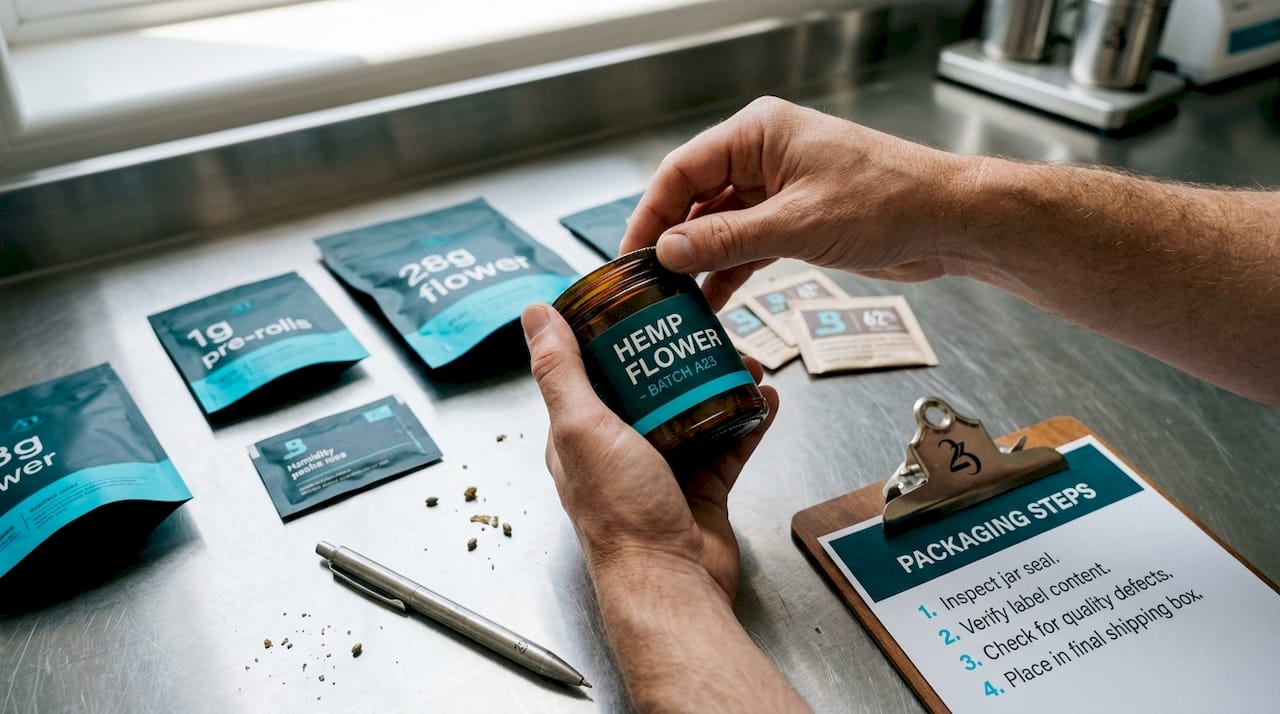
Understanding cannabis packaging and safety goes beyond just the jar itself. The packaging journey from harvest to your hands matters for overall freshness, and knowing what to look for at purchase gives you a head start.
Pro Tip: Buy a few extra humidity packs in bulk. They’re inexpensive and you’ll want to swap them out every 2-3 months or any time they feel rigid and dry instead of soft and slightly flexible.
Step-by-step cannabis storage workflow
With your materials ready, follow this proven storage workflow for optimum results. The order matters here. Skipping steps or delaying any part of the process can allow avoidable degradation to begin before you even get started.
-
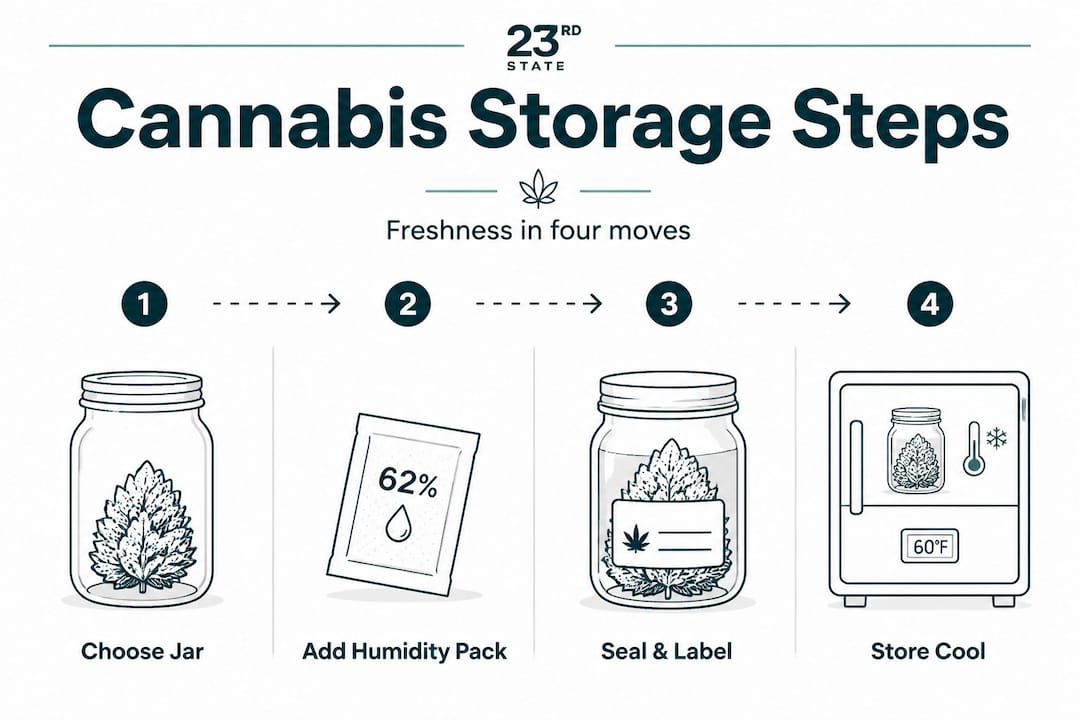
Transfer immediately after purchase. As soon as you get home, move your flower from its dispensary packaging into a clean, airtight glass jar. Don’t wait. Dispensary bags are functional for the short trip home but not for extended storage.
-
Add a humidity pack. Drop one appropriately sized Boveda or Integra pack into the jar alongside the flower. A 58% RH pack works well for drier climates or those who prefer a slightly firmer texture. A 62% RH pack suits more humid regions or those who want a slightly stickier feel.
-
Label every jar. Write the strain name, purchase date, and any relevant notes directly on the label. This step feels minor but becomes incredibly valuable when you’re managing multiple jars or returning to a stash after a few weeks away.
-
Choose the right spot. Place your sealed, labeled jar in a cool, dark location. A kitchen cabinet away from the oven, a bedroom drawer, or a purpose-built stash box all work great. Ideal temperature is 60-70°F (15-21°C), and you’re aiming for 58-62% relative humidity inside the jar.
-
Minimize how often you open the jar. Every time you open the lid, you allow fresh air in and let humidity escape. Open only when you’re ready to use the product, take what you need efficiently, and reseal promptly.
-
Practice first in, first out (FIFO). If you have multiple jars or strains, always reach for the oldest purchase first. This ensures nothing sits forgotten at the back of your cabinet while newer product gets all the attention.
Here’s a side-by-side look at the impact good versus poor storage choices have over time:
| Factor | Optimal storage | Poor storage |
|---|---|---|
| Temperature | 60-70°F | Room temp near heat sources (75°F+) |
| Humidity (RH) | 58-62% | Uncontrolled (below 45% or above 65%) |
| Light exposure | Zero UV exposure | Direct sunlight or fluorescent light |
| Container | Airtight glass with humidity pack | Plastic bag or dispensary pouch |
| Potency at 6 months | 95%+ retained | Potentially 50% or less |
| Aroma at 6 months | Bright and true to strain | Flat, hay-like, or off-putting |
For deeper guidance on pairing your storage approach with a full safe cannabis consumption workflow, it helps to think about storage as the first chapter in your broader ritual, not an afterthought.
Also, if you work with infused products like oils, tinctures, or edibles alongside flower, check out the tailored guide on storage for infused cannabis products. The rules shift slightly depending on format, and getting those details right matters.
Pro Tip: Keep a small notepad or use a phone note to track which jar you opened and when. Over time, you’ll start noticing patterns about which strains stay fresh longer, and that knowledge shapes smarter future purchases.
Troubleshooting and common mistakes
Even with a good workflow, avoidable mistakes can compromise your results. Here’s how to sidestep them. Most errors come from well-intentioned habits that happen to be wrong for cannabis specifically.
The biggest mistakes people make:
- Refrigerating flower. It seems logical since refrigerators preserve food, but condensation damages trichomes and creates the perfect moist environment for mold. The temperature swings from opening and closing the fridge door make things worse, not better.
- Using a cigar humidor. Humidors are calibrated for tobacco at much higher humidity levels (65-72% RH) and the wood actively absorbs and releases moisture. Cannabis needs a tighter, more stable range of 58-62% RH, and cedar wood can transfer its own flavor compounds to your flower.
- Mixing strains in one jar. Different strains have distinct terpene profiles, the aromatic compounds that shape flavor and effect. Mixing them causes cross-contamination of scent and flavor, which flattens both experiences.
- Overfilling jars. Packing a jar too tightly bruises buds, damages trichomes, and reduces airflow around the humidity pack. Fill to about 80% capacity and let the pack do its job.
- Ignoring your climate. Arid environments dry out humidity packs faster. If you live somewhere like Arizona or Colorado, you may need to replace your packs every 4-6 weeks rather than every 2-3 months. Humid climates like Florida or the Gulf Coast require the opposite attention: checking that humidity doesn’t creep above 65% inside the jar, which is where mold risk increases sharply.
Important: Aspergillus mold, a serious health hazard for immunocompromised individuals, thrives at relative humidity above 65%. Keeping your storage environment at or below 62% RH is not just a quality preference, it’s a health-conscious choice. If you ever see white fuzz, gray dust, or unusual spots on your flower, discard it immediately.
Terpene loss is another underappreciated issue. Terpenes are volatile, meaning they evaporate quickly when exposed to heat, air, and light. Once they’re gone, no amount of re-humidifying will bring them back. That’s why the full workflow matters from day one, not just when the flower starts to look dry. Protecting terpenes is protecting flavor and effect.
Revisit these cannabis storage mistakes periodically as a quick self-audit. Storage habits tend to slip over time, especially once the initial enthusiasm fades.
How to verify potency and freshness over time
With storage in place and mistakes avoided, here’s how to monitor your cannabis quality and know when action is required. Good storage is not set-and-forget. A brief monthly check keeps you on top of things before small issues become big problems.
Shelf-life benchmarks to keep in mind:
Under optimal conditions, cannabis retains over 95% potency at 6 months and roughly 84% at the one-year mark. Under poor conditions, those numbers drop sharply. That same research shows that light is the single biggest degrader of cannabinoids, accelerating THC breakdown faster than heat or air alone. A landmark study from 1976 by researcher Fairbairn confirmed light’s outsized role, and more recent work finds THC has a half-life of 21-28 months when stored at 25°C and 60% RH. That’s encouraging news if you’re storing intentionally. Also notable: Boveda packs enable 15% higher terpene retention compared to uncontrolled storage, which is a meaningful difference in both flavor and experiential effect.
How to assess your stored cannabis:
- Visual check. Healthy flower is vibrant green with visible trichomes that appear frosty or slightly sparkly. Degraded flower looks tan, yellow, or gray. Discolored or dusty patches may indicate mold.
- Physical feel. Good flower has some give when gently squeezed. Bone-dry flower crumbles immediately and produces harsh smoke. Overly wet flower feels spongy and won’t burn evenly. Both extremes indicate a humidity issue.
- Aroma test. Open the jar and take a slow inhale. Fresh, well-stored cannabis smells vivid and strain-specific, whether that’s citrusy, earthy, floral, or piney. If it smells like hay, grass, or nothing at all, terpene degradation has occurred. A musty or moldy smell is an immediate discard signal.
- Burn quality. When you use the product, well-stored flower burns evenly and cleanly with a smooth draw. Harsh, uneven burning or a chemical aftertaste suggests something went wrong in storage.
When to act:
- Humidity pack feels completely rigid and dry: replace immediately
- Flower looks or smells off but has no visible mold: improve storage conditions and use within a week
- Visible mold or musty odor: discard the entire jar’s contents and sanitize with isopropyl alcohol before reusing
Building a quick monthly cannabis freshness check into your routine keeps everything running smoothly and keeps your experience exactly where you want it.
Our perspective: Why workflow matters more than any single tool
Here’s a take we feel strongly about: people obsess over finding the perfect jar, the best humidity pack brand, or the most expensive stash box, and then they store their flower on top of the refrigerator next to a sunny window. The tool is not the solution. The habit is.
We’ve seen this pattern repeatedly. Someone invests in a beautiful UV glass container and a digital hygrometer, then leaves the lid cracked for 20 minutes while distracted. Or they buy top-shelf flower and forget to label it, only to find three mystery jars six weeks later with no idea which is oldest. The gear didn’t fail them. The workflow did.
The counterintuitive truth is that consistent, boring execution of simple steps outperforms every premium gadget on the market. A clean wide-mouth mason jar, a fresh humidity pack, a labeled date, and a dark drawer will outperform a $200 titanium stash box used carelessly every single time. Systemization is the real upgrade.
This matters especially for wellness-focused users who rely on specific terpene and cannabinoid profiles for consistent effects. If your storage is inconsistent, your experience is inconsistent, and that makes it hard to build a meaningful, intentional cannabis lifestyle workflow around your products. The ritual of checking your jars, rotating strains, and replacing packs is genuinely part of the experience. It’s intentional. It’s chic in its own quiet way. And it pays off every single time you open a jar that smells exactly like it did the day you bought it.
Ready to upgrade your cannabis storage routine?
You’ve got the workflow, the tools, and the troubleshooting knowledge to keep your hemp and cannabis products fresh, potent, and exactly as intended from the first use to the last. The next step is putting it all into practice with products worth protecting.

At 23rd State, we handcraft premium hemp-derived THC and CBG products designed for people who care about quality and consistency. From our infused flower to our lifestyle-forward edibles, everything we make is worth storing with intention. Explore more cannabis storage tips in our education hub, and browse our full product lineup to find your next favorite strain, stash, or infused experience. Your ritual deserves a solid foundation.
Frequently asked questions
What is the ideal temperature and humidity for storing cannabis flowers?
Store cannabis at 60-70°F and 58-62% relative humidity for the best balance of freshness and potency. These conditions slow degradation of both cannabinoids and terpenes.
Why shouldn’t cannabis flower be stored in the refrigerator or freezer?
Refrigeration causes condensation that damages trichomes and creates the moist conditions where mold thrives. Temperature fluctuations from opening the door repeatedly compound the damage.
How long does stored cannabis retain its potency?
Optimal storage retains over 95% potency at the six-month mark and approximately 84% at one year. Poor storage can cut those numbers dramatically in just a few weeks.
What’s the safest container material for cannabis storage?
Airtight amber or violet glass jars are the safest and most effective choice. Glass doesn’t leach chemicals, doesn’t generate static, and creates a genuinely sealed environment for long-term storage.
How do I prevent mold growth in my cannabis storage?
Keep humidity below 65% and use a calibrated humidity pack to stay in the safe range. Aspergillus mold risk increases above 65% RH, so consistent monitoring and total darkness are your best defenses.
