

TL;DR:
- Cannabis can reduce alcohol consumption and improve liver health through harm reduction.
- Users often experience fewer hangovers, better sleep, and less binge drinking when substituting cannabis.
- Responsible use requires understanding individual risks, starting low, and consulting healthcare providers.
What if one intentional swap could change how you feel on a Friday night, recover on a Saturday morning, and show up on Monday? Laboratory trials show cannabis can reduce immediate alcohol consumption by 19 to 27%, and that’s just the beginning. A growing wave of sober-curious adults, weekend wellness seekers, and lifestyle-forward people are rethinking what’s actually in their glass. This article walks you through the real science, the genuine benefits, the honest risks, and the practical steps for anyone curious about cannabis as a modern alternative to alcohol.
Table of Contents
- Why people are choosing cannabis instead of alcohol
- How cannabis impacts alcohol consumption: What the science shows
- Potential benefits and health implications
- Risks, caveats, and making the switch responsibly
- Why the future of social drinking might be cannabis — but not for everyone
- Explore cannabis beverage options for a modern lifestyle
- Frequently asked questions
Key Takeaways
| Point | Details |
|---|---|
| Evidence-based reduction | Replacing alcohol with cannabis can lead to 19–52% less alcohol consumption for many adults. |
| Health benefit potential | Using cannabis instead of alcohol is linked to lower liver disease risk and fewer alcohol-related health issues. |
| Individual variation matters | Not everyone benefits equally from substitution, and some may face new risks with cannabis use. |
| Responsible transition | Understanding personal health and using moderation is key to making the switch safely. |
Why people are choosing cannabis instead of alcohol
Something is shifting in the way adults think about unwinding. Alcohol has long been the default social lubricant, but more people are pausing to ask whether it’s actually serving their wellness goals. The answer, for a lot of them, is no.
The motivations behind switching are wide-ranging and personal. Some people are chasing better sleep. Others want to drop the bloat, the brain fog, or the creeping anxiety that follows a few drinks. And a growing number are simply curious, drawn in by the expanding culture around intentional cannabis use.
Here’s a snapshot of the most common reasons adults are making the swap:
- Health and wellness: Avoiding alcohol-related inflammation, liver strain, and weight gain
- Sleep quality: Cannabis, especially CBD-leaning products, is associated with more restful nights
- Stress and anxiety: Many users report a calmer, more grounded experience compared to alcohol
- Hangover-free mornings: No headache, no dehydration, no regret
- Social comfort: A growing number of social spaces are normalizing cannabis alongside or instead of drinks
- Mindful consumption: Cannabis allows for intentional microdosing in a way alcohol doesn’t easily support
The demographic driving this shift is telling. Younger women are more likely to substitute THC for alcohol, often citing health concerns or stress as the primary motivators. That’s not a small niche. That’s a significant cultural signal.
For those curious about how cannabis fits into a broader lifestyle approach, exploring alternative beverages for wellness is a great place to start building context.
“People aren’t just swapping substances. They’re rethinking what social and self-care rituals look like altogether.”
The sober-curious movement has created real permission for this kind of exploration. Cannabis, especially in low-dose or beverage form, gives people a way to participate in social rituals without the downsides of alcohol. That’s a powerful draw for anyone who’s ever nursed a Sunday headache and thought, “there has to be a better way.”
How cannabis impacts alcohol consumption: What the science shows
Motivations are powerful, but data is what actually moves the needle. And the data here is surprisingly compelling.
In controlled laboratory settings, smoked cannabis reduced alcohol intake by 19 to 27% and delayed the onset of drinking. That’s not a minor blip. That’s a measurable, repeatable effect happening in real-time.
In real-world studies, the numbers are even more striking. Cannabis beverage users cut their weekly alcohol intake by 52%. That’s roughly half the drinks gone, replaced by something that many users describe as smoother, more intentional, and easier to control.
| Measure | Before cannabis substitution | After cannabis substitution |
|---|---|---|
| Weekly drinks | Baseline | Down 52% (beverage users) |
| Acute alcohol intake | Baseline | Down 19 to 27% (lab setting) |
| Binge drinking episodes | Reported baseline | Markedly reduced |
| Onset of drinking | Earlier | Delayed |
So why does cannabis reduce alcohol intake? A few mechanisms are at play.
First, there’s satiation. Cannabis activates reward pathways in the brain, offering a sense of satisfaction that reduces the craving for another drink. Second, dopamine modulation plays a role. THC interacts with the same dopamine circuits alcohol targets, providing a substitute stimulus. Third, the delay effect matters practically: when cannabis slows the impulse to drink, people often drink far less overall.
Here’s what many people notice in the first few weeks of substituting:
- Fewer drinks per social outing
- Less craving for a nightcap after dinner
- A shorter window of intoxication (cannabis typically clears faster than a night of heavy drinking)
- Easier mornings with cleaner sleep
- A more dialed-in sense of their own tolerance
Exploring how cannabis beverages and drinking habits intersect can help you understand the bigger picture of this shift. And if you want to go deeper, the growing body of THC drinks research is genuinely fascinating.
Pro Tip: If you’re experimenting with cannabis as a substitute, try having a low-dose beverage, around 2 to 5 mg THC, about 30 minutes before a social event. Many people find this naturally reduces the urge to pour a second or third drink without any deliberate restraint.
Potential benefits and health implications
Once we see how cannabis can reduce drinking, it’s important to understand how this shift may impact your health for better or worse.
Alcohol has a well-documented list of long-term risks. Cannabis carries its own set of considerations. Putting them side by side gives you a clearer picture.

| Health area | Chronic alcohol risks | Cannabis considerations |
|---|---|---|
| Liver health | Cirrhosis, fatty liver, liver cancer | Minimal direct liver impact at moderate use |
| Mental health | Depression, anxiety, dependency | Can trigger anxiety with high-THC strains |
| Cardiovascular | Elevated blood pressure, heart disease | Mixed data; some vascular effects |
| Cancer risk | Linked to 7 types of cancer | Smoke-related risks; non-smoke forms lower risk |
| Sleep quality | Disrupts REM sleep | Improves sleep onset; long-term use may affect REM |
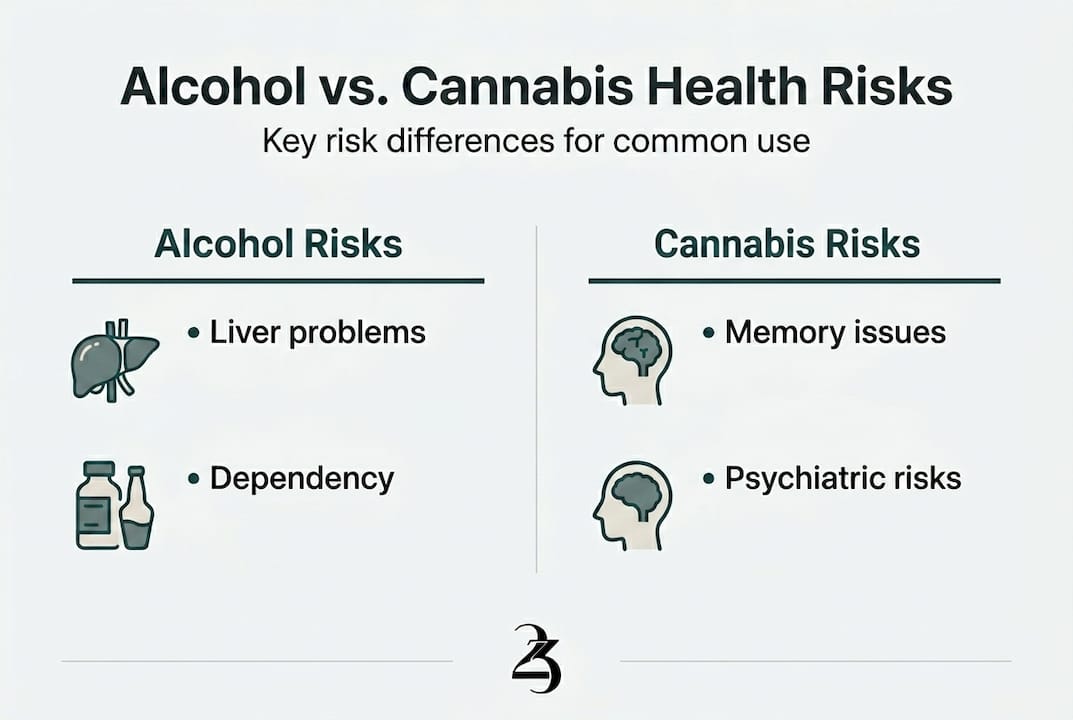
The liver health data is particularly worth noting. Cannabis use disorder linked to a 40% lower risk of alcohol-associated liver disease and 14% lower mortality in people who primarily used cannabis rather than alcohol. These are significant numbers in a field where outcomes usually shift in small increments.
Beyond the liver, people who substitute cannabis for alcohol often report a range of everyday benefits:
- No hangovers. Waking up clear-headed is life-changing for people used to writing off Sunday mornings.
- Less binge drinking. Cannabis users tend to self-regulate more easily than alcohol users.
- Better sleep onset. Falling asleep feels more natural for many.
- Reduced caloric intake. Alcohol is calorie-dense. Swapping it out often means fewer empty calories.
- Less physical inflammation. Alcohol is notoriously inflammatory. Many people notice joint and skin improvements.
For a broader look at the wellness potential, the trends and health benefits of THC beverages space is growing fast and worth staying current on.
That said, cannabis isn’t a clean-slate solution. Long-term, heavy use comes with its own uncertainties. Population-level studies are still catching up to widespread legal cannabis use, so the full picture isn’t written yet.
Risks, caveats, and making the switch responsibly
While the data shows promise, there are real risks and nuances in making the switch that shouldn’t be ignored.
Cannabis is not a universal upgrade. For some people, it’s genuinely not the right fit, and that’s okay. Understanding the risks before you start is the most responsible approach.
Here are the key risks to keep in mind:
- Psychiatric symptoms: High-THC cannabis can trigger anxiety, paranoia, or in rare cases, psychosis, especially in individuals with a personal or family history of mental health conditions
- Cognitive effects: Regular heavy use has been associated with short-term memory changes and slower processing in some users
- Dependency: Not all cannabis users substitute or reduce alcohol; some develop dependency on cannabis, alcohol, or both
- Drug interactions: Cannabis can interact with certain medications, including blood thinners and antidepressants
- Variable experience: Unlike alcohol, cannabis effects are highly individual. The same dose hits differently depending on metabolism, tolerance, and product type
It’s also worth knowing the difference between two types of users. Substituters genuinely replace alcohol with cannabis and reduce overall harm. Complementers add cannabis on top of existing alcohol use, which can increase total intoxication and health risk. The science supports the first group. The second group adds complexity that research is still untangling.
Pro Tip: Start low and go slow. A 2 to 5 mg THC product is a smart entry point. Give it at least 60 to 90 minutes before deciding whether you need more. And if you’re on any medications or managing a mental health condition, talk to your doctor before introducing cannabis into your routine.
Looking ahead, the future innovations in cannabis drinks space is focused on precision dosing and faster-onset formulas, which may make responsible use even more accessible over time.
Why the future of social drinking might be cannabis — but not for everyone
Here’s an honest take: the science on cannabis as an alcohol alternative is genuinely exciting, and also genuinely incomplete. Both things are true at once.
What the research shows is real. Fewer drinks. Lower liver disease risk. Better mornings. For a meaningful slice of adults, cannabis substitution represents authentic harm reduction, not just a lifestyle trend.
But the idea of cannabis as a universal fix gets tricky fast. Individual biology, mental health history, social context, and even the specific product all shape whether this swap helps or hurts. Someone with anxiety might find a high-THC drink amplifies their stress rather than eases it. Someone prone to overconsumption may shift that pattern from alcohol to cannabis without addressing the root behavior.
What we believe is that the most important shift isn’t which substance you choose. It’s moving toward intentional consumption as a value in itself. Cannabis, when used thoughtfully and in the right forms, can support that intention beautifully. The future of cannabis beverages in the U.S. reflects exactly that momentum, with low-dose, fast-acting, socially approachable options becoming more refined every year.
The cultural conversation around what it means to “drink” socially is already changing. Cannabis is a big part of that story, but it works best as a tool, not a blanket answer.
Explore cannabis beverage options for a modern lifestyle
If any part of this resonated with you, whether you’re sober-curious, looking to cut back, or simply open to something new, you’re already in the right headspace to explore what cannabis can offer. The next step is learning more and exploring safely.
At 23state.com, you’ll find a curated selection of hemp-derived cannabis beverages and infused products designed for adults who want a chic, intentional alternative to alcohol. From microdosed calm to sparkling refreshment, there’s something for every occasion. You can also browse discover alternative beverages to deepen your knowledge and feel confident in every choice you make. Your next great Saturday morning starts with a great Friday night decision.
Frequently asked questions
Can switching to cannabis really help reduce alcohol consumption?
Research shows cannabis use can lower alcohol intake by 19 to 52% depending on the format and individual, though effects vary widely across users.
Does substituting cannabis for alcohol improve liver health?
Studies indicate cannabis users have a 40% lower risk of alcohol-associated liver disease and reduced mortality compared to those who primarily consume alcohol.
Who should avoid substituting cannabis for alcohol?
Anyone with a history of psychiatric disorders, cannabis sensitivity, or who is pregnant should avoid using cannabis as a regular substitute, and always consult a healthcare provider first.
What are the main risks of using cannabis instead of alcohol?
Cannabis can cause psychiatric symptoms or lead to dependency, especially with high-THC use, and individual responses vary significantly based on biology and history.
Are cannabis beverages effective for those trying to drink less alcohol?
Yes. Cannabis beverage users reported markedly lower weekly alcohol intake and fewer binge drinking episodes compared to their pre-substitution baseline.
