

TL;DR:
- THC stimulates appetite by activating CB1 receptors in the hypothalamus, reversing neurons that suppress hunger.
- Its appetite-boosting effects peak within 30 to 60 minutes and are influenced by hormonal and neural pathways.
- Regular use can lead to tolerance, reducing THC’s effectiveness, especially in long-term users or specific populations.
THC does a lot more than just trigger the classic munchies. When you dig into what’s actually happening in your brain, you find a surprisingly sophisticated system at work, one that involves hormone shifts, neural reversals, and reward pathways lighting up in sequence. THC interacts with brain receptors to stimulate hunger in ways that go well beyond a simple craving spike. Whether you’re curious about cannabis for wellness, exploring appetite support during a health challenge, or just want to understand what’s going on after a session, this guide breaks it all down with clarity and zero fluff.
Table of Contents
- How THC stimulates appetite: The science explained
- Medical uses of THC for appetite stimulation
- When THC fails: Tolerance, edge cases, and limitations
- THC, CBD, and other cannabinoids: Comparing appetite effects
- A wellness perspective: What most guides miss about THC and appetite
- Explore more on safe, mindful cannabis use
- Frequently asked questions
Key Takeaways
| Point | Details |
|---|---|
| Brain-driven appetite boost | THC stimulates hunger by acting on brain receptors, intensifying food cravings beyond normal signals. |
| Medical uses and limits | Synthetic THC is FDA-approved for illness-related appetite loss but has mixed results depending on the condition and user. |
| Tolerance and individual variation | Regular use can blunt THC’s effects, and certain people or situations may see little benefit or unwanted side effects. |
| Cannabinoid comparison | While THC increases appetite, CBD can have the opposite effect, and long-term users may not gain weight as expected. |
How THC stimulates appetite: The science explained
Your brain runs a finely tuned hunger management system, and THC knows exactly where to knock. The key players are CB1 receptors, which are part of the endocannabinoid system, a network your body uses to regulate mood, pain, sleep, and yes, appetite. When THC enters your system, it binds to these CB1 receptors, particularly in the hypothalamus, the region of your brain that acts as the master control for hunger and fullness signals.
Here’s where it gets genuinely fascinating. Your hypothalamus contains neurons called POMC neurons (pro-opiomelanocortin neurons) that normally send out signals telling your body it’s full and satisfied. THC essentially flips the switch on these neurons, reversing POMC neurons from suppressing to stimulating appetite, so the same cells that were telling you to stop eating start telling you to eat more. That’s not a side effect. That’s a direct neurological reversal.
Beyond the hypothalamus, THC also influences key hunger hormones:
- Ghrelin (the “hunger hormone”) rises, sending stronger appetite signals throughout your body
- Leptin (the satiety hormone) gets dampened, so feelings of fullness are reduced
- Dopamine surges in reward pathways, making food smell better, taste brighter, and feel more satisfying
- Olfactory sensitivity increases, meaning your sense of smell sharpens and food aromas become more vivid
The peak appetite effect lasts roughly 30 to 60 minutes after use, and interestingly, this effect is non-specific to food type and works regardless of whether you were already hungry. You don’t need to be running on empty for THC to make food feel irresistible.
Here’s a quick breakdown of how brain-mediated and gut-mediated appetite control compare:
| Factor | Brain-mediated (central CB1) | Gut-mediated (peripheral) |
|---|---|---|
| Primary driver | Hypothalamus, POMC neurons | Digestive hormones, vagus nerve |
| THC influence | Direct and strong | Indirect and mild |
| Speed of effect | Fast (minutes) | Slower (30+ minutes) |
| Dependence on hunger state | Independent | Partially dependent |
| Duration of effect | 30 to 60 min peak | Variable |
For a deeper look at how THC affects your body beyond appetite, understanding THC effects is a great place to start. And if you’re thinking about how to use THC responsibly, THC use and safety covers the essentials clearly.
Medical uses of THC for appetite stimulation
Now that you know how THC jumpstarts hunger, it’s crucial to see how this translates into the medical world for people facing appetite loss. The clinical applications are real, regulated, and backed by meaningful evidence.
Synthetic THC (dronabinol/Marinol) is FDA-approved for two specific conditions: appetite loss and weight loss related to AIDS, and nausea and vomiting caused by chemotherapy. This isn’t alternative medicine territory. It’s mainstream pharmacology.

Here’s a summary of what clinical studies have found:
| Condition | Outcome | Notes |
|---|---|---|
| AIDS-related anorexia | Significant appetite improvement, modest weight stabilization | Effective over weeks of use |
| Chemotherapy-induced nausea | Reduced nausea, improved appetite | Compared favorably to older antiemetics |
| Cancer-related cachexia | Less effective than megestrol for weight gain | Megestrol showed stronger caloric results |
For patients considering THC-based appetite support, here’s how the process typically unfolds:
- Talk to your provider about whether dronabinol or a cannabis-based option is appropriate for your condition
- Review your current medications for potential interactions, especially with CNS depressants
- Start with the lowest effective dose to gauge your response before adjusting
- Track your appetite and weight over the first two to four weeks to assess real outcomes
- Revisit with your provider regularly, since dosing needs can shift as your body adapts
Understanding how THC onset and duration work is especially useful here, since timing your dose around meals can make a real difference in clinical settings.
Pro Tip: If you’re using THC medicinally for appetite, keep a simple food and mood journal. Tracking what you eat, when you dosed, and how you felt helps you and your provider fine-tune your approach much faster than guessing.
When THC fails: Tolerance, edge cases, and limitations
Although THC can be powerful, it’s not infallible, and there are several situations where its appetite-stimulating power falls short. Knowing these limits is just as important as knowing the benefits.
The biggest issue is biological tolerance. When you use THC regularly, your CB1 receptors begin to downregulate, meaning they become less responsive over time. The result? What cannabis users sometimes call “faded munchies,” where the dramatic appetite surge you felt early on gradually softens or disappears entirely.
Regular THC use can cause tolerance and reduced appetite effects, and stopping use after heavy consumption can actually trigger a period of appetite suppression rather than relief.
This withdrawal-related appetite dip is worth knowing about, especially for anyone considering THC as a long-term appetite solution. It’s not permanent, but it can be uncomfortable and counterproductive.
Edge cases where THC may not deliver the expected appetite boost include:
- Older adults: Randomized controlled trials in elderly populations showed little to no significant caloric gain from THC
- People with anorexia nervosa: Evidence for meaningful weight gain in clinical anorexia studies remains weak
- Heavy, long-term users: Tolerance blunts the acute hyperphagia effect significantly
- Individuals with high anxiety sensitivity: THC can trigger anxiety in some people, which suppresses appetite rather than boosting it
- Those on certain medications: Drug interactions can alter how THC metabolizes and reduce its effectiveness
For anyone navigating these scenarios, safe THC usage practices offer practical guidance on minimizing risks.
Pro Tip: To slow tolerance buildup, try scheduling intentional “tolerance breaks” of two to four days every few weeks. Even short breaks can help reset your CB1 receptor sensitivity and restore that fresh appetite response.
THC, CBD, and other cannabinoids: Comparing appetite effects
Understanding potential limitations, it’s helpful to see how THC’s appetite effects compare with other cannabinoids found in cannabis. The differences are striking, and knowing them helps you make smarter, more intentional choices.
THC is the only major cannabinoid with a well-established appetite-stimulating effect. Acute THC reliably increases appetite, but chronic use does not necessarily increase BMI, and CBD may actually suppress appetite. That’s a meaningful contrast worth sitting with.
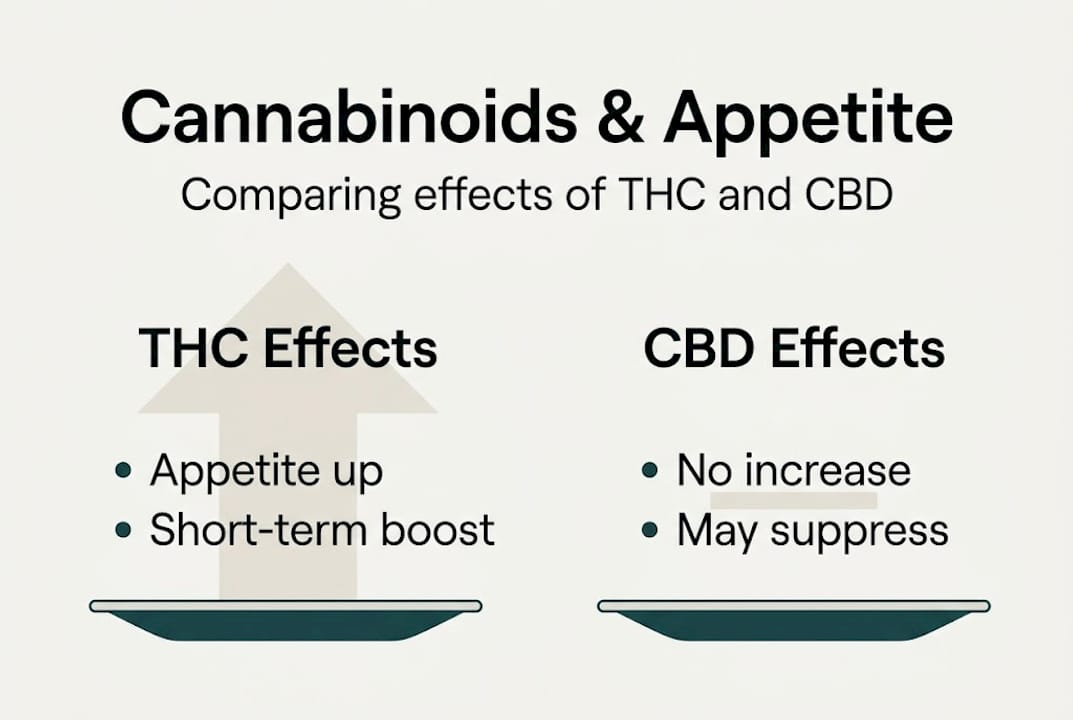
The BMI paradox is one of the more surprising findings in cannabis research. Despite the acute hyperphagia (short-term overeating) that THC produces, regular cannabis users tend to have lower average BMIs than non-users. Researchers believe this may relate to metabolic adaptations, behavioral patterns, or the complex interplay of chronic cannabinoid exposure on insulin sensitivity.
Here’s how the three main cannabinoids stack up on appetite:
| Cannabinoid | Appetite effect | Clinical notes |
|---|---|---|
| THC | Stimulates (acute) | FDA-approved for appetite loss; tolerance develops with regular use |
| CBD | May suppress | Emerging evidence; no FDA approval for appetite use |
| CBG | Potentially stimulating | Early research; less studied than THC or CBD |
Key takeaways about cannabinoids and appetite:
- THC is the primary driver of acute hunger increases
- CBD works differently and may counteract some of THC’s appetite effects
- CBG shows early promise but needs more research before strong conclusions are drawn
- The ratio of cannabinoids in a product matters, not just the THC content alone
For a clear breakdown of how these compounds differ, THC vs CBD is a solid read. You can also explore THC vs CBG and a detailed CBG vs THC guide to see how each fits into a wellness-focused lifestyle.
A wellness perspective: What most guides miss about THC and appetite
Most articles on THC and appetite stop at the science and skip the part that actually matters for real life: context. The dose, the timing, your current dietary goals, and your relationship with food all shape whether THC is genuinely useful for you or just a fun but aimless detour.
Here’s an uncomfortable truth: not everyone should be chasing a bigger appetite. If your wellness goals involve mindful eating or weight management, a strong appetite surge from THC can work against you. That’s not a reason to avoid cannabis. It’s a reason to be intentional about when and how much you use.
Small, deliberate doses tend to outperform larger ones for appetite support. A microdose approach, where you use just enough to gently activate those CB1 pathways without going full munchies mode, gives you more control and less tolerance buildup over time. Think of it as dialing in your experience rather than cranking the volume.
We always recommend an open conversation with a wellness professional or healthcare provider before using THC for any appetite-related goal. Understanding THC in a wellness context can help you walk into that conversation informed and confident.
Explore more on safe, mindful cannabis use
If this guide sparked your curiosity about using cannabis more intentionally, you’re in the right place. Navigating the world of THC and appetite is so much easier when you have trusted, curated resources backing you up.
At 23state.com, we’re passionate about helping you make informed, lifestyle-aligned choices around cannabis. Whether you’re just starting out or refining your wellness routine, our education hub covers everything from THC effects and benefits to product guidance designed for real people with real goals. Explore our handcrafted hemp-derived offerings, dig into our blog for deeper reads, and feel free to reach out when you need a little direction. Your intentional cannabis journey starts here.
Frequently asked questions
How quickly does THC increase appetite after use?
THC can stimulate appetite within about 30 minutes, with a peak intake window of 30 to 60 minutes as your brain shifts into hunger-promoting mode. Timing a meal or snack within this window gets you the most out of the effect.
Does everyone who uses THC experience increased appetite?
Not everyone will feel hungrier after using THC. Regular users with built-up tolerance or individuals in certain populations, like older adults, may see little to no significant caloric gain even with consistent use.
Can CBD counteract THC’s appetite effects?
CBD may suppress appetite and can offset some of the hunger-boosting effects of THC, which is why the cannabinoid ratio in any product matters more than THC content alone.
Is THC a reliable solution for major appetite loss in illness?
Dronabinol is FDA-approved for appetite loss in AIDS and chemotherapy patients, but effectiveness varies by individual, and for cancer-related cachexia, megestrol has shown stronger results in some studies.
