

TL;DR:
- Edibles typically contain 5 to 10 mg THC per serving, with 5 mg being beginner-friendly.
- State regulations vary, setting different THC limits for edibles across the US.
- Finding your ideal dose involves gradual testing, patience, and considering personal factors.
Edibles feel like a whole different universe compared to smoking or vaping, and that’s not just a vibe. The effects are stronger, they last longer, and they sneak up on you in ways that catch even experienced cannabis users off guard. Understanding exactly how many mg THC is in a single serving is the difference between a blissful evening and an unexpectedly intense few hours on your couch. This guide breaks down standard serving sizes, state regulations, personal dosing strategies, and the science behind why edibles hit the way they do, so you can enjoy every experience with confidence and intention.
Table of Contents
- What is a standard THC serving for edibles?
- Why do THC edible servings differ by state?
- How to choose your ideal mg THC per serving
- Microdosing and wellness: Is less really more?
- The science behind edible effects and safety
- Why “one size fits all” doesn’t apply to THC servings
- Explore quality THC edibles with clear serving info
- Frequently asked questions
Key Takeaways
| Point | Details |
|---|---|
| Standard dose range | Most edibles are labeled with 5–10 mg THC per serving depending on state rules. |
| Dosing varies by state | State law sets maximum mg THC per serving, so always check your local regulations. |
| Start low, go slow | Begin with a low dose and wait 1–2 hours to avoid overconsumption or negative effects. |
| Microdosing for wellness | Doses as low as 1–5 mg THC can provide relief without strong intoxication. |
| Edibles act differently | THC edibles are metabolized into stronger, longer-lasting effects than inhaled cannabis. |
What is a standard THC serving for edibles?
When you pick up an infused edible, the label tells you two key numbers: mg THC per serving and total mg THC per package. The “per serving” number is the one that matters most for your experience. It tells you exactly how much active THC you’re consuming in one go, whether that’s a single gummy, a square of chocolate, or a measured pour of an infused beverage.
A standard single serving of edibles typically contains 5 to 10 mg THC, with 5 mg becoming increasingly common as a beginner-friendly and approachable dose. In most U.S. recreational cannabis states, the legal maximum per serving for infused edibles is capped at 10 mg. That cap exists for a reason: it protects new users from accidentally consuming too much before they understand how their body responds.
“A single serving of a cannabis edible is generally defined as containing no more than 10 mg of THC, intended to provide a manageable, predictable experience for adult consumers.” — Industry standard adopted across most regulated U.S. cannabis markets.
Here’s a quick look at how recommended doses stack up across experience levels:
| Experience level | Recommended starting dose | Typical effect |
|---|---|---|
| Beginner | 2.5 to 5 mg | Mild relaxation, light mood lift |
| Casual user | 5 to 10 mg | Clear euphoria, body ease |
| Experienced user | 10 to 25 mg | Strong euphoria, deep relaxation |
| High tolerance | 25 mg and above | Intense effects, not for newcomers |
If you want a deeper look at how these benchmarks apply to specific formats, our gummies dosing guide walks through serving sizes in detail. Knowing these numbers before you open a package sets you up for a much more enjoyable, intentional experience.
Why do THC edible servings differ by state?
Once you know the typical serving, it’s crucial to recognize that serving sizes aren’t nationally uniform. Cannabis regulation in the U.S. happens at the state level, not federally. That means every state with a legal recreational market gets to set its own rules for how much THC can be in a single edible serving and how much can be in an entire package.
The differences can be significant. State variations include Washington allowing 10 mg per serving, Massachusetts setting a tighter 5 mg per serving maximum, and Michigan permitting up to 200 mg total THC in a single gummy package. These aren’t minor tweaks. They reflect each state’s philosophy on consumer safety, product accessibility, and harm reduction.
Here’s a snapshot of how some leading states approach edible THC limits:
| State | Max THC per serving | Max THC per package |
|---|---|---|
| California | 10 mg | 100 mg |
| Colorado | 10 mg | 100 mg |
| Washington | 10 mg | 100 mg |
| Massachusetts | 5 mg | 20 mg (single-serving) |
| Michigan | 10 mg | 200 mg (gummies) |
| Illinois | 10 mg | 100 mg |
The FDA does not regulate recreational cannabis edibles. Instead, each state’s Cannabis Regulatory Agency (CRA) enforces dosing limits through mandatory lab testing and strict packaging requirements. This patchwork system means that a product you buy in one state might look completely different from a similar product in another, even if the brand name is the same.
When you’re shopping, keep these practical tips in mind:
- Always check the “per serving” line, not just the total package THC content.
- Look for the number of servings per package to calculate total THC and plan accordingly.
- Verify the state where the product was manufactured, since labeling requirements vary.
- Ask your budtender or retailer if you’re unsure how to read a specific label format.
Brushing up on how labels differ is worth your time. Our guide to comparing THC edibles covers what to look for across different product types and states.
How to choose your ideal mg THC per serving
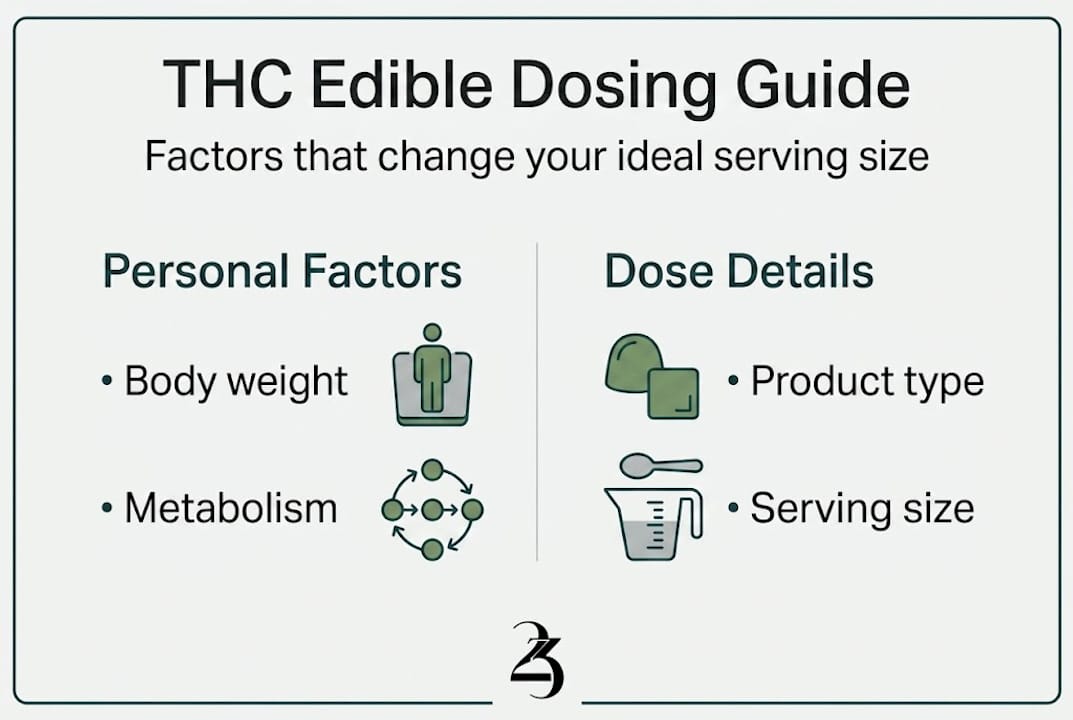
State laws might tell you the max, but finding your ideal serving relies on more personal factors. Your body weight, metabolism, tolerance level, and even your mood on a given day all influence how THC affects you. There’s no universal “right” dose, but there is a smart process for finding yours.
For recreational adults, the general framework is straightforward: beginners do best at 2.5 to 5 mg, casual users can explore 5 to 10 mg, and experienced users may find their sweet spot between 10 and 25 mg per serving. Going beyond that range significantly increases the risk of overconsumption, especially given how long edibles take to kick in.
Here’s a step-by-step process to find your personal starting dose:
- Assess your experience level. Have you used cannabis before? If you’re brand new, start at 2.5 mg or less.
- Consider your goal. Are you looking for light relaxation, pain relief, social ease, or deeper euphoria? Lower doses work well for subtle effects; higher doses deliver more intensity.
- Check your environment. First-time edible experiences are best enjoyed somewhere comfortable and familiar, with no obligations for several hours.
- Start with the lowest available dose. Many quality products now offer 2.5 mg or even 1 mg servings specifically for this reason.
- Wait the full onset window. Edibles take 1 to 2 hours to kick in. Do not redose early.
- Note your experience. Keep a simple log of the dose, timing, effects, and how you felt overall.
- Adjust gradually. If the first experience felt too mild, increase by 2.5 mg next time. Small steps protect you from overshooting.
Pro Tip: The single biggest mistake new edible users make is redosing too soon. You eat a gummy, feel nothing after 45 minutes, and eat another one. Then both hit at once. Set a timer for 2 hours before even considering a second serving.
For a full breakdown of safe practices across different cannabis formats, our guide to safe cannabis dosages is a great companion read. And if you’re curious about how these principles apply specifically to drinks, check out our article on THC beverage servings.
Microdosing and wellness: Is less really more?
For those who prefer gentler effects or therapeutic outcomes, microdosing offers a genuinely different approach to THC. Microdosing means consuming very small, consistent amounts of THC, typically 1 to 5 mg per serving, to achieve subtle benefits without significant intoxication. Think of it as a soft glow rather than a full spotlight.
Wellness-oriented users favor microdoses in the 1 to 5 mg range for subtle relief without intoxication, while recreational users seeking euphoria tend to gravitate toward the 5 to 10 mg window. Both approaches are valid. The key is knowing which experience you’re after.
Benefits of microdosing compared to standard dosing include:
- Less risk of anxiety or paranoia, which can accompany higher doses, especially in new users
- Greater control over your mental clarity, allowing you to stay functional during the day
- Easier to maintain consistency, since small doses are more predictable across sessions
- Ideal for pain management, focus, and mild anxiety relief without disrupting your routine
- Lower tolerance buildup over time, meaning you don’t need to keep increasing your dose
Pro Tip: Look for products specifically designed for microdosing, those offering 1 to 2 mg THC per serving. Some infused beverages and mints are formulated at these precise low doses, giving you real control over your intake without having to cut gummies into tiny pieces.
The idea that “more is better” simply doesn’t hold up when it comes to THC. Higher doses increase the risk of uncomfortable side effects, including heightened anxiety, rapid heart rate, and disorientation. Over time, frequent high doses also accelerate tolerance, meaning you need more to feel the same effect. Intentional, lower-dose use keeps the experience fresh and enjoyable. Explore why low-dose THC matters and what the cannabis microdose benefits really look like in practice. If you’re specifically exploring pain relief applications, our piece on THC microdosing for pain relief goes deep on that topic.
The science behind edible effects and safety
Understanding how THC is processed in your body gives even more clarity on why serving size matters so much. When you inhale cannabis, THC enters your bloodstream through your lungs almost immediately. Edibles work completely differently.
After you eat an infused product, THC travels through your digestive system to your liver. There, it gets converted into a compound called 11-hydroxy-THC, which is significantly more potent and longer-lasting than the THC you’d absorb through inhalation. This metabolic process is why edibles require ‘start low, go slow’ and why waiting at least 2 hours before redosing is essential. The liver conversion produces stronger effects that can last anywhere from 4 to 8 hours, compared to the 1 to 3 hours typical of smoking or vaping.
“Because edibles are metabolized by the liver into 11-hydroxy-THC, a more potent compound than inhaled THC, even experienced cannabis users can be caught off guard by the intensity and duration of effects. Always wait at least two hours before considering an additional serving.”
Signs that you may have taken too much THC include:
- Rapid or irregular heartbeat that feels uncomfortable
- Heightened anxiety or paranoia, especially in unfamiliar environments
- Nausea or dizziness that doesn’t pass quickly
- Extreme drowsiness or difficulty staying present
- Confusion or difficulty with short-term memory
If any of these happen, stay calm. Find a comfortable, safe space. Drink water, eat a light snack if your stomach allows, and rest. Effects will diminish with time. CBD has been reported by some users to help counteract THC intensity, though individual responses vary. The entourage effect in edibles is worth understanding here, since the combination of cannabinoids in a product can meaningfully shape your overall experience.
Why “one size fits all” doesn’t apply to THC servings
With all the facts laid out, here’s the perspective that matters most: regulated serving sizes are a helpful starting point, not a finish line. The 10 mg standard exists to protect the broadest range of consumers, but your ideal dose might be 3 mg or it might be 15 mg. Both are valid, and neither makes you more or less of a cannabis enthusiast.
What the data and real-world experience consistently show is that higher doses do not automatically equal better experiences. In fact, the most common reports of uncomfortable or negative cannabis experiences involve edibles consumed in excess, often because someone assumed that “more” would get them where they wanted to go faster. It doesn’t work that way. Edibles reward patience and intentionality.
The smartest move you can make is to keep a simple dosing journal. Note the product, the mg THC per serving, the time you consumed it, how long it took to feel effects, and what the experience was like. After a handful of sessions, patterns emerge. You’ll know your sweet spot clearly, and you’ll stop guessing. Our article on building a microdosing workflow offers a practical framework for tracking this over time.
Body chemistry, stress levels, whether you’ve eaten recently, and even your sleep quality all shift how THC lands on any given day. A 10 mg serving that felt perfect last Saturday might feel like too much on a stressful Tuesday. Staying curious and adaptable is part of the experience.
Explore quality THC edibles with clear serving info
Ready to put your knowledge to use? Knowing how many mg THC is in a serving transforms you from a passive consumer into an intentional one. You can read a label confidently, choose the right product for your mood and goals, and enjoy every experience without second-guessing yourself.
At 23rd State, every product is crafted with transparent dosing information so you always know exactly what you’re getting per serving. Whether you’re drawn to a microdosed calm or a brighter, more social buzz, the lineup is designed to meet you where you are. Browse the full selection of clearly labeled, thoughtfully formulated hemp-derived THC products and find your perfect serving size today.
Frequently asked questions
What is considered a low THC dose for edibles?
A low THC dose is typically 1 to 5 mg per serving, which is ideal for beginners or wellness-focused users seeking subtle relief without intoxication.
How long does it take to feel the effects of THC edibles?
THC edibles usually take 1 to 2 hours to take effect because they are metabolized by the liver rather than absorbed directly through the lungs, making delayed onset a key reason to wait before redosing.
Can I split an edible to get a lower dose?
Yes, many edibles can be split to achieve a lower dose, but always check the packaging for accurate THC content per serving to ensure even distribution throughout the product.
Is there a federal limit for mg THC per serving?
There is no federal limit for recreational edibles; limits are set and enforced by individual state Cannabis Regulatory Agencies through lab testing and packaging requirements.
What should I do if I take too much THC?
Stay calm, find a comfortable space, drink water, and rest since effects will wear off with time. Seek medical help if you feel seriously unwell or experience symptoms that concern you.
