

TL;DR:
- Responsible cannabinoid wellness promotion focuses on education and lifestyle support without making medical claims. Transparency through sharing COAs, sourcing, and realistic expectations builds consumer trust and long-term credibility. Employing honest language, safety disclosures, and scientific nuance ensures compliant, effective marketing that fosters genuine brand loyalty.
Wanting to share the genuine lifestyle benefits of cannabinoids is exciting. But the moment you start writing marketing copy, a familiar tension surfaces: how do you communicate real value without crossing into medical claims that could invite legal trouble or erode consumer trust? The good news is that responsible, effective cannabinoid wellness promotion is absolutely achievable. With the right framework, clear language, and a commitment to transparency, you can build an audience that trusts you, returns often, and feels genuinely supported in their wellness journey.
Table of Contents
- Clarifying your messaging: Education over medical claims
- Building trust: Transparency, sourcing, and third-party testing
- Step-by-step: Responsible promotion techniques for cannabinoid wellness
- Safety, dosing, and risk communication for wellness audiences
- Communicating the science: Balancing benefits and limitations
- Perspective: Why honest, science-based wellness promotion wins long term
- Next steps: Elevate your cannabinoid wellness journey with 23rd State
- Frequently asked questions
Key Takeaways
| Point | Details |
|---|---|
| Focus on education | Promote cannabinoid wellness by providing educational resources, not medical claims. |
| Prioritize transparency | Build consumer trust with third-party lab results and clear sourcing. |
| Communicate risks clearly | Always acknowledge both benefits and possible risks for your audience. |
| Use responsible promotion techniques | Favor owned content and educational strategies over uncompliant paid advertising. |
| Balance benefits with evidence | Share both the strengths and limitations of scientific findings about cannabinoids. |
Clarifying your messaging: Education over medical claims
The foundation of any solid cannabinoid wellness strategy starts with language. This is where many brands stumble early, reaching for dramatic benefit language that sounds compelling but creates serious compliance risk.
Frame cannabinoids as education and lifestyle support, not as treatment or cures, and never make medical promises in your marketing copy. That single principle changes everything about how you write, post, and present your products. Instead of saying “CBD cures anxiety,” you say “CBD supports a calming evening ritual.” The shift feels subtle, but it keeps you compliant and actually builds more trust with modern, well-informed consumers.
Here are phrases to avoid and better alternatives:
- Instead of “treats inflammation” → use “supports post-activity recovery”
- Instead of “prevents seizures” → use “part of a mindful wellness routine”
- Instead of “cures insomnia” → use “promotes a relaxing wind-down experience”
- Instead of “clinically proven” → use “used by wellness enthusiasts seeking balance”
Your best channels for educational content are the ones you own and control. Blog posts, email newsletters, product FAQs, and social media captions give you space to educate without navigating the strictest paid advertising restrictions. Explore our cannabis education facts hub to see how educational content can feel vibrant and inviting, never clinical or stiff. When content feels like a lifestyle guide rather than a pharmaceutical insert, readers engage more deeply and share more freely.
Pro Tip: Build a dedicated FAQ section on your website that answers common questions about cannabinoids in plain, compliant language. FAQs are often the first thing new users read, and they rank well in search engines. Use them to highlight wellness-focused cannabis benefits without veering into drug claim territory.
Building trust: Transparency, sourcing, and third-party testing
Once your messaging language is dialed in, the next layer of trust-building is transparency. Consumers are more savvy than ever, especially in the cannabinoid space where unverified claims run rampant. What separates the brands people loyally return to? Proof.

Third-party testing transparency, including sharing Certificates of Analysis (COAs), clear sourcing information, and realistic expectations, is now a baseline expectation for responsible product promotion. A COA is a document from an independent laboratory that verifies potency, purity, the absence of harmful contaminants, and compliance with legal THC limits. Sharing it publicly signals that you have nothing to hide.
Here’s what you should be ready to share with your audience:
- Source story: Where your hemp is grown, by whom, and under what standards
- Formulation details: What’s in the product, why those ingredients were chosen, and how they interact
- COA links: Accessible, current lab results for each product batch
- Expected outcomes: Honest, lifestyle-framed descriptions of what users might experience
- Limitations: What the product does not do or is not designed for
| Transparent promotion | Non-transparent promotion |
|---|---|
| Lab results published per batch | No COA available or hard to find |
| Sourcing story on website | Vague “premium hemp” language only |
| Realistic outcome language | Overpromised cure or treatment claims |
| Dosing guidance provided | No usage instructions included |
| Customer questions answered openly | Comments disabled or ignored |
The contrast is stark. Brands that operate in the left column earn loyal communities. Brands on the right tend to face regulatory scrutiny and frustrated customers. Transparency is not just a compliance strategy. It is your most powerful marketing asset.
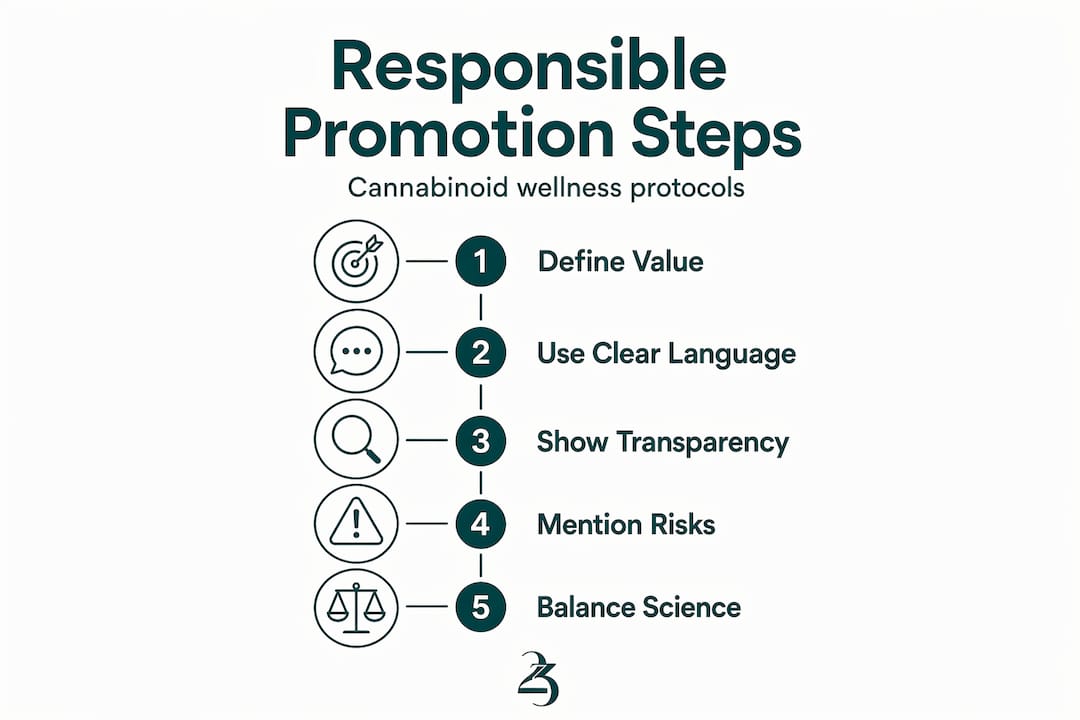
Step-by-step: Responsible promotion techniques for cannabinoid wellness
Now that you have your messaging and transparency foundation in place, let’s get practical. Here is a sequential framework you can apply immediately.
-
Define your compliant value proposition. Write one or two sentences that describe exactly what your product supports, using lifestyle and wellness language. Test it against the “medical claims” checklist. Revise until it feels clear, honest, and inviting.
-
Use educational content over paid ads. Because platform and regulatory limits affect what you can claim in paid advertising, prioritize owned and organic education such as brand blog content, lifecycle email, and FAQs. Paid ads on major platforms often reject cannabinoid content entirely or restrict what benefit language you can use.
-
Deploy lifecycle emails, FAQs, and customer support. Once someone joins your list or makes a purchase, educate them with a welcome series that covers your product’s sourcing, suggested use, and honest expected outcomes. Customer support touchpoints are also educational opportunities. A friendly, informative response to a dosing question builds more long-term loyalty than any paid impression.
-
Share COAs and safety profiles openly. Link your COAs from product pages, include them in onboarding emails, and mention them in social posts when launching new batches. Safety profiles, meaning what the product does and does not contain and how it behaves at different doses, belong front and center.
-
Invite feedback and refine your messaging. Ask customers what language resonated, what confused them, and what made them trust you enough to purchase. Use that data to update your FAQs, product descriptions, and educational content. Promotion that evolves with your community stays relevant and credible.
| Step | Common mistake | Compliance check |
|---|---|---|
| Define value proposition | Using “treats” or “cures” | Lifestyle language only? |
| Educational content | Skipping owned channels | Blog, email, FAQ active? |
| Lifecycle email | No dosing guidance | Usage instructions included? |
| Share COAs | Outdated lab results | Current batch COA linked? |
| Collect feedback | Ignoring negative reviews | Addressing all feedback? |
For more actionable ideas, our essential cannabis lifestyle tips and cannabis self-care workflow guides offer real examples of compliant, engaging content that resonates with wellness audiences.
Pro Tip: Build your email list before you need it. Paid channels for cannabinoid brands can disappear overnight due to policy changes. An engaged email audience is an asset no algorithm can take from you.
Safety, dosing, and risk communication for wellness audiences
Responsible promotion goes beyond pretty language and lab results. It means being upfront about safety, dosing guidance, and the real risks that come with cannabinoid use, even when those conversations feel uncomfortable for marketing purposes.
Cannabis and cannabinoids have known risks and benefits with condition-specific evidence and genuinely inconclusive areas. Acknowledging this openly is not weakness. It is credibility. Audiences that encounter honest risk communication trust your benefit claims far more than they would trust a brand that presents only the rosy side.
Key safety points to communicate proactively:
- Potential adverse effects: Drowsiness, dry mouth, changes in appetite, and in some cases mood fluctuations
- Contraindications: Pregnancy, nursing, certain medications (especially blood thinners), and liver-related health conditions
- Addiction and dependency risk: Low but real, particularly with high-frequency high-dose THC use
- Cognitive effects: Short-term memory and coordination impacts, particularly relevant for new users
- Drug interaction alerts: Always recommend consulting a healthcare provider when combining with other medications
On dosing, the widely respected principle is simple: start low, go slow. For THC specifically, very low starting doses significantly reduce the chance of adverse effects. Dose titration, meaning gradually increasing the dose in small increments over time, allows users to find their personal sweet spot without overshooting into uncomfortable territory.
Understanding the difference between THC and CBD is also fundamental for new wellness users. Our guide on THC vs. CBD breaks this down in a practical, accessible way. For those interested in subtle, intentional use, our hemp microdosing workflow is a great complement to this conversation. And if you’re building a fuller picture of how cannabinoids fit into daily rituals, our cannabis self-care tips offer grounded, lifestyle-forward guidance.
Communicating the science: Balancing benefits and limitations
Part of responsible promotion is knowing how to talk about research without overstating it. The cannabinoid science landscape is genuinely exciting but also genuinely complicated. Some areas have solid evidence; others are still emerging.
Some expert commentary emphasizes that cannabis is not a cure-all and that evidence for psychiatric symptom treatment is limited or entirely absent for certain conditions. Knowing where the science is strong and where it is murky lets you promote with integrity.
Here’s a practical breakdown:
- Strongest evidence base: Certain seizure disorders (FDA-approved CBD medication exists), chemotherapy-related nausea, chronic pain in specific populations
- Emerging and promising: Sleep support, anxiety management, inflammation-related discomfort, appetite regulation
- Limited or inconclusive: Depression treatment, PTSD, most psychiatric applications, long-term neurological effects
When you’re writing about benefits in the emerging category, use language like “early evidence suggests,” “users report,” or “some research indicates, though more study is needed.” These phrases are honest and they protect you legally. They also signal to sophisticated readers that you know your subject.
Clinical dosing for established CBD formulations starts low and is carefully titrated upward, with clinicians monitoring liver function over time in medical contexts. For wellness audiences, this reinforces why “start low, go slow” is the golden rule and why any brand promoting cannabinoids responsibly should incorporate it into their standard messaging.
Our cannabinoid science insights resource page digs deeper into the research landscape for anyone who wants the fuller scientific picture alongside the lifestyle perspective.
Perspective: Why honest, science-based wellness promotion wins long term
Here is an uncomfortable truth most cannabinoid marketers avoid saying out loud: the brands that cut corners on compliance and overpromise benefits often see short-term spikes and long-term collapses. Meanwhile, the brands that chose rigorous honesty from day one are now the household names in this space, the ones with loyal communities, press features, and staying power as regulations tighten.
Overpromising is a trap that feels reasonable in the moment. Your product genuinely helps people. You believe in it. So stretching the language just a little seems harmless. But that stretch erodes the credibility of your entire brand. One regulatory complaint or viral callout can undo years of trust-building instantly.
The better path is building a brand that people feel genuinely proud to recommend. That happens when your educational content is thorough, your safety communication is proactive, and your COAs are front and center. Explore how to weave these principles into cannabis wellness routines content that resonates with real-life users. Regulations will keep evolving. Consumer expectations for transparency will only grow. The brands investing in honest education right now are building the kind of trust that no paid advertising budget can buy.
Pro Tip: Start every piece of promotional content by asking, “Would a new user feel informed, safe, and empowered after reading this?” If yes, you’re on the right track.
Next steps: Elevate your cannabinoid wellness journey with 23rd State
You’ve got the framework. You know the language to use and avoid, the transparency practices that build real trust, the step-by-step promotion process, and how to communicate safety and science honestly. Now it’s time to put it all into practice with products and resources that are already built for exactly this approach.
At 23rd State, everything from our handcrafted hemp-derived products to our educational blog is designed with you in mind. Whether you’re a wellness newcomer curious about your first microdose or an enthusiast refining your self-care ritual, we’ve created a space that feels both informed and inviting. Explore our product lineup, browse our education library, and connect with a community that takes cannabinoid wellness seriously without taking itself too seriously. Good things are growing here.
Frequently asked questions
What language should I avoid when promoting cannabinoid wellness?
Avoid terms like “cure,” “treat,” or “prevent disease” and instead focus on wellness, education, and lifestyle benefits. Frame it as education and lifestyle support rather than medical treatment to stay compliant and credible.
Why are third-party lab results important in cannabis marketing?
They build trust by verifying product contents, purity, and safety beyond the company’s own claims. Third-party testing transparency including sharing COAs and clear sourcing is now a baseline expectation for responsible brands.
What are the key risks to mention to new cannabinoid users?
New users should be informed about potential adverse effects, drug interactions, cognitive effects, and addiction risk at high doses. Cannabis and cannabinoids have known risks alongside benefits, with some areas still inconclusive, so honest risk communication matters.
How should I explain uncertainty in cannabinoid benefits?
Use phrases like “emerging evidence” or “more research is needed” to stay honest and protect your credibility. Expert commentary consistently notes that cannabis is not a cure-all and that evidence in psychiatric applications remains limited for several conditions.
What’s the safest way to introduce CBD or THC for wellness?
Start with the lowest possible dose and increase gradually only as needed, monitoring your response carefully along the way. The start low, go slow principle and careful dose titration significantly reduce the chance of adverse effects for new users.
