

TL;DR:
- Cannabis topicals target localized skin areas without producing psychoactive effects because cannabinoids interact only with skin cell receptors. They are effective for reducing pain, inflammation, and skin conditions like eczema, with absorption depending on formulation type. Proper product selection and consistent application optimize benefits, but topicals cannot treat systemic conditions or provide a high.
You’ve probably heard someone dismiss cannabis topicals with a wave of the hand: “Isn’t that just going to get me high?” It’s the most common misconception surrounding this growing wellness category, and it couldn’t be further from the truth. Why use cannabis topicals at all if you don’t want the buzz? Because their entire advantage is that they skip the buzz entirely. These creamy, soothing formulas work right where you apply them, targeting muscles, joints, and skin without touching your bloodstream. This guide covers the real science, the genuine benefits of cannabis topicals, and exactly how to fold them into a wellness routine you’ll actually stick with.
Table of Contents
- How cannabis topicals work: localized relief without the high
- Proven and potential benefits of cannabis topicals for skin and pain
- Types of cannabis topicals and how to choose the right one for you
- Setting realistic expectations: what cannabis topicals can and can’t do
- How to integrate cannabis topicals into your wellness routine
- Why choosing the right cannabis topical matters more than you think
- Explore 23rd State’s cannabis collection for your wellness journey
- Frequently asked questions
Key Takeaways
| Point | Details |
|---|---|
| Local action only | Cannabis topicals work on the skin and nearby tissues without causing a high or systemic effects. |
| Varied formulations | Creams, balms, and patches offer different delivery modes suited for distinct wellness goals. |
| Evidence emerging | Scientific studies show promise particularly for pain relief and inflammatory skin conditions but more research is needed. |
| Realistic expectations | Topicals do not penetrate deep tissues extensively and effects require consistent application to evaluate. |
| Informed choices | Understanding product formulation and use is key to getting the most benefit from cannabis topicals. |
How cannabis topicals work: localized relief without the high
Let’s get into the mechanics, because understanding how these products work is what separates an informed buyer from someone just hoping for the best. When you rub a cannabis cream or balm onto your skin, the cannabinoids (CBD, THC, CBG, and others) interact with cannabinoid receptors located in skin cells, sensory nerve endings, and immune cells just beneath the surface.
These receptors are part of your endocannabinoid system, which plays a role in managing local pain signals, inflammation, and skin barrier health. The key detail: cannabis topicals act locally on skin and underlying tissue with minimal systemic absorption, meaning the cannabinoids don’t ride your bloodstream to your brain.
Understanding your route of cannabis administration matters enormously here, because not all cannabis products behave the same way. Topicals sit at one end of the spectrum.
Here’s a quick breakdown of how topicals differ from other application types:
- Standard topicals (creams, lotions, balms): Cannabinoids stay at the application site, interacting with local receptors only. No intoxication.
- Transdermal patches: These use penetration enhancers to push cannabinoids through all skin layers and into the bloodstream. Systemic effects are possible.
- Inhalation or edibles: Deliver cannabinoids systemically through lungs or digestion, producing whole-body effects including intoxication with THC.
If you see the word “transdermal” on a label, that’s a fundamentally different product from a standard topical. Knowing this distinction helps you choose the right tool for the right job.
Proven and potential benefits of cannabis topicals for skin and pain
With the delivery science clear, here’s where things get exciting. The benefits of cannabis topicals are more specific, and better supported by research, than a lot of people realize.
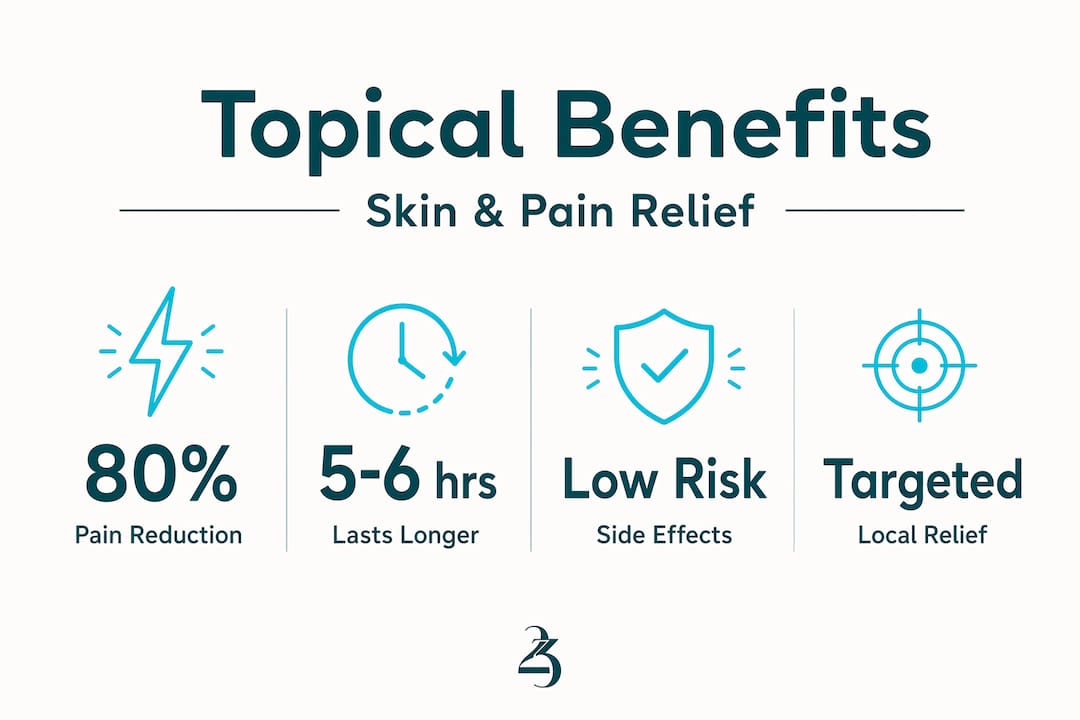
Localized pain and inflammation relief is the headline use case. Your skin and nearby peripheral nerves are loaded with cannabinoid receptors, and when cannabinoids bind to them, they can dial down local pain signaling and reduce inflammatory activity. Topical cannabinoids reduce pain and inflammation locally, with studies showing measurable benefits for peripheral neuropathy and inflammatory skin conditions.
The skin health angle is just as compelling. A 2026 clinical study found a cannabinoid-based topical cream reduced atopic dermatitis (eczema) symptoms by 55 to 60% with no significant adverse events. That’s a meaningful number for anyone who’s cycled through a shelf full of conventional moisturizers without lasting relief.
“Cannabis topicals sit in a sweet spot: they offer real therapeutic activity where you need it most, without any compromise to your mental clarity or daily function.”
Here’s a summary of the most supported uses for cannabis topicals:
- Arthritis and joint pain: CBD applied around the affected joint may reduce swelling and discomfort, particularly for superficial joints like knuckles and wrists.
- Post-workout muscle soreness: Massaging a cooling balm into tired muscles after exercise targets local inflammation without the lag time of an oral supplement.
- Eczema and psoriasis flares: Anti-inflammatory cannabinoid properties may calm redness, itching, and barrier disruption.
- Dry or irritated skin: CBD and hemp-based formulas are naturally moisturizing and soothe reactive skin without clogging pores.
- Peripheral neuropathy: Early research points to localized relief from nerve-related burning or tingling sensations.
Explore the full scope of benefits of infused topicals to see how the evidence stacks up across different conditions.
Types of cannabis topicals and how to choose the right one for you
Not all formulations feel or perform the same on your skin. Choosing the right type makes a real difference in both the sensory experience and the result.

| Product type | Base | Absorption speed | Best for |
|---|---|---|---|
| Cream | Water and oil blend | Fast | General skincare, mild joint discomfort |
| Lotion | Mostly water-based | Very fast | Large surface areas, daily moisturizing |
| Balm or salve | Oil or wax-based | Slower, prolonged | Deep muscle and joint areas |
| Transdermal patch | Adhesive with enhancers | Sustained, systemic | Whole-body cannabinoid delivery |
Creams and lotions absorb quickly and moisturize effectively; balms create an occlusive layer that slows evaporation and enhances absorption over time; patches deliver cannabinoids systemically over hours and are a different category entirely.
Here’s a simple process to find your match:
- Identify your goal. Dry skin and redness? A lightweight lotion wins. Post-run knee soreness? Reach for a thicker balm.
- Check the ingredient list. Look for known penetration enhancers like menthol, camphor, or DMSO if you want deeper delivery. If those are absent, you’ve got a standard topical.
- Check cannabinoid concentration. Higher milligram counts are not always better, but low-potency products under 150 mg per container may not deliver enough to feel anything.
- Start with one area. Apply to a small patch of skin first to rule out sensitivity to carrier ingredients like essential oils or preservatives.
- Give it a real trial. Consistent use over one to two weeks is the honest minimum to evaluate whether a topical is working for you.
Pro Tip: If you’re curious about how nano-formulation technology affects absorption, the science behind nanoemulsion cannabis absorption explains why some topicals feel more active than others even at the same cannabinoid dose.
Setting realistic expectations: what cannabis topicals can and can’t do
Here’s the honest conversation that most product descriptions skip. Cannabis topicals are genuinely useful for localized needs. They are not a whole-body solution.
Topical cannabis products work locally and do not produce psychoactive systemic effects, but they have limited penetration to deep tissues. If your issue is a deep hip flexor, an inflamed spinal disc, or systemic inflammation throughout your body, a topical won’t reach it. That’s not a failure of the product; it’s just physics.
“Think of cannabis topicals as precision tools, not broad-spectrum treatments. They shine when the problem is right where you can touch it.”
A few things topicals genuinely cannot do:
- Relieve anxiety or improve sleep. Without systemic absorption, cannabinoids won’t reach brain receptors. You’d need an inhalable or edible product for that.
- Address internal pain. Stomach cramps, headaches, or back pain from a deep spinal source are beyond a topical’s range.
- Work faster with more product. Increasing product amount does not proportionally increase active concentration in target tissues. Slathering on triple the amount wastes product without improving results.
- Replace medical treatment. For diagnosed conditions like severe psoriasis or arthritic damage, topicals are a complement, not a substitute, for professional care.
Understanding your cannabis administration routes gives you a fuller picture of which products are right for which goals.
Pro Tip: If you’re not feeling effects after two weeks of consistent, label-guided use, the formulation may not be right for your skin type rather than cannabis topicals failing you as a category. Try a different base formula before writing them off.
How to integrate cannabis topicals into your wellness routine
This is where it all comes together. Topicals are easiest to love when they have a clear, consistent place in your day rather than sitting forgotten in a drawer.
Follow these steps to build a sustainable practice:
- Choose your moments. Evening wind-down massages, post-workout recovery, or pre-event skin prep are all natural entry points that don’t require extra effort.
- Clean the application area first. Apply to clean, dry skin for best absorption. Residue from lotions or sunscreen can create a barrier.
- Massage gently for 60 seconds. Friction increases local circulation and helps cannabinoids reach nearby receptors more effectively.
- Follow the recommended amount on the label. Start there and adjust only after a full week, not after your first use.
- Track your results simply. A quick note in your phone after each session, rating discomfort or skin condition, gives you real data to work with.
Topical effects typically begin within 15 to 30 minutes and last about 5 to 6 hours, so timing your application matters. Apply about 20 minutes before you need relief, not in the moment.
Here are some easy, feel-good ways to build topicals into daily life:
- Morning: A CBD-rich hand cream during your skincare routine for knuckle stiffness
- Midday: A targeted balm on sore wrists or shoulders after desk work
- Evening: A soothing, aromatic salve massaged into tired feet or calves as a wind-down ritual
- Post-workout: A cooling lotion on worked muscle groups within 30 minutes of exercise
Pro Tip: Pairing a cannabis topical with a lightly infused beverage during your evening routine creates a layered, intentional wellness moment. The topical handles local tension while the beverage eases your overall vibe. It’s a genuinely enjoyable combination that makes self-care feel less like a chore.
Explore more about the infused topicals benefits to see how consistent use shapes long-term results.
Why choosing the right cannabis topical matters more than you think
Most conversations about cannabis topicals stop at cannabinoid type: CBD or THC? That’s actually the least important question. What determines whether a topical works or collects dust on your shelf is the formulation, specifically the delivery technology, the carrier oils, and what else is in that jar.
Consumers often underestimate the importance of delivery method, and penetration enhancers can fundamentally alter whether a product stays local or starts behaving more like a transdermal. Some products on shelves make bold claims about “deep penetration” and “full-body relief,” but those claims should raise a flag. A true topical doesn’t offer full-body relief. If a product does, it’s functioning more like a transdermal, and that changes its risk and effect profile.
Here’s a perspective most brands won’t offer: the cannabinoid milligram count printed on the front of a jar is marketing, not a meaningful performance indicator on its own. A 500 mg CBD balm in a poor-quality carrier may deliver less to your skin receptors than a well-formulated 250 mg cream with the right emulsifiers and absorption-supporting ingredients. Formulation science matters more than the headline number.
Experienced users who apply a results-based lens (rather than a marketing one) track three things: onset time, duration of effect, and skin response. If onset takes more than 45 minutes or there’s no noticeable effect by 90 minutes, the product isn’t penetrating adequately for your skin type. Swap formulations before you swap the cannabinoid. Check out the guide to choosing infused topicals for a deeper look at reading labels intelligently.
The most effective approach treats cannabis topicals the way a clinician treats any intervention: clear baseline, defined goal, consistent use, measurable outcome. Anything less and you’re just guessing.
Explore 23rd State’s cannabis collection for your wellness journey
You’ve done the learning. Now here’s the fun part: finding products that actually live up to the science. At 23rd State, the approach is intentional from the start, with hemp-derived cannabis products built around real formulation quality and a lifestyle that feels as good as it sounds.
Whether you’re exploring SHAKE for a lightly infused social moment, reaching for Blush Crush for a soft, relaxing evening, or looking into their topical line for targeted daily care, every product is crafted to deliver a genuine, joyful experience. No guesswork, no compromising your clarity. New to cannabis topicals? They’re a natural starting point since there’s no intoxication risk and no steep learning curve. Browse the infused topicals benefits article to match your wellness goals to the right product and make your self-care ritual something to actually look forward to.
Frequently asked questions
Will cannabis topicals make me feel high?
No, standard cannabis topicals do not enter your bloodstream in significant amounts, so they will not produce psychoactive effects or a high. THC topicals do not produce a psychoactive high due to limited systemic absorption.
How long do cannabis topical effects generally last?
Effects typically begin within 15 to 30 minutes after application and last approximately 5 to 6 hours, depending on the product and formulation.
Can cannabis topicals treat systemic conditions like anxiety or insomnia?
No, cannabis topicals work locally and do not deliver cannabinoids systemically, so they cannot address conditions requiring whole-body effects such as anxiety or insomnia. Cannabinoids do not reach the bloodstream in significant concentrations from standard topicals.
Are there any side effects from using cannabis topicals?
Most people experience minimal side effects, though some may notice skin irritation from carrier ingredients like essential oils or preservatives. The most common side effect is skin irritation caused by secondary ingredients, not cannabinoids, and THC topicals do not produce intoxication.
How should I choose between creams, balms, and patches?
Choose creams and lotions for easy absorption and daily moisturizing, balms for deeper muscle or joint contact with a longer-lasting effect, and patches only if you specifically want systemic cannabinoid delivery through transdermal absorption. Creams absorb quickly; balms prolong contact time; patches deliver cannabinoids systemically.
