

TL;DR:
- Adaptogenic hemp is a marketing term for hemp products believed to support stress relief, but it is not scientifically classified as an adaptogen. Hemp cannabinoids like CBD primarily interact with the endocannabinoid system, supporting mood, sleep, and inflammation, rather than modulating the HPA axis like true adaptogens. Consumers should verify product quality through third-party lab testing and be cautious of unregulated claims.
Adaptogenic hemp is defined as hemp products marketed for their stress-regulating and wellness benefits, combining hemp-derived cannabinoids with properties associated with traditional adaptogens. The term is popular in wellness culture, but hemp itself is not scientifically classified as a classical adaptogen. That distinction matters if you want to make smart choices about what you put in your body. This article breaks down what adaptogens actually are, how hemp cannabinoids like CBD work differently, and how you can use hemp products as part of a genuinely enjoyable wellness routine.
What is adaptogenic hemp, and where does the term come from?
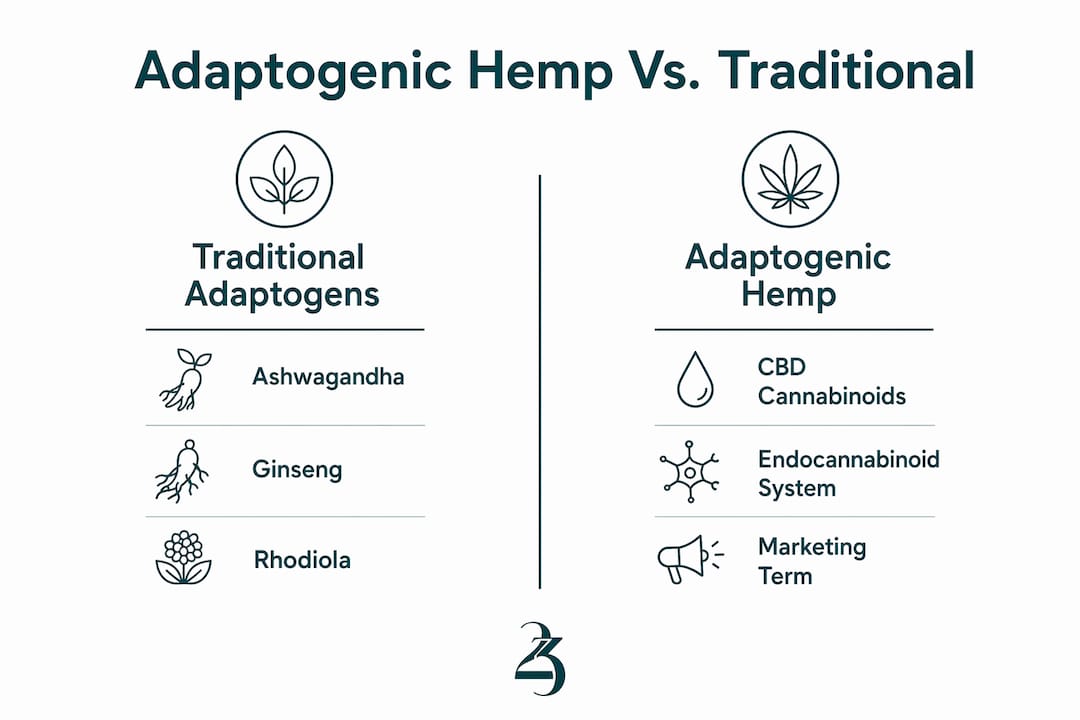
“Adaptogenic hemp” is a marketing phrase, not a formal scientific category. It describes hemp products, often containing CBD or other cannabinoids, that brands position as stress-support tools. The word “adaptogenic” borrows from the world of herbal medicine, where true adaptogens like ashwagandha, ginseng, and rhodiola have decades of clinical research behind them.
Hemp entered this conversation because CBD shows real promise for mood, anxiety, and relaxation support. Brands began pairing hemp with adaptogenic herbs or simply labeling hemp products as “adaptogenic” to tap into the wellness trend. The result is a category that blends genuine benefit with some marketing stretch.
Understanding the difference between the marketing claim and the science gives you real power as a consumer. You can enjoy hemp’s actual benefits without being misled by inflated promises.
How do adaptogens work in the body?
Adaptogens are non-toxic plant or fungi substances that improve the body’s resistance to stress by modulating the hypothalamic-pituitary-adrenal (HPA) axis. The HPA axis is your body’s central stress-response system. When it gets overactivated, you feel anxious, fatigued, and burned out.
To earn the label “adaptogen,” a substance must meet three strict criteria:
- Nonspecific resistance: It must help the body resist a broad range of physical, chemical, and biological stressors, not just one type.
- Normalizing effect: It must push the body toward balance, or homeostasis, regardless of whether stress is driving you too high or too low.
- High safety profile: It must be safe for long-term use with minimal side effects.
Classical adaptogens like ashwagandha, ginseng, and rhodiola meet all three. They work through pleiotropic effects on signaling pathways including the HPA axis, SAPK/JNK, FOXO, and NF-κB, delivering antioxidant and neuroprotective support. Clinical studies show cortisol reductions in the range of 14–30% with consistent adaptogen use. That is a meaningful physiological shift, not just a feeling.
Registered dietitian nutritionist Kristen Smith emphasizes that adaptogens help the body adapt by maintaining balance, rather than simply stimulating or sedating. That distinction separates them from caffeine, melatonin, and most other common wellness supplements.
Pro Tip: Traditional adaptogen formulas rarely use a single herb. They combine multiple plants for broader systemic support. If you see a product with only one ingredient labeled “adaptogenic,” look closer at the evidence behind it.
How does hemp work for stress relief?
Hemp’s primary bioactive compounds are cannabinoids, most notably CBD (cannabidiol). These compounds interact with the endocannabinoid system (ECS), a network of receptors throughout your brain and body that regulates mood, sleep, appetite, and stress response.
CBD and hemp cannabinoids have pleiotropic biological activities that are distinct from classical adaptogen mechanisms. Where adaptogens modulate the HPA axis broadly, cannabinoids primarily bind to CB1 and CB2 receptors in the ECS. The pathways are different, but the destination, which is a calmer, more balanced you, can overlap.
Here is what hemp cannabinoids actually do for wellness:
- Mood support: CBD interacts with serotonin receptors, which influences how you process stress and anxiety.
- Anti-inflammatory effects: Cannabinoids reduce inflammatory signaling, which chronic stress tends to amplify.
- Sleep quality: Hemp compounds can support the transition into restful sleep without the grogginess of pharmaceutical sleep aids.
- Antioxidant contribution: Hemp seeds contain nutrients that support oxidative stress reduction, adding a nutritional layer to hemp’s wellness profile.
Hemp’s antioxidant and anti-inflammatory properties contribute to overall wellness beyond cannabinoid effects alone. That nutritional dimension is often overlooked in the adaptogen conversation.
Key insight: Cannabinoids do not have the typical adaptogen ligand-receptor properties or HPA axis modulation seen in classical adaptogens. Both categories support stress resilience, but they do it through fundamentally different biological routes.
Is hemp truly adaptogenic? Science vs. marketing
The honest answer is no, hemp is not formally an adaptogen by scientific standards. Cannabinoids do not meet traditional adaptogen definitions, even though both hemp and adaptogens aim to improve stress resilience. The mechanisms are simply too different for hemp to earn that classification under current scientific criteria.
The bigger issue is that “adaptogenic” is an unregulated marketing term. The FDA does not regulate the adaptogen label, which means any brand can apply it to any product without meeting a defined standard. That creates real variability in product quality, potency, and honesty.
The Merck Manual warns that extensive health claims often lack robust evidence. That warning applies directly to the adaptogenic hemp category. Some products genuinely combine hemp with proven adaptogens like ashwagandha or l-theanine. Others simply use the word “adaptogenic” as a marketing badge.
Here is how to shop smart:
- Look for third-party lab testing (COA): A certificate of analysis confirms cannabinoid content and screens for contaminants.
- Check the ingredient list: Real adaptogenic hemp products list specific herbs alongside cannabinoids.
- Verify dosing transparency: Reputable brands publish exact milligram amounts per serving.
- Prioritize hemp safety standards: Quality sourcing and clean extraction methods matter as much as the label.
The hemp classification as adaptogenic remains debated in scientific communities. That debate does not mean hemp lacks value. It means you should know what you are actually buying.
Practical uses of hemp adaptogens in your wellness routine
Hemp products fit naturally into a wide range of daily wellness moments. The key is matching the product format and dose to your specific goal.
- Morning calm: A low-dose CBD tincture or hemp beverage in the morning can take the edge off a stressful day before it starts. Pair it with a traditional adaptogen like ashwagandha for broader HPA axis support.
- Afternoon reset: Hemp-infused beverages work well as a midday ritual. They replace the cortisol spike of a second coffee with something that supports balance instead.
- Evening wind-down: Hemp edibles or capsules before bed support relaxation and sleep quality. This is where hemp’s ECS interaction shines most clearly.
- Social occasions: Hemp beverages offer a way to be present and relaxed at gatherings without alcohol. The experience is social, light, and genuinely enjoyable.
- Post-workout recovery: Hemp’s anti-inflammatory properties make it a natural fit after exercise. Some people pair it with rhodiola for combined physical and mental recovery support.
Adaptogenic hemp formulations often combine CBD with herbs like ashwagandha, l-theanine, or holy basil for synergistic effects. That combination approach mirrors how traditional adaptogen formulas have always worked, using multiple plants together rather than relying on a single compound.
Pro Tip: Start with a consistent low dose for two to three weeks before adjusting. Your endocannabinoid system responds to regular input, and many people notice the most benefit after building a steady routine rather than using hemp sporadically.

The table below shows common hemp product formats and their best-fit wellness uses:
| Product format | Best use | Onset time |
|---|---|---|
| Hemp beverage | Social relaxation, afternoon reset | 20–45 minutes |
| CBD tincture | Morning calm, precise dosing | 15–30 minutes |
| Hemp capsule | Sleep support, consistent daily dose | 45–90 minutes |
| Hemp edible | Evening wind-down, longer duration | 45–90 minutes |
For guidance on choosing hemp for your routine, the format you enjoy most is often the one you will actually use consistently.
Key Takeaways
Adaptogenic hemp delivers real stress-relief benefits through the endocannabinoid system, but it is not a classical adaptogen by scientific standards, and smart consumers verify lab testing before buying.
| Point | Details |
|---|---|
| Hemp is not a classical adaptogen | Hemp cannabinoids work via the ECS, not the HPA axis modulation that defines true adaptogens. |
| “Adaptogenic” is unregulated | The FDA does not regulate this label, so third-party lab testing is your best quality check. |
| CBD supports stress relief differently | CBD interacts with serotonin and ECS receptors to support mood, sleep, and inflammation. |
| Synergy is real | Pairing hemp with ashwagandha or l-theanine creates broader stress support than either alone. |
| Format and consistency matter | Matching the product format to your goal and using it regularly produces the best results. |
What I actually think about adaptogenic hemp
I have watched the adaptogenic hemp trend grow from a niche wellness conversation into a full-blown product category, and my honest take is this: the science is more nuanced than most brands admit, and that is okay. Hemp does not need to be a classical adaptogen to be genuinely useful.
What I find most exciting is the beverage format. A well-crafted hemp drink fits into the moments where people actually want to unwind, which are Friday evenings, Sunday brunches, post-hike cool-downs. It does not require a supplement mindset. It just feels good and fits naturally into a joyful life. That is a real advantage over capsules and tinctures, which can feel clinical.
My caution is this: do not let the “adaptogenic” label do all the heavy lifting. The hemp microdosing approach works best when it sits on top of solid sleep, movement, and real food. Hemp is a wonderful addition to a balanced life. It is not a replacement for one.
Choose products from brands that publish their lab results, list exact doses, and do not make medical claims. Those are the brands that respect you enough to be honest. The rest are selling a vibe, not a product.
— Leah Kollross, founder, 23rd State
Hemp wellness, made delicious with 23rd State
You now know the science. Here is where the fun part starts.
23rd State crafts hemp-derived cannabinoid beverages designed for real life moments, not just supplement routines. Fresh Press is a standout: bright, flavorful, and precisely dosed so you always know exactly what you are getting. Every batch is lab-tested for cannabinoid content and purity, which means no guessing and no surprises. Whether you are winding down after a long week or looking for a lighter way to celebrate, 23rd State gives you a hemp experience that actually tastes as good as it feels. Browse the full lineup at 23state.com and find your new favorite ritual.
FAQ
What is adaptogenic hemp in simple terms?
Adaptogenic hemp refers to hemp products marketed for stress relief and balance, typically containing CBD or other cannabinoids. The term borrows from herbal medicine but hemp is not formally classified as a classical adaptogen by scientific standards.
Does hemp actually reduce stress?
CBD interacts with the endocannabinoid system and serotonin receptors, which supports mood regulation and reduces anxiety-related responses. The effect is real, but it works through different biological pathways than traditional adaptogens like ashwagandha or rhodiola.
What are the benefits of adaptogenic hemp?
Hemp cannabinoids support relaxation, sleep quality, mood stability, and anti-inflammatory response. When combined with true adaptogens like ashwagandha or l-theanine, the stress-relief benefits can be broader and more consistent.
Is the adaptogenic hemp label regulated by the FDA?
No. “Adaptogenic” is an unregulated marketing term, and the FDA does not require brands to prove adaptogenic claims before using them. Always look for products with third-party certificates of analysis to verify what you are actually buying.
How is hemp different from traditional adaptogens?
Traditional adaptogens modulate the HPA axis and multiple stress-signaling pathways to normalize body function. Hemp cannabinoids primarily target the endocannabinoid system. Both support stress resilience, but through distinct biological mechanisms.
