

TL;DR:
- Artisan cannabis is small-batch flower grown with hands-on methods that prioritize terpenes and sensory quality. The most reliable indicators include batch-level COAs, grower transparency, and detailed curing and trimming practices, not just the “craft” label. Its higher cost reflects labor-intensive cultivation, longer curing times, and genetic stewardship, serving a niche focused on flavor and provenance.
Artisan cannabis, also called craft cannabis, is small-batch flower grown with hands-on methods that put terpene expression, genetic care, and sensory experience ahead of raw yield. Think of it the way you’d think about a small-batch bourbon or a single-origin coffee: the grower is making deliberate choices at every step, and you can taste the difference. Here’s what separates genuine craft from the rest:
- Small-batch scale: Limited canopy size, often a few hundred plants or fewer per run
- Hand-trimming and hand-curing: No machines stripping trichomes off the buds
- Terpene and flavor focus: Strain selection and growing conditions chosen for aroma and effect, not just THC percentage
- Grower transparency: A real farm name, a batch number, and a story you can verify
- Third-party lab testing: A Certificate of Analysis (COA) showing cannabinoids, terpenes, and contaminant screening
Table of Contents
- What does “craft cannabis” actually mean?
- How does craft cannabis differ from commercial flower?
- What cultivation practices actually define a craft grow?
- What do craft flower’s aroma, appearance, and lab results tell you?
- Why does artisan cannabis cost more, and where can you find it?
- How do you spot genuine artisan cannabis at the dispensary?
- Why has the craft cannabis segment grown since legalization?
- What does research say about why craft costs more?
- Key Takeaways
- The craft ethos is worth celebrating
- SHAKE: craft-forward flavor in every can
- FAQ
- Useful sources
What does “craft cannabis” actually mean?
Craft cannabis is an industry and marketing term, not a federally protected label. There is no single U.S. federal definition, which means any grower can technically use the word “craft” on their packaging. A few states have moved to change that. Illinois, for example, created a formal Craft Grower license under its Cannabis Regulation and Tax Act, setting explicit canopy limits and social equity provisions. As of the Illinois Department of Agriculture’s FY2024 report, a limited number of such licenses had been issued, with only a few operational — a sign of how early and limited formal craft recognition still is.
Because the label is unprotected at the federal level, defining craft requires looking at multiple variables together: lot size, harvesting technique, pest control philosophy, and curing method. No single factor makes a product “craft.” That complexity is exactly why a checklist matters more than a label.
Common practices you’ll find in genuine craft grows:
- Single-strain runs (one variety per batch, not blended)
- Pheno-hunting to find the best expression of a strain’s genetics
- Heirloom or legacy genetics preserved across generations
- Living soil with active microbial communities
- Slow hang-drying and controlled cure rooms
- Direct grower-to-dispensary supply chains
Pro Tip: The most reliable buyer signals are a batch number, a linked COA, and the grower’s actual name on the label. “Small-batch” language alone means nothing without those anchors.
How does craft cannabis differ from commercial flower?
| Dimension | Craft / Artisan | Commercial / Mass-Produced |
|---|---|---|
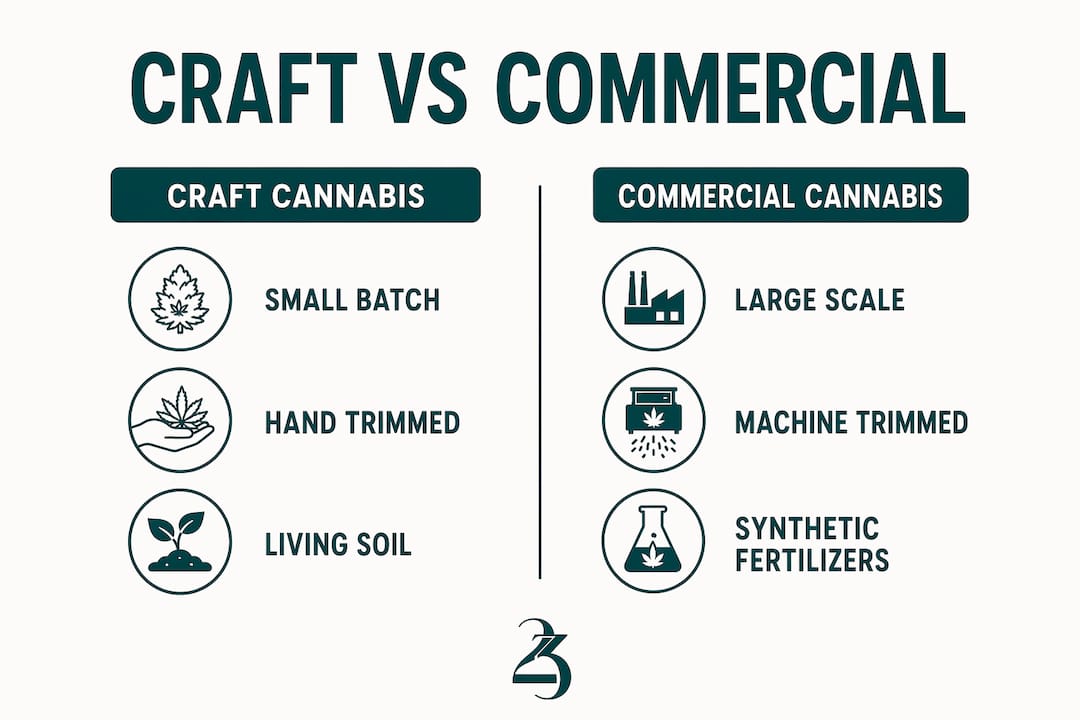
| Scale | Small canopy, limited batch runs | Large-scale, continuous high-volume harvests |
| Cultivation method | Living soil, organic inputs, hand-tended | Hydroponic or mixed, nutrient-solution driven |
| Post-harvest care | Hand-trimmed, slow hang-dry, long cure | Machine-trimmed, fast-dry, accelerated cure |
| Sensory focus | Terpene-forward, strain-specific flavor | Consistent THC percentage, broad appeal |
| Price per gram | Higher, reflecting labor and lower yield | Lower, reflecting scale efficiency |
| Traceability / COA | Batch-level COA, grower name, harvest date | Brand-level COA, less batch specificity |
A few things that table can’t fully capture:
- Hand-trimming preserves trichomes and the aromatic compounds attached to them. Machine trimming can shear off trichome heads, reducing both flavor intensity and visual appeal.
- Slow curing in a controlled environment lets chlorophyll break down naturally, which smooths harshness and lets terpene profiles develop fully. Rushed cures skip that window.
- “Craft-washing” is real. Large operators sometimes use small-batch language, rustic packaging, and farm-to-shelf copy without changing their actual methods. Without a COA and a grower name, you can’t tell the difference.
What cultivation practices actually define a craft grow?
The growing environment is where craft starts. Many small-batch growers use living soil, a medium teeming with bacteria, fungi, and microorganisms that feed the plant naturally rather than through synthetic nutrient solutions. Living soil systems and hand-trimming demand more labor and attention than conventional setups, and small errors in soil moisture or microbial balance can spoil an entire batch.
Harvest and post-harvest care are equally defining:
- Staggered harvests: Different plants in the same run may reach peak ripeness at different times; craft growers harvest each individually rather than clearing the room all at once.
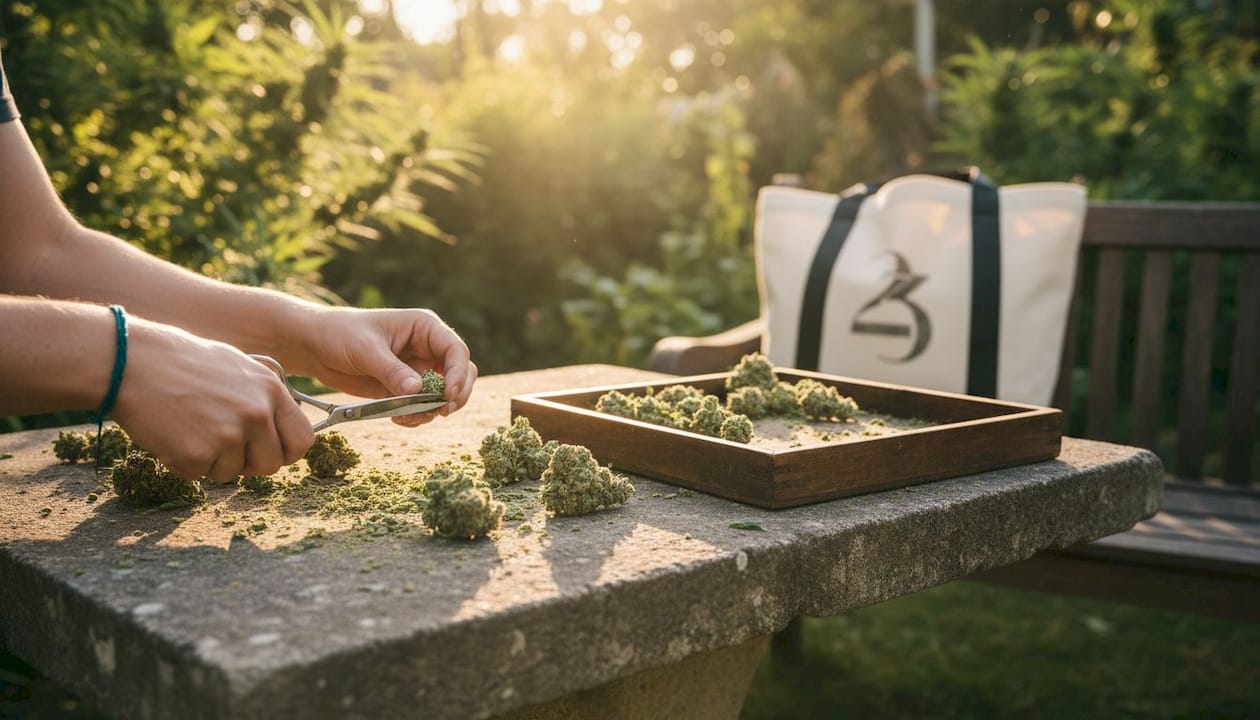
- Hand-trimming: Each bud is shaped by hand, preserving the resin glands that carry flavor and aroma.
- Slow hang-dry: Whole branches hang in climate-controlled rooms for one to two weeks, allowing moisture to leave gradually.
- Controlled cure: Trimmed flower is sealed in containers and “burped” regularly over weeks to develop the final terpene profile.
Genetics are another major investment. Pheno-hunts can take one to two years before a grower settles on the best expression of a strain for production. That timeline is built into the price of every jar.
Pro Tip: Ask your budtender: “How long did this cure, and was it hand-trimmed?” A grower who can answer both questions specifically is one worth trusting.
What do craft flower’s aroma, appearance, and lab results tell you?
Great craft flower announces itself before you even open the jar. The aroma is pronounced and specific — citrus, pine, fuel, berry — rather than a faint, generic “weed” smell. Visually, intact trichome heads catch the light like tiny crystals, and the bud structure holds together without crumbling or feeling bone-dry.
On a COA, look beyond THC percentage:
- Full cannabinoid profile: CBD, CBG, CBN, and minor cannabinoids alongside THC
- Terpene breakdown: Named terpenes with percentages (myrcene, limonene, caryophyllene, linalool, etc.)
- Contaminant panel: Pesticide residue, heavy metals, microbial counts, and residual solvents
- Batch-level ID: A lot or batch number that matches the label on the package
| COA Element | What to Look For |
|---|---|
| Terpene total | Named terpenes listed with individual percentages |
| Cannabinoid panel | Full spectrum, not just THC/CBD |
| Contaminant screen | Pesticides, heavy metals, mold/yeast counts |
| Batch traceability | Lot number matching the product label |
| Testing lab | Accredited third-party lab, not in-house |
Illinois’ Craft Grower license program is one of the few U.S. frameworks that formally links canopy limits to a licensed craft designation, giving buyers in that state a regulatory anchor when evaluating claims.
Why does artisan cannabis cost more, and where can you find it?
The price premium on craft flower reflects the same logic as craft coffee or handmade chocolate: smaller scale, more labor, and a focus on flavor over volume. Specific cost drivers include:
- Hand-trimming labor (far more hours per pound than machine processing)
- Lower yield per square foot from soil-based, low-stress growing methods
- Longer crop cycles and extended cure times
- Genetic stewardship: preserving mother plants and running pheno-hunts
- Small-batch packaging and marketing for limited SKUs
Craft product typically shows up as limited drops, single-grower batches, or regionally exclusive offerings rather than continuous high-volume SKUs on a dispensary menu. Where to look:
- Regional dispensaries with dedicated craft or “small-batch” shelf sections
- Farm-direct pop-up events in states where they’re permitted
- Boutique brands within regulated markets that publish grower names and batch info
- Limited-release drops announced through brand newsletters or social channels
When comparing price, think price-per-gram for flower and price-per-mg of THC for infused products. A higher sticker price backed by a detailed COA and a named grower is usually justified. A high price with no traceability is a red flag.
How do you spot genuine artisan cannabis at the dispensary?
Use this checklist before you buy:
- Batch number on the label: If it’s not there, ask for it.
- Linked or available COA: Scan the QR code or ask the budtender to pull it up.
- Grower or farm name: Not just the brand, but the actual grow operation.
- Hand-trim or small-batch language with supporting detail: Not just a claim, but specifics.
- Tasting notes and terpene list: Named terpenes, not just “earthy” or “floral.”
- Harvest and cure dates: Freshness matters; older flower loses terpene intensity.
Questions worth asking at the counter: “Which grower produced this batch? Was it hand-trimmed? How long did it cure and where?” A budtender at a shop that carries genuine craft product will know the answers.
Pro Tip: In-store, open the jar if you can. Pronounced, specific aroma is the fastest quality signal. If it smells faint or generic, the terpenes have likely degraded, regardless of what the label says.
Why has the craft cannabis segment grown since legalization?
Two parallel tracks emerged as state-by-state legalization expanded: industrial-scale efficiency and small-batch quality. Both persist because they serve different buyers. Large operators compete on price and consistency; craft growers compete on flavor, provenance, and experience.
Drivers behind craft’s sustained growth:
- Consumer interest in terpene profiles and strain-specific effects, not just THC numbers
- Regional licensing structures (like Illinois’ Craft Grower program) that give smaller operators a formal lane
- Growing appeal of sustainability and organic practices among wellness-oriented buyers
- The “provenance” effect: knowing who grew your flower and where, similar to farm-to-table dining
Near-term trends worth watching: more states are likely to formalize craft definitions with canopy and licensing rules, demand for craft concentrates and infused products is rising alongside flower, and craft-washing pressure will grow as the category gains cachet. Buyers who know how to read a COA will stay ahead of the marketing noise.
What does research say about why craft costs more?
The labor intensity of small-scale growing is well-documented. Living soil management, hand-trimming, and slow curing all demand more hours per unit of output than conventional commercial methods. For a small operation, a single failed batch represents a much higher percentage of annual revenue than the same loss would for a large producer, which means craft growers carry more risk per cycle.
Genetic stewardship adds another layer. Preserving legacy strains and running pheno-hunts that can span one to two years before a variety enters production is a real investment with no guaranteed payoff. That time cost is baked into every retail price.
Pro Tip: A price premium is evidence-backed when three things align: a traceable COA with terpene data, a named grower with a verifiable location, and consistent tasting notes across multiple batches from the same source. If any of those three are missing, the premium is marketing, not craft.
Key Takeaways
Artisan cannabis is defined by small-batch cultivation, hands-on post-harvest care, and verifiable traceability — and the COA is your single most reliable tool for separating genuine craft from craft-washed marketing.
| Point | Details |
|---|---|
| Craft has no federal definition | “Artisan” and “craft” are unprotected labels; verify with a batch-level COA and grower name. |
| Hand-trimming protects terpenes | Machine trimming removes trichome heads, reducing flavor and aroma intensity. |
| Price reflects real labor | Hand-trimming, slow curing, and pheno-hunting all add hours and risk that show up in the retail price. |
| Find it through limited drops | Craft flower appears as single-grower batches and regional exclusives, not continuous high-volume SKUs. |
| 23rd State brings craft values to beverages | 23rd State’s SHAKE delivers a flavor-forward, carefully sourced hemp-derived THC in an approachable format. |
The craft ethos is worth celebrating
Here’s a perspective worth sitting with: most cannabis marketing talks about THC percentage the way fast food talks about calories, as if the number is the whole story. Craft growers have always known better. The terpene profile, the cure, the genetics, the soil, the hands that trimmed it — those are what make a session memorable. The rise of artisan cannabis isn’t a niche trend. It’s a correction.
At 23rd State, we think that same quality-first mindset belongs in every format, not just flower. Whether you’re winding down on a Friday, hosting a Sunday brunch, or marking something worth celebrating, the details of what you’re consuming matter. Flavor is an experience. Provenance is a story. And the best moments deserve both.
SHAKE: craft-forward flavor in every can
If the artisan ethos resonates with you, SHAKE is where 23rd State brings it to life in a can. Every batch is formulated with flavor at the center, using carefully sourced hemp-derived THC and a commitment to the kind of intentional ingredient choices that craft flower buyers already expect. No mystery ingredients, no generic “cannabis flavor” — just bright, specific taste profiles and a gentle, social-friendly dose that fits the moment.

SHAKE delivers a consistent, approachable onset that works whether you’re new to hemp-derived THC or a seasoned enthusiast looking for a cleaner format. Think of it as the craft beverage answer to the small-batch flower you just learned to look for. Check out SHAKE and find the flavor that fits your Friday.
FAQ
What is artisan cannabis in simple terms?
Artisan cannabis is small-batch flower grown with hands-on methods, including hand-trimming, slow curing, and living soil, that prioritize terpene expression and sensory quality over maximum yield.
How is craft cannabis different from regular cannabis?
Craft cannabis uses smaller grow scales, organic or living-soil methods, hand-trimming, and extended curing, while commercial cannabis prioritizes volume, machine processing, and consistent THC output.
How can you tell if cannabis is genuinely craft?
Look for a batch-level COA from an accredited third-party lab, a named grower or farm, hand-trim labeling with supporting detail, and specific terpene percentages — not just a “craft” or “small-batch” claim on the packaging.
Why does artisan cannabis cost more?
Higher prices reflect hand-trimming labor, lower yields from soil-based growing, longer cure times, and the cost of genetic stewardship including pheno-hunts that can take one to two years before a strain enters production.
Is there a legal definition of craft cannabis in the U.S.?
No federal definition exists. Illinois is one of the few states with a formal Craft Grower license under its Cannabis Regulation and Tax Act, setting canopy limits and licensing requirements for small-scale operators.
Useful sources
These are the primary references behind this article, worth bookmarking if you want to go deeper:
- CannabisGlossary.org: The clearest single-source definition of craft cannabis, including notes on Illinois’ Craft Grower license and Health Canada’s micro-cultivation rules.
- Cannabis & Tech Today: Detailed reporting on why craft operations stay small, covering living soil, pheno-hunting timelines, and labor intensity.
- Stoner Things: Practical breakdown of how hand-trimming and slow curing differ from commercial processing and why it matters for terpene retention.
- The Cannabis Industry committee blog: Industry-level explanation of why defining craft requires multiple operational variables, not a single metric.
- Rolling Stoner: Consumer-facing comparison of craft and commercial cannabis, framing the quality premium through the lens of craft coffee and artisan food.
When evaluating any craft claim, COA traceability and grower transparency remain your strongest next steps, more reliable than any label or marketing copy.
