

The cannabis beverage industry is revolutionizing social consumption in Minnesota, offering a sophisticated, smoke-free alternative to traditional methods. As consumers increasingly move away from alcohol in favor of "better-for-you" options, brands like 23rd State are leading the charge with precisely dosed, premium-crafted drinks, like our "THC Perry" designed for the modern ritual of human connection.
Key Takeaways
23rd State is setting the standard for Minnesota’s cannabis beverage market through precision dosing, clinical validation, and sophisticated flavor profiles that respect the consumer's autonomy and wellness goals.
-
Market Evolution: The shift from alcohol to functional cannabis beverages.
-
23rd State Lineup: A deep dive into SHAKE, Fresh Press, and Blush Crush.
-
Consumer Benefits: Faster onset, precise dosing, and clinical validation.
| Point | Details |
|---|---|
| Regulatory literacy wins hires | Employers prioritize compliance skills and documentation accuracy over cannabis familiarity. |
| THC facts serve the job, not consumption | Potency percentages and COAs matter for labeling, safety checks, and customer conversations. |
| Roles vary in requirements | Lab and extraction roles often need technical coursework; retail and cultivation lean on transferable skills. |
| Interview with specifics | Candidates who describe concrete examples of following procedures stand out over general claims. |
| MNCC connects training to jobs | MNCC offers tuition-free programs in retail, cultivation, and manufacturing plus a free job board linking Minnesota employers and trained candidates. |
Table of Contents
- Why THC Knowledge and Regulatory Literacy Matter to Employers
- What THC Facts Matter for Cannabis Jobs?
- Which Cannabis Jobs Use THC Knowledge?
- What Skills Should Job Seekers Highlight?
- Training Pathways, Certificates, and MNCC Programs
- What Should Candidates Expect From Workplace Testing?
- Common Misconceptions About THC in Professional Cannabis Roles
- How Can Employers Assess THC-Related Skills in Interviews?
- MNCC’s Perspective: Building Careers, Not Just Filling Jobs
- Ready to Start? Here’s How Students and Employers Get Moving
- Sources
- FAQ
Why THC Knowledge and Regulatory Literacy Matter to Employers
Regulatory literacy, meaning the ability to interpret and apply cannabis rules as they change, ranks among the most valuable skills a worker can bring to a licensed operation, according to MSU Denver’s cannabis career guide. That skill shows up in daily tasks, not just paperwork.
Minnesota cannabis employers care less about whether a candidate has personally used cannabis and more about whether that candidate can follow a rule, read a label correctly, and document a process without cutting corners.
Here’s what it protects:
- Compliance readiness — knowing what state rules require before an inspector asks
- Audit-readiness — keeping records clean enough to survive a surprise review
- Safety and quality control — catching a labeling error before a product reaches a shelf
- Customer education — explaining potency and product information accurately, without overstating effects
- Loss prevention — tracking inventory so nothing goes missing between intake and sale
Pro Tip: In an interview, don’t just say you “know the rules.” Describe a specific time you followed an SOP, caught an error, or kept a record straight under pressure. Employers remember examples, not adjectives.
What THC Facts Matter for Cannabis Jobs?
In the beverage sector, "THC facts" focus on the technical precision of liquid formulations rather than personal advice. For 23rd State’s product line, potency standards are strictly defined by milligrams per unit (mg/unit), ensuring each can or bottle delivers a consistent experience. Compliance in this space requires rigorous adherence to beverage-specific labeling requirements and the verification of a Certificate of Analysis (COA) for every batch. These lab documents confirm precise dosing and certify that liquid ingredients are free from contaminants like mold or heavy metals. Safety protocols extend to the stability of infused ingredients, ensuring that the potency rating stays accurate from the production line to the consumer’s glass.
On the job, that knowledge translates into concrete tasks:
- Checking incoming product against its COA before it goes into inventory
- Knowing acceptance and rejection criteria when a COA doesn’t match the label
- Following storage and handling rules that keep potency stable and products compliant
- Reading potency figures accurately enough to answer a customer’s question without guessing
This is workplace safety and labeling accuracy information, not guidance on how to consume any product.
Do Workforce Cannabis Jobs Use THC Knowledge?
From liquid formulation and infusion to quality assurance, packaging, and retail, every role in the beverage sector relies on THC knowledge, though each stage applies that expertise in distinct ways.
A cultivator uses THC knowledge to time harvests around cannabinoid development and understand how genetics affect potency outcomes. An extraction technician applies it to solvent handling and concentration controls, since small errors can change a product’s potency dramatically. A packaging associate checks that labeled potency matches what’s actually in the container. A budtender translates a COA into plain language a customer can use, without exaggerating what a product does. The Department of Labor’s cannabis career mapping shows how these tasks connect directly to roles in food service, nursery work, and manufacturing that many candidates already have experience in.
Career progression tends to follow a familiar shape:
- Entry level: budtender, trimmer, packaging associate, inventory associate
- Experienced: cultivation technician, extraction technician, quality control associate, retail shift lead
- Manager: cultivation manager, lab or extraction manager, retail store manager, compliance manager
Lab and extraction roles more often require formal coursework or certification in chemistry or lab technique, while retail and cultivation entry points lean on transferable skills, according to The Purple Leaf’s 2026 industry guide. That’s good news if your background is in restaurants, farming, or general retail rather than a lab.
What Skills Should Job Seekers Highlight?
Employers in the beverage sector prioritize candidates who demonstrate regulatory literacy, COA fluency, strict adherence to SOPs, meticulous record-keeping, and the ability to communicate technical product information clearly to consumers.
Skills checklist:
- Technical: reading potency percentages, interpreting a COA, understanding product format differences
- Soft skills: clear customer communication, reliability, comfort with routine and repetition
- Documentation: inventory logs, batch tracking, SOP acknowledgment forms
- Safety practices: proper storage, contamination awareness, accurate labeling checks
Resume and interview phrasing that works:
- Turn “worked in retail” into “handled point-of-sale transactions and explained product details accurately to customers daily.”
- Turn “farm experience” into “managed crop timing and monitored plant health, skills that transfer directly to cultivation scheduling.”
- Turn “warehouse job” into “tracked inventory and followed strict documentation procedures for incoming and outgoing stock.”
Applicants who connect past experience to specific regulated tasks, rather than expressing general interest in cannabis, tend to stand out more clearly to hiring managers.
For employers, the tell is in the details. A candidate who describes how they followed a process, not just that they “worked with rules before,” is usually the stronger hire. Ask for one specific example during the interview instead of a general skills summary.
Education Pathways, Certificates, and MNCC Programs
Job-ready training exists at several time and cost levels, and MNCC’s tuition-free programs are built specifically to connect Minnesota learners with local employers.
Here’s how the main options compare:
- Short courses: a few weeks, often low-cost or self-paced, good for foundational vocabulary but limited on hands-on practice
- Certificate programs: several weeks to a few months, moderate cost, often include lab or retail simulation
- MNCC tuition-free tracks: structured programs in retail operations, cultivation, and manufacturing, designed for eligible enrollees with no tuition cost, paired with employer connections through the MNCC job board
Industry-recognized training and documented course completion can raise a candidate’s visibility with employers, according to Careers in Cannabis, and continuous, sector-specific learning tends to improve prospects across cultivation, extraction, and retail alike, per Greenbroz’s industry overview.
Enrollment steps for prospective students:
- Review MNCC’s current program tracks and eligibility criteria
- Submit an application with basic identification and residency documentation
- Complete an intake conversation to confirm program fit and timeline
For employers, connecting with trained candidates is direct: post open roles on the free MNCC job board at mncannabiscollege.org/jobs, and reach out about partnership opportunities to help shape curriculum around your hiring needs.
Pro Tip: If you’re an employer hiring your first cannabis-industry employee, ask MNCC about curriculum alignment before you write the job posting. A role description built around what students actually learn tends to attract better-matched applicants.
What Should Candidates Expect From Workplace Testing?
Testing and documentation requirements are common in licensed cannabis workplaces, so prepare by understanding typical test types and how employers usually present policies before your first day.
For candidates, expect:
- Standard pre-employment or periodic testing windows, disclosed during onboarding
- Employers to walk through testing and disclosure policies clearly, in writing
- Course completion or safety certificates (like COA literacy training) to sometimes ease onboarding
For employers, typical onboarding items include:
- SOP acknowledgment forms signed before an employee handles product
- A documented COA handling procedure for incoming inventory
- Routine inventory and labeling audits, scheduled rather than ad hoc
- Ongoing training refreshers as regulations shift
This is general workplace information, not legal advice. Consult an attorney or your state regulatory body for specific compliance questions.
Common Misconceptions In the THC Beverage Industry
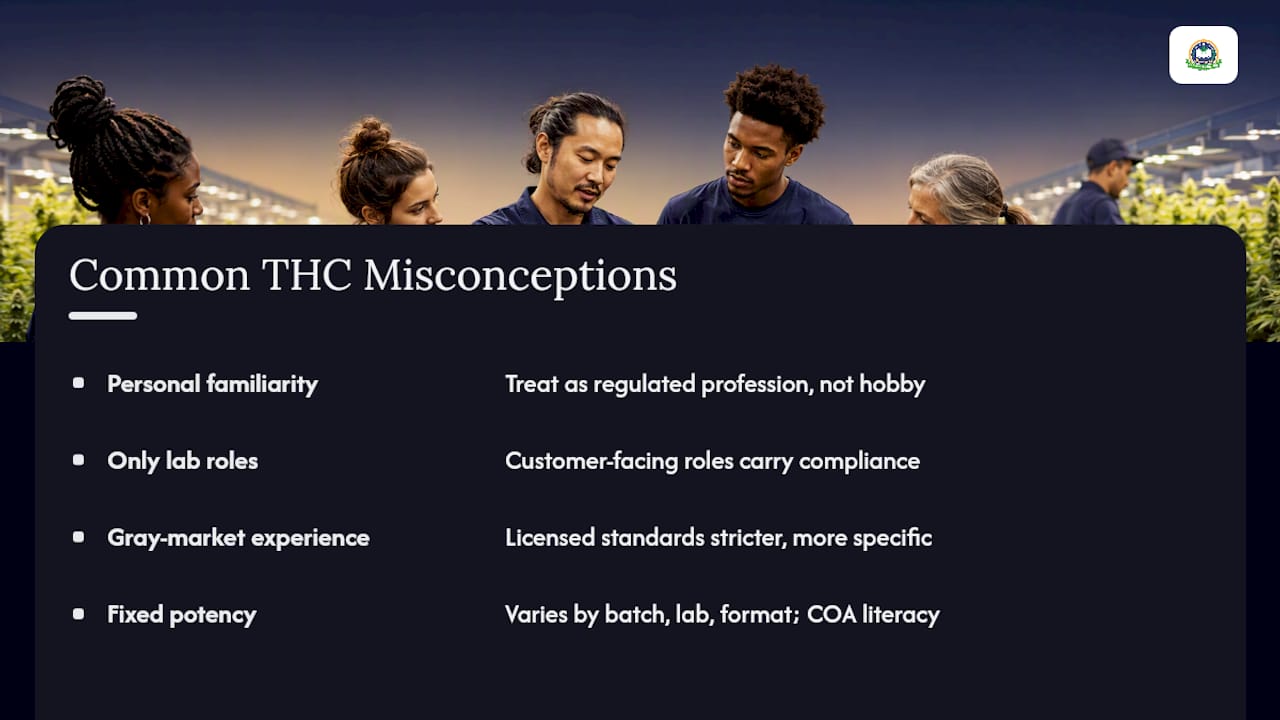
The most common misconception is that personal familiarity with cannabis products equates to professional qualification. In the licensed beverage sector, employers seek professionals who approach cannabis with the same rigor as a pharmacy or commercial kitchen. Another myth is that only lab or production roles require technical knowledge; in reality, a retail lead or server who misinterprets a COA for a beverage creates significant liability. Similarly, experience from "gray market" settings rarely transfers directly, as licensed production demands stricter documentation and labeling compliance. Finally, some candidates view THC potency as a static number. In the beverage world, potency is a variable measurement that shifts by batch and format—understanding this variability and communicating it accurately is a core professional competency, not just a data point.
How Can Employers Assess THC-Related Skills in Interviews?
The most reliable interview technique is asking a candidate to walk through a specific scenario rather than answer a general knowledge question.
Try asking a candidate to explain what they’d do if a COA didn’t match a product label, or how they’d respond to a customer asking whether a product is “strong.” The answer reveals whether they understand potency variability, labeling accuracy, and the limits of what staff should say to customers about effects.
A short practical task works well too: hand a candidate a sample COA and ask them to summarize it in plain language, the way they would for a customer. This tests both technical comprehension and communication skills at once, without requiring a written exam.
Watch for candidates who default to vague reassurance (“it’s all good, don’t worry”) rather than specific, accurate information. That gap often signals a comfort with cannabis culturally but a gap in regulatory seriousness.
Finally, ask about a time they caught an error in a process, whether in a cannabis job or another regulated field like food service or healthcare. The specifics of the story usually matter more than the industry it came from.
MNCC’s Perspective: Building Careers, Not Just Filling Jobs
We see THC education as workforce training that opens real careers, supports equity for communities disproportionately affected by cannabis prohibition, and reduces hiring friction for Minnesota employers who need workers who show up ready. Our tuition-free programs and free job board exist to make that connection faster and fairer for everyone involved.
Ready to Start? Here’s How Students and Employers Get Moving
MNCC is the tuition-free path into Minnesota’s licensed cannabis workforce, built specifically to connect trained candidates with employers who need them, without the cost barrier that keeps many people out of career training altogether.
If you’re a prospective student, here’s the quickest path forward:
- Explore MNCC’s current tracks in retail operations, cultivation, or manufacturing
- Confirm your eligibility and gather basic documentation
- Apply and schedule an intake conversation to map out your timeline
If you’re an employer, here’s your checklist:
- Post open roles on the free MNCC job board at mncannabiscollege.org/jobs
- Reach out about employer partnerships to help shape training around your actual hiring needs
- Consider hosting a hands-on lab session or site visit for current students
Whether you’re stocking shelves with product from a supplier or building your first cultivation team, understanding how THC-infused beverages and other formats reach retail shelves, like those covered in 23rd State’s wholesale program, can round out a new hire’s product knowledge once they’re trained and on the job.
Visit MNCC’s programs page to see current enrollment windows and start your application today.
Sources
These sources informed this guide and offer more detail for students and employers researching cannabis career paths:
- Cannabis Industry Career Guide | MSU Denver
- Cannabis Career Exploration | Department of Labor
- How to Get a Job in the Cannabis Industry: A 2026 Guide | The Purple Leaf
- Working in Cannabis - How to & Salaries
For enrollment or employer partnerships, MNCC’s main site remains the primary starting point. These links support further reading and are not endorsements of consumer products.
FAQ
What Does “THC Perry” Mean in a Career Context?
It refers to job-focused THC education, the practical knowledge people need for licensed cannabis roles in retail, cultivation, or manufacturing, not product listings or retail menus.
Do I Need Prior Cannabis Experience to Get Hired?
No. Most entry-level roles value transferable skills from retail, hospitality, or agriculture over direct cannabis experience, according to The Purple Leaf’s industry guide.
Which Cannabis Jobs Require the Most Technical THC Knowledge?
Extraction and quality assurance roles typically require the deepest technical knowledge, often including formal lab or chemistry coursework, while retail and cultivation roles lean more on transferable skills.
Is MNCC Training Really Tuition-Free?
Yes. MNCC offers tuition-free training programs in retail operations, cultivation, and manufacturing for eligible enrollees, paired with a free job board connecting graduates to Minnesota employers.
How Can Employers Find Trained Candidates?
Employers can post open roles directly on the MNCC job board at mncannabiscollege.org/jobs or reach out about partnership opportunities to help shape training around specific hiring needs.
