

Yes, liposomal cannabinoid beverages are worth it for most shoppers — they deliver faster, more predictable absorption than plain oil-in-water drinks, and the best ones taste clean with no oily aftertaste. If you want a single place to start, 23rd State’s SHAKE is the pick: it’s a clear, shelf-stable liposomal beverage with a precise per-serving cannabinoid dose and a flavor profile bright enough to enjoy on its own.
Before you buy anything, check the label for three things:
- Per-serving milligrams of Δ9 THC and CBD (not just total per bottle)
- A scannable COA (Certificate of Analysis) link from a third-party lab
- Visible clarity in the bottle — no oil rings, no separation
The short version: A well-formulated liposomal drink should look like sparkling water, not a salad dressing. If it separates, the dose separates with it.
Key Takeaways
Liposomal cannabinoid beverages offer meaningfully better absorption than plain oil-in-water drinks, and a quality product proves it with a third-party COA, clear particle-size data, and a stable, transparent liquid.
| Point | Details |
|---|---|
| Absorption advantage is real | Liposomal CBD showed 8-fold higher dissolution than crystalline CBD in comparative lab testing. |
| Particle size signals quality | Look for 20–100 nm range on the label; smaller particles generally mean better uptake. |
| Onset is faster than edibles | Expect 15–40 minutes for liposomal beverages vs. 45–90 minutes for standard oil edibles. |
| COA is non-negotiable | Confirm Δ9 THC per serving and a full contaminant panel before purchasing any product. |
| 23rd State’s top pick | SHAKE delivers a precise, consistent dose in a clear, shelf-stable liposomal format. |
Table of Contents
- What does “liposomal cannabinoids” actually mean for drinks?
- How liposomal encapsulation changes cannabinoid absorption
- How to separate credible liposomal products from marketing claims
- What to expect from onset, peak, and duration
- Safety and U.S. legal basics every buyer should know
- Storage, shelf life, and serving tips
- How to choose a true liposomal beverage before you buy
- A note from 23rd State on why we built a liposomal beverage
- Ready to try 23rd State’s liposomal line?
- Sources
- FAQ
What does “liposomal cannabinoids” actually mean for drinks?
Liposomal cannabinoids are cannabinoid molecules (CBD, Δ9 THC, CBG, and others) wrapped inside tiny phospholipid bubbles called liposomes. Phospholipids are the same fats that make up your cell membranes, so they’re naturally compatible with your body. The encapsulation keeps the cannabinoid suspended evenly in water — something raw cannabis oil simply cannot do on its own.
This is different from a plain oil-in-water infusion, where oil droplets float freely and tend to separate. It’s also distinct from a nanoemulsion, which uses surfactants to break oil into ultra-fine droplets without a full phospholipid shell. Industry primers note that nanoemulsions often carry higher active loading and produce transparent beverages, while liposomes offer a protective shell that can shield cannabinoids through digestion — a genuine trade-off worth knowing.
Two label signals that tell you a brand is being honest about its technology:
- Particle size reported (ideally in nanometers, e.g., “~85 nm average”)
- Third-party COA covering both potency and contaminants, not just one
Worth knowing: “Nano” alone on a label means nothing without a particle-size figure or a COA to back it up. It’s a marketing word until proven otherwise.
How liposomal encapsulation changes cannabinoid absorption
Raw cannabinoids are fat-soluble. Your gut is mostly water. That mismatch is why a plain CBD oil capsule can feel inconsistent — some days it hits, some days it doesn’t, depending on what you ate. Liposomal encapsulation addresses this by wrapping the cannabinoid in a water-compatible shell, improving its apparent solubility and helping it survive the trip through your digestive system.
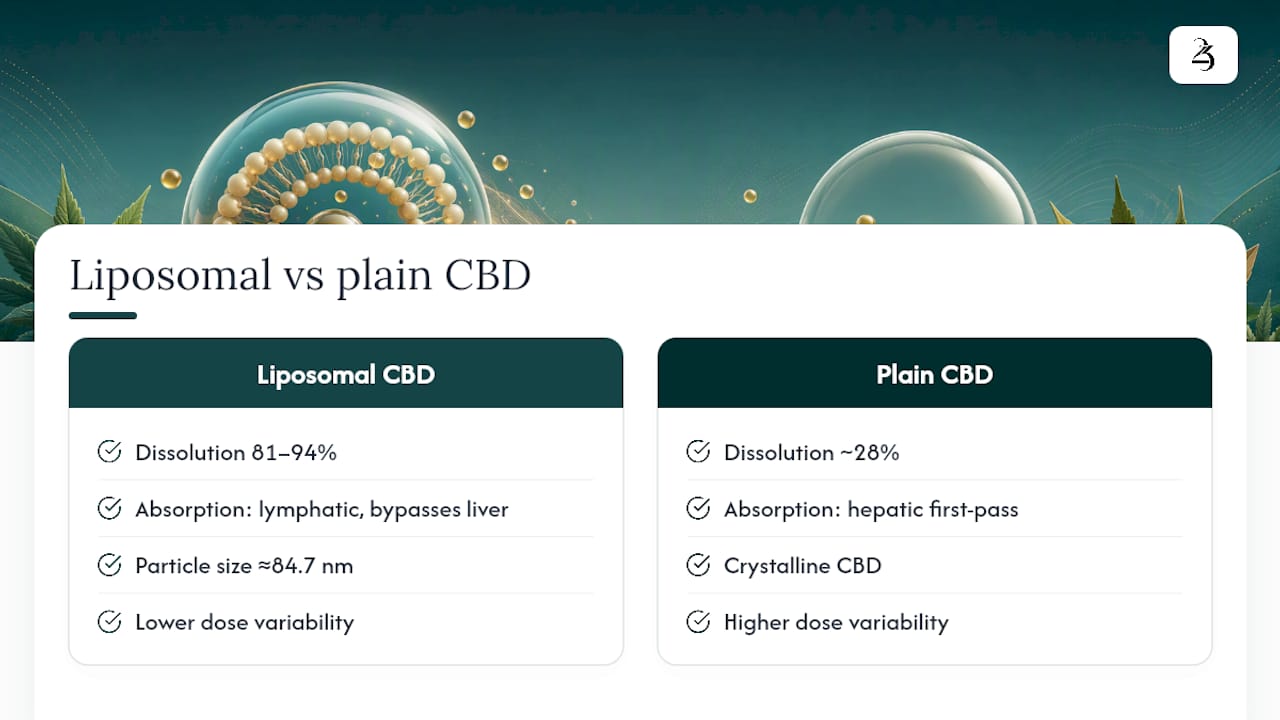
Once the liposome reaches your small intestine, it can be absorbed via lymphatic pathways rather than going straight through the liver — which is where a lot of unformulated cannabinoids get broken down before they ever reach your bloodstream. Smaller particles move through biological membranes more easily: according to industry experts, engineered liposome sizes in a nanometric range are generally associated with improved uptake. A peer-reviewed nano-CBD study confirmed a particle size of approximately 84.7 nm with enhanced dissolution at duodenal pH under simulated GI conditions.
The absorption difference can be substantial. A comparative study on CBD solubilizing systems found that a liposomal CBD formulation produced a substantially higher dissolution amount than crystalline CBD and delivered markedly higher oral absorption. Separately, in vitro testing showed liposomal formulations reaching 81–94% dissolution in simulated intestinal fluid, compared to roughly 28% for a plain CBD tablet under the same conditions.
Pro Tip: Expect less dose-to-dose variability with a quality liposomal drink than with a standard oil tincture — but eat something light beforehand. A completely empty stomach can still affect how quickly you feel the onset.
How to separate credible liposomal products from marketing claims
Green lights — what a quality product shows you:
- Particle size or encapsulation method stated on the label or product page
- Crystal-clear appearance with no visible oil droplets or cloudiness (a well-formulated beverage should be effectively invisible in solution)
- Third-party COA covering potency (Δ9 THC per serving, total cannabinoids) and contaminants
- GMP manufacturing disclosure or facility information
- Refrigeration or shelf-stability instructions that match the formulation type
- Clear per-serving mg for each cannabinoid, not just per bottle
Red flags — walk away if you see these:
- “Nano” or “liposomal” with no particle-size data and no COA link
- Cloudy liquid with visible oil separation at the top
- Unsupported claims like “10x faster than any other product” with no lab data
- COA that only shows potency but skips pesticides, heavy metals, and residual solvents
What to expect from onset, peak, and duration
Liposomal beverages typically onset faster than traditional oil-based edibles, though individual results vary with metabolism, body weight, and meal state. They’re generally slower than inhalation but more predictable than a standard gummy.
| Dose (Δ9 THC) | Typical onset | Peak window | Best occasion |
|---|---|---|---|
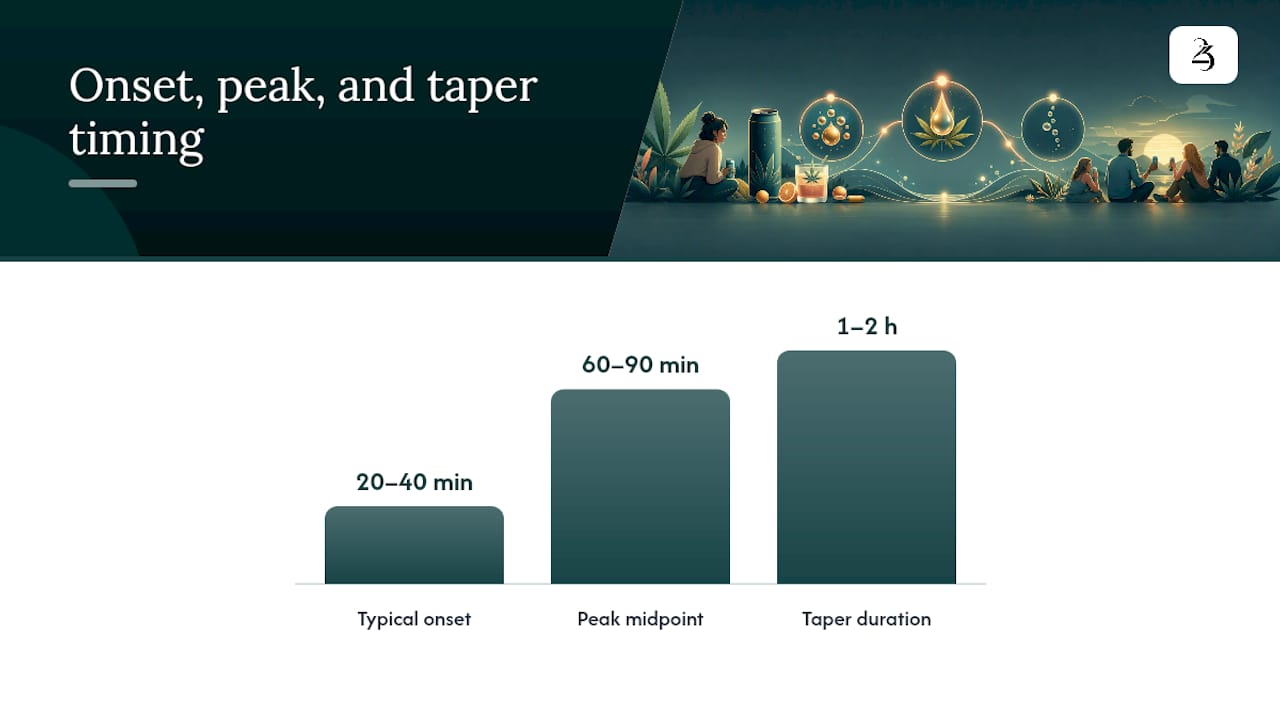
| 2 mg | 20–40 min | 60–90 min | First-timer, social brunch |
| 5 mg | 20–40 minutes | 60–90 minutes | Friday wind-down, casual gathering |
| 10+ mg | 20–40 minutes | 60–90 minutes | Experienced users, long evening |
Clinical pharmacokinetic research on bioavailability-enhanced CBD formulations shows that advanced encapsulation can increase peak blood concentration (Cmax) and total exposure (AUC) several-fold versus unformulated CBD, and reduce variability between individuals — meaning your second can should feel a lot like your first.
A simple timeline to plan your occasion: open the can → feel onset around 20–40 minutes → peak around 60–90 minutes → gentle taper over the following hour or two. That arc fits a brunch, a sunset hang, or a wind-down perfectly.
Safety and U.S. legal basics every buyer should know
Hemp-derived products sold in the U.S. must contain no more than the federally legal limit for Δ9 THC on a dry-weight basis to qualify as hemp. Your COA should confirm the Δ9 THC per serving in milligrams — not just a percentage — so you know exactly what you’re consuming.
Common side effects at low-to-moderate doses include mild drowsiness, dry mouth, and a relaxed feeling. At higher doses, some people experience increased heart rate or mild anxiety. If you take prescription medications, check with a healthcare provider before adding cannabinoids to your routine, since cannabinoids can affect how certain drugs are metabolized.
Federal hemp rule: Hemp-derived Δ9 THC is federally legal at or below 0.3% dry-weight, but state laws vary. Check your state’s current rules before purchasing, especially for products with higher per-serving THC doses.
Pro Tip: If you’re pregnant, nursing, or under 21, skip cannabinoid beverages entirely until you’ve spoken with a doctor. No serving size makes them appropriate in those situations.
Storage, shelf life, and serving tips
Liposomal beverages fall into two camps: refrigerated and shelf-stable. Refrigerated products typically use fewer preservatives and rely on cold temperatures to keep the phospholipid shell intact. Shelf-stable versions often incorporate hybrid encapsulation approaches — combining liposomal protection with self-nanoemulsifying agents — to extend product life at room temperature.
Practical storage rules:
- Follow the label. If it says refrigerate, refrigerate from day one.
- Keep away from direct sunlight and heat above 75°F, which can degrade both the cannabinoids and the liposome structure.
- Don’t shake unless the label instructs it — agitation can disrupt a well-formed emulsion.
- Consume within the manufacturer’s recommended window after opening.
Pro Tip: Serve liposomal beverages cold. Beyond tasting better, a lower temperature helps maintain particle stability and keeps the liquid clear. A warm, shaken can is more likely to show separation — and uneven dosing.
How to choose a true liposomal beverage before you buy
Must-haves (non-negotiable):
- COA link on the product page — potency and contaminants, from an accredited third-party lab
- Per-serving Δ9 THC and CBD in milligrams, clearly labeled
- Visible clarity in product photos or description (no oil separation)
Nice-to-haves (worth asking about):
- Reported particle size in nanometers
- GMP-certified manufacturing facility
- Stated shelf life and storage method
The single best question to ask customer support: “Can you share the COA that shows particle-size testing and Δ9 THC per serving?” A brand that answers quickly with a real document is a brand that knows what’s in its product.
On price: a higher cost per mg is justified when it comes with verified manufacturing, a full-panel COA, and a stable, clear formulation. Cheap liposomal claims with no documentation are just expensive oil water.
Pro Tip: Use the hemp edibles dosing guide to cross-reference serving sizes before committing to a new product.
A note from 23rd State on why we built a liposomal beverage
We built our liposomal line around three things: taste, predictability, and stability. A cannabinoid drink that separates in the bottle or tastes like a supplement isn’t something you reach for on a Friday night — it’s something you tolerate. That’s not the experience we’re after.
SHAKE is our go-to for social moments: bright, effervescent, and formulated for a consistent dose whether you’re sharing with friends or cracking one solo after work. FRESH PRESS leans daytime — lighter, citrus-forward, and dosed for a clear-headed lift that fits a brunch or an afternoon on the patio. Blush Crush is the wind-down pick, a rose-tinted, slightly sweet option that pairs well with a slow evening.
Honest note: if you need near-instant onset (under 10 minutes), a vape or sublingual tincture still gets there faster. Liposomal beverages are the better call when you want something social, sippable, and predictable — not the fastest possible delivery. For a deeper look at how cannabinoids interact with your body, the 23rd State cannabinoid science guide is worth a read.
Ready to try 23rd State’s liposomal line?
Shoppers who want a clear, lab-verified, great-tasting liposomal cannabinoid beverage will find exactly that at 23rd State.
- SHAKE — social, effervescent, consistent dose per can; the crowd-pleaser
- FRESH PRESS — daytime-friendly, citrus-bright, dosed for clarity
- Blush Crush — soft, rosy, and perfect for winding down
Head to 23rd State and pull up the product page for whichever SKU fits your moment. Check the COA tab, confirm the per-serving Δ9 THC, and look at the storage instructions before you add to cart. Everything you need to buy with confidence is right there.
Sources
- Capitalizing on Cannabinoid Emulsification Methods | Prepared Foods
- PMC — Nano-CBD liposome study (open access)
- Formulation and in vitro evaluation of liposomal and self-microemulsifying drug delivery systems for oral delivery of cannabidiol
- Science for product makers: the difference between micelles, emulsions, liposomes, and lipid nanoparticles | Vertosa
FAQ
What are liposomal cannabinoids in a drink?
Liposomal cannabinoids are CBD, THC, or other cannabinoids encapsulated in phospholipid shells (liposomes) that keep them evenly suspended in water, improving absorption compared to plain oil-in-water infusions.
How fast do liposomal cannabinoid beverages kick in?
Most shoppers feel onset within 15–40 minutes, faster than a standard oil-based edible but slower than inhalation. Meal state and individual metabolism affect timing.
Are hemp-derived liposomal drinks legal in the U.S.?
State laws vary, so check your state’s current rules and confirm per-serving THC on the product’s COA.
What should a COA for a liposomal beverage include?
A complete COA covers potency (Δ9 THC and total cannabinoids per serving), plus contaminants: pesticides, heavy metals, residual solvents, and microbials. Potency-only COAs are a red flag.
Which 23rd State product is best for a first-timer?
SHAKE is the most approachable starting point: clear, precisely dosed, and formulated for a consistent, social-friendly experience without overwhelming onset.
