

E-commerce is the strategic backbone of every modern hemp brand: it builds awareness, captures first-party customer data, and converts canna-curious buyers into repeat customers. Your three immediate priorities are compliance (platform policies, payments, and shipping rules), payment stability with a documented evidence package, and transparent product education anchored by published Certificates of Analysis (COAs). This guide maps each of those priorities to concrete tactics, business model choices, and a 90-day action plan you can start this week.
- Compliance first. Platform acceptable-use policies, payment processor underwriting, carrier rules, and state-level restrictions each function as independent gates. Clear one and you still have three more to clear.
- Payment stability. Mainstream processors like Stripe and Square routinely reject hemp merchants. Specialist processors with guided onboarding and dispute-management tools are the only reliable path forward.
- Trust through education. Publishing COAs and dosage guides converts uncertain shoppers into confident buyers and loyal subscribers.
Pro Tip: Before you write a single product description, confirm your payment processor is hemp-specific and your COAs are live on every product page. Those two steps prevent the most common launch failures.
Table of Contents
- How does e-commerce shape hemp and THC beverage brands?
- What compliance and payment constraints block hemp e-commerce?
- How does e-commerce convert canna-curious buyers into loyal customers?
- What platform and tech features does hemp e-commerce require?
- How do shipping and age verification work in practice?
- Which business model fits your hemp brand: DTC, subscription, or wholesale?
- Eight actions to stabilize and scale hemp e-commerce in 90 days
- How 23rd State uses e-commerce to convert canna-curious buyers
- Key Takeaways
- Useful sources and further reading
- 23rd State brings the celebration to your doorstep
- FAQ
How does e-commerce shape hemp and THC beverage brands?
Online selling does five distinct jobs for hemp businesses, and understanding each one helps you allocate budget and attention correctly.
- Demand generation and sampling. A well-built product page reaches a canna-curious shopper who has never walked into a dispensary. DTC e-commerce accounts for an estimated 35–45% of U.S. retail sales for hemp-derived CBD consumer products, making it the single largest channel by volume. For beverage brands, that share is meaningful but not permanent.

2. Education and trust. Brands that publish COAs and demystify lab results see higher conversion among first-time buyers. A product page that explains onset time, dosage, and what the cannabinoid profile actually means does the work a retail shelf never could.
3. First-party data and CRM. Every checkout, email opt-in, and quiz response is a data point you own. Unlike retail, DTC gives you a direct line to your customer for reorder reminders, flavor launches, and loyalty rewards.
4. Subscription and repeat revenue. Subscription billing turns a single curious purchase into predictable monthly revenue. For hemp beverages, where margins are tight and shipping costs are real, repeat buyers are the economics that make DTC viable.
5. Bridge to retail and wholesale. DTC is often a discovery channel, not the end state. Analyst commentary consistently frames beverage DTC as a proof-of-concept play before brands pursue retail distribution aligned with the three-tier alcohol model.
| Channel / Segment | Estimated U.S. Share |
|---|---|
| DTC e-commerce (all hemp CBD) | 35–45% of retail sales |
| Tinctures and oils | 30–35% of market revenue |
| Topicals | 25–30% of market revenue |
| Edibles (including beverages) | 20–25% of market revenue |
Source: IndexBox U.S. Hemp-Derived Cannabidiol Market Report
The table makes one thing clear: DTC is dominant today, but edibles and beverages hold the smallest product-segment share. That gap is exactly why e-commerce trends in hemp point toward hybrid models rather than pure DTC for beverage brands.
What compliance and payment constraints block hemp e-commerce?
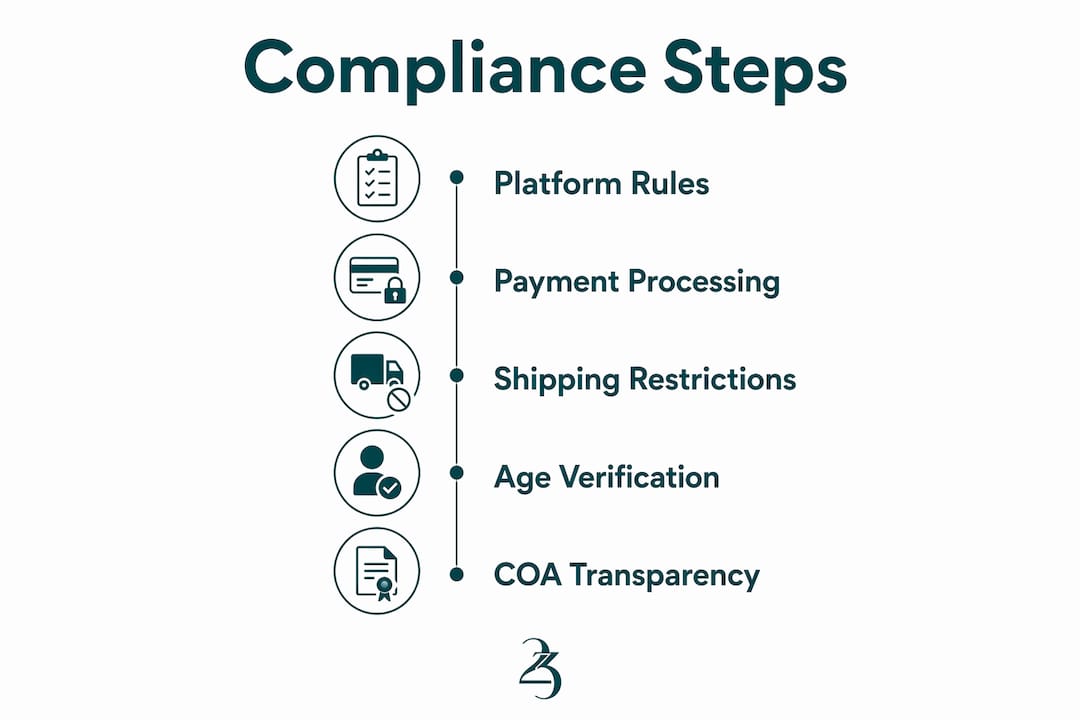
Four independent gates stand between your product and a completed sale. Clearing all four simultaneously is the operational challenge that separates brands that scale from brands that stall.
The four gates every hemp merchant must clear
Gate 1: Platform acceptable-use policies. Shopify, BigCommerce, and WooCommerce each publish their own rules for hemp and THC products. Being approved on one platform does not transfer to another, and platform-specific constraints change with little notice. WooCommerce offers the most flexibility because you control the hosting environment; Shopify’s hosted model means a policy update can affect your store overnight.
Gate 2: Payment processor underwriting and card-network risk programs. Mainstream processors often reject hemp merchants not because of federal illegality but because of historical chargeback and fulfillment issues in the category. Specialist processors provide guided onboarding, transparent pricing, and dispute-management tools that mainstream gateways simply do not offer for hemp. Card networks also run their own risk programs that monitor dispute rates and subscription behaviors independently of your processor relationship.
Gate 3: Carrier and shipping rules. UPS, FedEx, and USPS each have their own documentation requirements for hemp shipments. Required documents typically include COAs, batch numbers, and hemp compliance certificates. Carrier policies shift, and a shipment that cleared last quarter may trigger a hold today.
Gate 4: State-level product and shipping restrictions. A “legal in all 50 states” claim is almost never accurate for delta-8, HHC, THCA, or full-spectrum CBD with measurable THC. In 2025 alone, at least 14 states modified their hemp regulations, some with minimal advance notice. Treat every SKU as having its own shipping-lane map and update it as state rules change.
Compliance checklist for hemp merchants
- Publish COAs for every active SKU, linked directly from the product page
- Implement age-gating at storefront entry with a defensible audit trail
- Build a SKU-level shipping routing table and block checkout for non-compliant state/product combinations
- Review all marketing claims against FDA guidance (no health or drug claims)
- Monitor dispute rates and subscription cancellation metrics monthly
- Maintain a documented evidence package: COAs, fulfillment proof, customer support records
Pro Tip: Integrate lot-level traceability between your inventory system and your COA database so every sold batch can be matched to its lab results. This single step reduces both compliance risk and dispute exposure, and it gives underwriters the documentation they need to approve your account.
Payment risk deserves its own paragraph. Age-gating alone is not enough: card-network risk programs monitor dispute rates and subscription behaviors, and merchants have lost processor access because of those metrics even when their storefront was technically compliant. Build an evidence package from day one: COAs, shipping confirmations, customer support logs, and return records. That package is what an underwriter reviews when deciding whether to keep your account open.
How does e-commerce convert canna-curious buyers into loyal customers?
The conversion funnel for a first-time hemp shopper looks different from almost any other category. Uncertainty is the primary friction point, not price. Your product page has to answer three unspoken questions before a nervous newcomer will add to cart: Is it safe? How strong is it? How will it make me feel?
Educational assets map to each funnel stage. At the awareness stage, SEO-optimized blog content and social proof bring shoppers in. At consideration, COAs, dosage guides, and ingredient explainers do the heavy lifting. At conversion, clear labeling, third-party testing badges, and a quick FAQ close the sale.
How to build a product page that educates and converts
- Publish the COA prominently. Link it from the product image or a dedicated “Lab Results” tab. Shoppers who find COAs buried in a footer rarely trust them.
- Explain onset and dosage in plain language. “You may feel effects in 15–45 minutes; start with one serving” is more useful than a cannabinoid percentage alone.
- Show the full cannabinoid profile. Delta-9 THC, CBD, CBG, and minor cannabinoids all matter to an informed buyer. Display them visually.
- Include third-party testing badges. ISO/IEC 17025-accredited lab logos signal rigor without requiring the shopper to read a full report.
- Add a short FAQ on the product page. Answer “Will this get me high?”, “Is this legal in my state?”, and “What does it taste like?” directly on the page.
- Use sensory language. Describing a beverage as “bright citrus with a clean, easy finish” tells a newcomer more than “flavored hemp drink.”
Pro Tip: Frame your COA data around those three customer questions. Pull the delta-9 THC number for “How strong is it?”, highlight the pesticide-free and heavy-metals results for “Is it safe?”, and use tasting notes and onset language for “How will it make me feel?” That framing turns a compliance document into a conversion asset.
Content formats that work well for digital marketing for hemp brands include lab-results visuals (a clean graphic of the cannabinoid panel), short micro-videos showing tasting notes and pour moments, and dosage comparison widgets that let shoppers self-select their experience level. Each format reduces uncertainty and moves the shopper one step closer to checkout.
What platform and tech features does hemp e-commerce require?
Your tech stack has to do things a standard Shopify store does not need to worry about. Here is what to build or buy before you launch.
Must-have features
- SKU-level jurisdiction flags that block checkout when a product cannot legally ship to the buyer’s state
- Age verification with an audit trail (third-party services like Veratad, IDology, or Jumio provide defensible records)
- Subscription billing with chargeback controls and clear cancellation flows to keep dispute rates low
- COA integration so lab results update automatically when a new batch is tested
- Role-based content moderation to flag marketing copy that edges toward health claims before it goes live
- Robust returns flow with photographic evidence capture in the RMA process
Vendor selection criteria
When evaluating platforms and gateways, ask these questions:
- Does the platform allow hemp/THC products in your specific product category without requiring a workaround?
- Is the payment gateway hemp-specific, with guided onboarding and transparent fee structures?
- Does the gateway offer chargeback prevention tools and responsive support when holds occur?
- Can the stack integrate with your ERP, warehouse management system, and COA database?
Pro Tip: For early-stage brands that need speed, a hosted platform with a specialist gateway gets you to market faster. For brands that have hit $1M+ in revenue and need more control, a headless WooCommerce build with a specialist processor gives you the flexibility to customize compliance logic at the SKU level without platform policy risk.
Regulated e-commerce categories like hemp are growing online precisely because specialized payment providers have reduced underwriting friction. The infrastructure exists. The question is whether you vet it properly before you need it.
How do shipping and age verification work in practice?
Logistics is where compliance theory meets operational reality. A compliant product page means nothing if the wrong SKU ships to a restricted state or a package arrives without age verification at the door.
Shipping compliance checklist
- Build a routing table that maps every SKU to the states where it can legally ship, and update it when state laws change
- Include COAs and batch numbers in every shipment’s documentation
- Confirm carrier requirements for your specific product type before onboarding (UPS, FedEx, and USPS each have distinct documentation standards)
- Block checkout at the cart level for state/SKU combinations that are non-compliant, rather than catching errors at fulfillment
Age verification runs at two points: front-end gating when the shopper enters the site, and delivery-age verification when the package arrives. Front-end gating alone does not satisfy carrier requirements for age-restricted products. Keep records of both verification events for audit purposes.
Returns and refunds deserve a tighter policy than most brands write. A clear inspection window (typically 30 days), a restocking policy, and photographic evidence captured in the RMA flow all reduce chargeback risk. When a customer disputes a charge, your evidence package, including the return record and delivery confirmation, is what keeps the dispute from becoming a processor termination trigger.
Pro Tip: Treat your SKU routing table as a live document, not a launch-day spreadsheet. Assign one person to monitor state regulatory updates weekly. Real-time compliance verification tools can automate this across all 51 jurisdictions and update your checkout flow automatically when a state changes its rules.
Which business model fits your hemp brand: DTC, subscription, or wholesale?
The right revenue mix depends on your product format, margin structure, and growth stage. Here is how the main models compare for hemp brands.
| Model | Pros for Hemp Brands | Cons for Hemp Brands |
|---|---|---|
| DTC (direct-to-consumer) | Full margin, first-party data, brand control | Shipping cost-sensitive for beverages; payment risk |
| Subscription | Predictable revenue, lower CAC over time | Dispute risk if cancellation is hard; chargeback scrutiny |
| Wholesale / retail partnerships | Scale and reach without shipping complexity | Lower margin, less customer data, retailer compliance burden |
| Hybrid (DTC + retail) | Balances discovery with sustainable economics | Operational complexity; channel conflict risk |
For beverage brands specifically, DTC economics are challenging. A 12-pack of canned beverages is heavy and fragile, which means shipping costs eat margin fast. Many analysts frame beverage DTC as a customer-acquisition play: you use it to build brand awareness and loyalty data, then convert those customers to retail purchases once distribution is in place.
The portfolio strategy that works best mixes formats. Pair a lighter, lower-cost-to-ship SKU (like a glitter-drop edible or a tincture) with your beverage line in DTC bundles. The lighter SKU carries the margin; the beverage drives the brand experience. Subscriptions work best on the lighter SKUs where shipping economics are favorable and the repeat-purchase cycle is predictable.

Eight actions to stabilize and scale hemp e-commerce in 90 days
- Secure a specialist payment processor (high impact, high complexity). Submit a full underwriting package: COAs, business license, fulfillment proof, and customer support records. Target processor approval within 30 days.
- Build your SKU shipping routing table (high impact, medium complexity). Map every product to the states where it can legally ship. Block non-compliant combinations at checkout. Success indicator: zero manual shipping overrides at fulfillment.
- Publish COAs on every product page (high impact, low complexity). Link directly from the product image or a dedicated tab. Success indicator: COA link visible without scrolling on mobile.
- Implement age-gating with an audit trail (high impact, medium complexity). Use a third-party verification service and log every verification event. Success indicator: audit log accessible for any order within 60 seconds.
- Set up subscription billing with dispute controls (medium impact, medium complexity). Configure clear cancellation flows and set dispute-rate alerts at 0.5% (well below card-network thresholds). Success indicator: first subscription cycle completes without holds.
- Define your customer support SLA and evidence flow (medium impact, low complexity). Every support ticket should generate a timestamped record. Success indicator: evidence package for any order retrievable in under five minutes.
- Test your full platform and gateway integration (high impact, high complexity). Run test transactions across every product category and shipping destination. Success indicator: no holds on test transactions; COA data populates correctly.
- Launch first-party CRM and tracking (medium impact, medium complexity). Capture email at checkout, set up post-purchase flows, and tag customers by product category. Success indicator: first automated post-purchase email sends within 24 hours of order.
For a step-by-step store launch and optimization guide, 23rd State’s education hub covers platform setup, payment onboarding, and compliance frameworks in detail.
How 23rd State uses e-commerce to convert canna-curious buyers
23rd State built its DTC approach around one insight: the canna-curious shopper needs permission to feel confident, not just a product to buy. That means every product page leads with education, not just a purchase button.
The SHAKE line is the clearest example of this in action. Each SKU targets a distinct moment and buyer type:
- SHAKE Emerald (green) serves as the acquisition SKU. Its bright, fresh profile and approachable dosage make it the natural entry point for first-time buyers who want something fun and low-stakes. The product page leads with tasting notes and a plain-language dosage guide before the COA appears.
- SHAKE 24k (gold) anchors the premium tier. Its golden visual and richer profile position it as the upgrade for a buyer who has already tried the category and wants a more intentional experience. It works well as a subscription SKU because repeat buyers know exactly what they are getting.
- SHAKE Cosmo (pink) drives repeat purchase through flavor-forward creativity. Its rose-blush aesthetic and playful personality make it the social SKU: the one shoppers photograph, share, and reorder for brunches and celebrations.
The UX changes that drove engagement were straightforward: COA links moved from the footer to the product image area, dosage guidance was rewritten in conversational language, and a short FAQ answered the three core questions (“Is it safe?”, “How strong is it?”, “How will it make me feel?”) directly on the page. Payments onboarding used a specialist processor with a full evidence package submitted at launch, which avoided the holds that typically delay new hemp merchants. Fulfillment routing was built SKU-by-SKU from day one.
Pro Tip: Use your SHAKE SKUs as a natural sampling ladder. Offer SHAKE Emerald as the entry point in a first-purchase bundle, then trigger a post-purchase email introducing SHAKE 24k and SHAKE Cosmo as the next step. That sequence converts a one-time buyer into a subscriber without a hard sell.
Key Takeaways
E-commerce’s role in the hemp industry comes down to one discipline: treat compliance and customer education as your primary competitive advantages, not afterthoughts.
| Point | Details |
|---|---|
| DTC dominates but has limits | DTC accounts for an estimated 35–45% of U.S. hemp CBD retail sales; beverage brands need hybrid models because shipping economics differ from tinctures. |
| Four gates, not one | Platform policies, payment processors, carriers, and state rules each function independently; clearing one does not guarantee the others. |
| COAs convert | Publishing Certificates of Analysis and plain-language dosage guides directly improves conversion for first-time buyers. |
| Payments need specialist partners | Mainstream processors routinely reject hemp merchants; specialist processors with guided onboarding and dispute tools are the reliable path. |
| 23rd State’s SHAKE line | SHAKE Emerald, SHAKE 24k, and SHAKE Cosmo each serve a distinct role in the acquisition, premium, and repeat-purchase funnel. |
The compliance-first approach is also the brand-building approach
Here is the thing most hemp brands get backwards: they treat compliance as a tax on growth, a box to check before the fun starts. At 23rd State, we see it the other way around. The brands that publish clean COAs, explain their dosing honestly, and build payment infrastructure that does not collapse mid-campaign are the ones that earn real loyalty. The canna-curious shopper is not looking for a brand that hides behind fine print. They want someone who will tell them exactly what is in the can, how it will feel, and why it is worth cracking open on a Friday night. That transparency is not just good compliance. It is good hospitality. And hospitality is what turns a curious first purchase into a standing order.
Useful sources and further reading
A short list of authoritative U.S. resources for hemp e-commerce compliance, payments, and market data:
- HempData Hemp E-Commerce Compliance Checklist — Covers product legality, shipping, payment processing, labeling, and age verification requirements by state. The most practical single-page compliance reference available.
- HempData Hemp Compliance Checklist 2026 — Focuses on lot-level traceability and COA integration into inventory systems; essential for brands managing multiple SKUs across multiple states.
- HempData: Why Hemp Websites Need Real-Time Compliance Verification — Explains why static “legal in all 50 states” claims are a liability and how automated verification tools protect against enforcement actions.
- Bankful: CBD Payment Processing in 2026 — The most thorough publicly available guide to hemp payment processor vetting, underwriting documentation, and dispute-rate management.
- Brewbound: THC Drinks and DTC Economics — Analyst perspective on why beverage DTC is a discovery channel, not a long-term business model, and what retail distribution alignment looks like.
- 23rd State Education Hub: Cannabis E-Commerce Guide — 23rd State’s own compliance-focused guide covering age verification, payment processing, and platform setup for hemp and THC online stores.
- 23rd State: 2025 Cannabis Trends for Wellness Shoppers — Trend framing for why online channels matter and where the hemp beverage category is heading.
23rd State brings the celebration to your doorstep
If you have spent time reading about compliance gates, payment processors, and shipping routing tables, you already know this category rewards the brands that do the work. 23rd State does that work so you do not have to wonder what is in your drink.
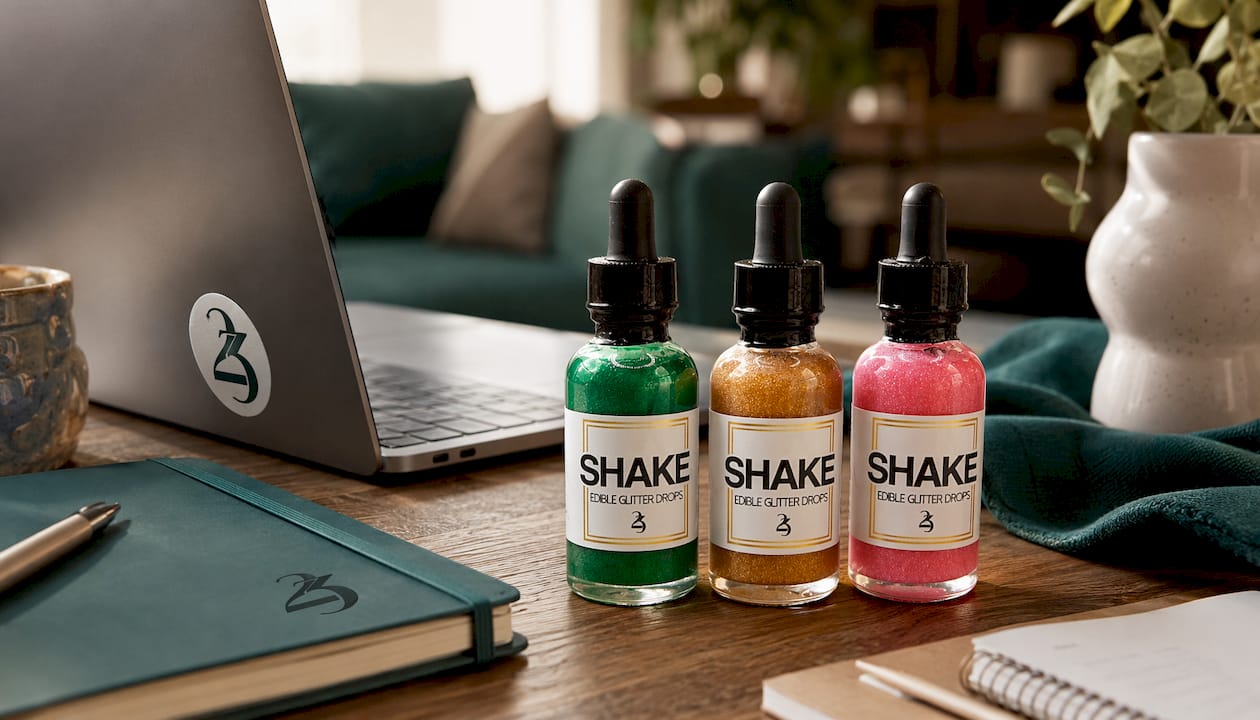
The SHAKE line, including SHAKE Emerald, SHAKE 24k, and SHAKE Cosmo, ships with full COA documentation, plain-language dosage guidance, and the kind of sensory detail that makes a first-time buyer feel like they already know what they are getting into. Whether you are stocking up for a Friday wind-down or sampling the full lineup for the first time, the product pages give you everything you need to choose with confidence. Head to 23state.com to browse the current lineup and find the SKU that fits your moment.
FAQ
What is the role of e-commerce in the hemp industry?
E-commerce serves as the primary channel for hemp brand awareness, customer education, and direct sales, accounting for an estimated 35–45% of U.S. hemp CBD retail sales. It also functions as the main platform for publishing COAs, dosage guidance, and compliance information that convert uncertain shoppers into repeat buyers.
Why do hemp brands struggle with payment processing?
Mainstream processors like Stripe and Square routinely reject hemp merchants due to historical chargeback and fulfillment issues in the category, not federal illegality. Specialist processors with hemp-specific underwriting, transparent fees, and dispute-management tools are the reliable alternative.
How does age verification work for hemp e-commerce?
Age verification runs at two points: a front-end gate when the shopper enters the site, and a delivery-age verification when the package arrives. Third-party services like Veratad, IDology, or Jumio provide defensible audit trails that satisfy both carrier requirements and platform policies.
Can hemp products legally ship to all 50 states?
No. A “legal in all 50 states” claim is almost never accurate for delta-8, HHC, THCA, or full-spectrum CBD with measurable THC. Merchants must maintain a SKU-level shipping routing table and block checkout for non-compliant state and product combinations.
How does 23state use e-commerce to build customer loyalty?
23rd State publishes COAs directly on product pages, uses plain-language dosage guides, and structures its SHAKE lineup (Emerald, 24k, and Cosmo) as a natural sampling ladder that moves first-time buyers toward subscription repeat purchases through post-purchase email flows.
