

TL;DR:
- THC can help you fall asleep faster but may cause tolerance and rebound insomnia with long-term use. Using low doses and predictable formats like hemp-derived beverages can offer short-term benefits while minimizing risks. Long-term, THC’s effects on sleep architecture are negative, especially for those without pain-related issues.
THC can help you fall asleep faster — that part is well-supported. The catch is that it also changes how you sleep, and repeated nightly use tends to create tolerance, dependency, and rebound insomnia that can leave you worse off than when you started. Short-term, low-dose use shows real promise, especially for people whose sleep is disrupted by chronic pain or anxiety. Long-term, the evidence gets murkier fast.
- Acute benefit: THC often reduces how long it takes to fall asleep and can feel deeply sedating at low doses.
- Main long-term risk: Regular use suppresses REM sleep and can trigger rebound insomnia and vivid dreams when you stop.
- Practical next step: Start low (think 2–5 mg), choose a format with predictable onset like a hemp-derived THC beverage, and plan a short, monitored trial rather than nightly use.
Table of Contents
- How does THC affect your sleep?
- What does the research actually show?
- What are the real risks of using THC for sleep?
- Forms, dosing, and timing: what changes your experience
- THC vs. CBD vs. CBN: which one actually helps you sleep?
- Who may benefit from THC for sleep, and who should avoid it?
- A safer-use checklist for your first THC sleep trial
- Key Takeaways
- Our take on THC and sleep
- Blush Crush is a great first step for a bedtime wind-down
- Useful sources and further reading
- FAQ
How does THC affect your sleep?
THC works on sleep primarily by binding to CB1 receptors in the brain, part of the endocannabinoid system that regulates arousal, anxiety, and the timing of sleep cycles. At low doses, this binding has a sedative effect: it lowers sleep onset latency (the time it takes to fall asleep), reduces anxiety that can keep you wired, and promotes slow-wave sleep (SWS), the deep, physically restorative phase. That is why so many people report feeling like they “crash” in a good way after a low-dose edible or beverage.
The sleep-stage picture is more complicated, though. THC suppresses REM sleep consistently across studies and populations. REM is the stage tied to emotional processing, memory consolidation, and dreaming. Reduce it, and you may wake feeling rested in a physical sense but emotionally flat or cognitively foggy. A high-density EEG trial in adults with insomnia found that an oral THC/CBD combination (10 mg THC + 200 mg CBD) decreased total sleep time by roughly 24.5 minutes, reduced REM sleep by roughly 33.9 minutes, and pushed REM latency out by roughly 65.6 minutes compared to placebo.
Sleep-stage snapshot with THC (acute, low dose): Short-term use → faster sleep onset, more slow-wave sleep, less REM sleep, longer REM latency. Long-term use → tolerance to SWS benefits, decreased total sleep time, increased wake-after-sleep-onset, continued REM suppression.
Dose matters enormously here. THC is sedating at low doses, stimulating at moderate doses, and can trigger anxiety or psychosis-like effects at high doses. This dose-dependent swing is one reason accidental overconsumption with edibles is so common and so disruptive to sleep. The role of cannabinoids in sleep is genuinely nuanced, and understanding the mechanism is the first step to using THC intentionally rather than just hoping for the best.
Pro Tip: If you are trying THC for sleep for the first time, aim for 2–5 mg and give it at least 90 minutes before you judge the effect. Higher doses often backfire, producing alertness or anxiety rather than calm.
What does the research actually show?
The honest bottom line: THC shows modest, real benefits for sleep onset in the short term, particularly in people dealing with chronic pain, but the evidence for long-term sleep quality improvement is weak and the adverse-event profile is real.
A systematic review of cannabis dosing for sleep covering 19 randomized studies and 12 uncontrolled trials found sleep improvements in 7 of the randomized studies and 7 of the uncontrolled trials. Crucially, those improvements were concentrated in populations with chronic pain conditions, not in otherwise healthy adults with primary insomnia. Healthy volunteers showed no consistent sleep-architecture improvements.
| Study type | Population | THC dose/ratio | Primary sleep finding | Key adverse signal |
|---|---|---|---|---|
| High-density EEG RCT | Adults with insomnia | 10 mg THC + 200 mg CBD (oral) | REM reduced ~33.9 min; total sleep time reduced ~24.5 min | REM latency increased ~65.6 min |
| Systematic review (39 RCTs) | Chronic pain patients | Variable | Small improvement in sleep quality scores | Significant increase in dizziness risk |
| Systematic review (19 RCTs + 12 uncontrolled) | Mixed (pain + primary insomnia) | Variable | Improvements in 7/19 RCTs; no consistent architecture benefit in healthy volunteers | Heterogeneity limits dosing guidance |
| Single RCT (Cousens & DiMascio) | Healthy adults with insomnia | Multiple THC doses | Reduced sleep onset latency | “Hangover effect” next morning; temporal disorganization |
A meta-analysis of randomized clinical trials in chronic pain populations found small but statistically significant improvements in sleep quality scores alongside a statistically significant increase in dizziness risk. Small improvement plus real side effects is a tradeoff worth thinking through carefully.
Where the evidence is weakest: long-term outcomes in healthy adults, objective sleep-architecture improvements (as opposed to subjective “I slept better” reports), and any consistent dosing recommendation that holds across populations. The heterogeneity across studies makes firm guidance nearly impossible, which is exactly why starting low and monitoring your own response matters so much.
Key takeaway from the research: Subjective sleep often improves. Objective sleep architecture, measured by polysomnography or EEG, often does not, and sometimes worsens. Those two things can coexist, which is part of what makes THC as a sleep aid so tricky to evaluate.
What are the real risks of using THC for sleep?
The risk-benefit balance tips unfavorably with regular use, and that is worth stating plainly before you decide to make THC a nightly ritual.
Tolerance and dependence develop faster than most people expect. The slow-wave sleep benefit fades with repeated use as the brain adapts to CB1 receptor stimulation. You need more THC to get the same effect, and then more again. Neurologist Dr. Joanna Fong-Isariyawongse describes this pattern as a “cycle of dependency” where the acute sedation masks nonrestorative sleep and the long-term dependence risk builds quietly in the background.
Rebound insomnia is the most disruptive withdrawal effect. When you stop using THC after regular nightly use, REM sleep surges back aggressively, producing vivid, often disturbing dreams and fragmented sleep that can last days to weeks. That rebound is uncomfortable enough that many people return to THC just to stop it, which is exactly how the dependency cycle reinforces itself.
Common side effects to know:
- Daytime sleepiness and grogginess (the “hangover effect” noted in clinical trials)
- Dizziness, particularly at higher doses or with edibles
- Cognitive slowing: slower reaction time, reduced working memory acuity
- Dry mouth, increased appetite
Red flags — stop use and consult a clinician if you notice:
- Worsening insomnia after the first few nights (tolerance building fast)
- Anxiety or paranoia at your usual dose
- Difficulty functioning the next day
- Any signs of dependence: feeling like you cannot sleep without it
- Mood changes, irritability, or low motivation
Drug interactions: THC is metabolized by CYP3A4 and CYP2C9 enzymes in the liver. This means it can interact with blood thinners (warfarin), some antidepressants, antiepileptics, and other sedatives. Combining THC with alcohol or prescription sleep aids amplifies sedation unpredictably and increases fall risk, particularly in older adults.
Warning: Never combine THC with benzodiazepines, opioids, or other CNS depressants without explicit guidance from a prescribing clinician. The sedative interaction is not additive — it can be multiplicative.
People with a personal or family history of psychosis, schizophrenia, or bipolar disorder should avoid THC for sleep entirely. The psychosis risk at higher doses is well-documented, and even low doses can destabilize mood in vulnerable individuals.
Forms, dosing, and timing: what changes your experience
The form you choose changes everything about your experience — onset speed, peak intensity, duration, and how easy it is to dose accurately. That variability is a major driver of accidental overconsumption and next-day grogginess.
| Form | Onset | Peak | Duration | Variability |
|---|---|---|---|---|
| Inhalation (vape/flower) | 5–15 min | 30–60 min | 2–3 hours | Moderate (technique-dependent) |
| Edibles (gummies, capsules) | 45–90 min | 2–3 hours | 4–8 hours | High (food, metabolism-dependent) |
| Sublingual tincture | 15–45 min | 1–2 hours | 3–5 hours | Moderate |
| THC beverage | 15–45 min | 1–2 hours | 2–4 hours | Lower (consistent per-can dosing) |

Edibles are a popular sleep format because they last longer, but their onset can be variable and delayed, sometimes causing dosing challenges that may affect sleep timing.
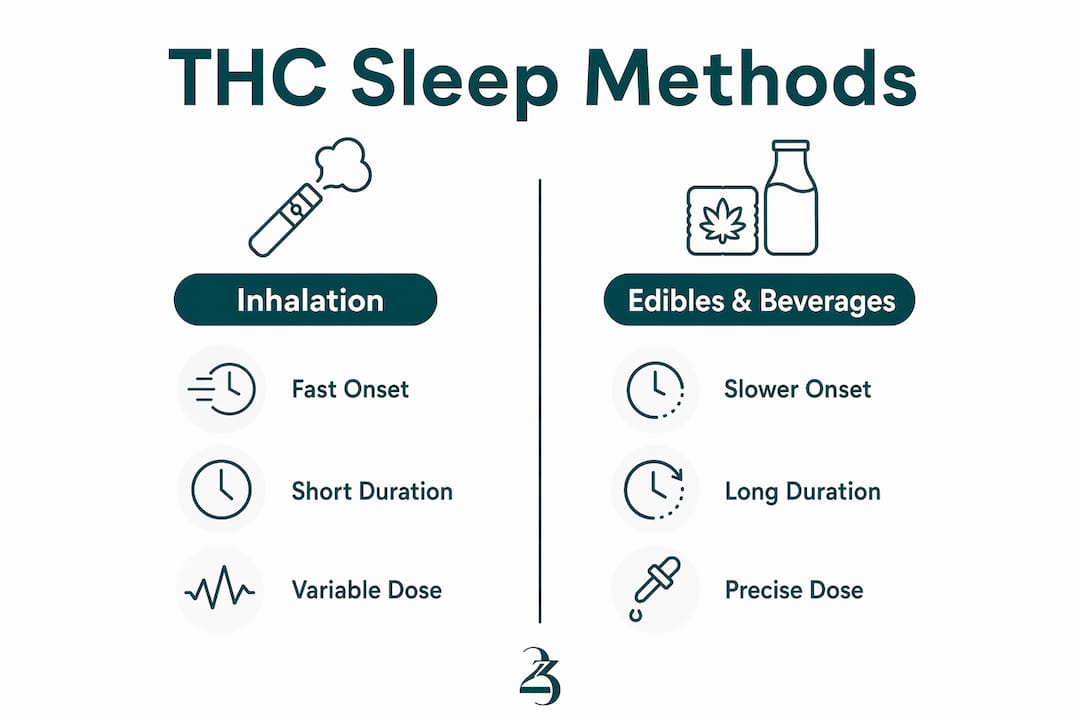
Beverages occupy a genuinely different position. A hemp-derived THC beverage with clear per-can milligram labeling gives you consistent, measurable dosing with an onset closer to 15–45 minutes in many formulations. That faster, more predictable window makes it easier to time for a Friday wind-down or a pre-sleep ritual without the guessing game that comes with standard edibles. The social format helps too: cracking open a can feels intentional and measured in a way that portioning a gummy does not.
Inhalation is the fastest route but also the hardest to dose precisely for sleep, and the duration is shorter, which can mean waking in the middle of the night as the effect wears off.
For bedtime use specifically: a sublingual tincture or a low-dose THC beverage taken 30–60 minutes before your target sleep time gives you the most control over timing. Edibles work but require planning well in advance.

Pro Tip: For a first bedtime try, choose a hemp-derived THC beverage with 2–5 mg per serving, sip it about 45 minutes before you want to be asleep, and do not redose if you feel nothing after 30 minutes. Wait the full hour. Beverages with consistent per-can dosing, like those from 23state, make that discipline much easier to maintain.
THC vs. CBD vs. CBN: which one actually helps you sleep?
THC is the most consistently sedating cannabinoid acutely, but it carries the least favorable long-term safety profile of the three. CBD and CBN show real promise with fewer adverse signals, and a 2026 systematic review is now shifting clinical guidance toward those options.
A 2026 systematic review and meta-analysis on medical cannabis for insomnia found that formulations prioritizing CBN (20–100 mg) or combinations of CBN and CBD had more favorable safety and efficacy signals than THC-dominant products. THC formulations showed higher adverse event rates across the included studies. That is a meaningful shift in how clinicians are being advised to approach cannabis for sleep.
Here is how the three cannabinoids compare in practical terms:
THC
- Onset: fast to moderate depending on form
- Best for: sleep onset (falling asleep faster), pain-related sleep disturbance, PTSD-related nightmares
- Adverse-event profile: highest of the three — dizziness, daytime sedation, REM suppression, dependency risk
- Ideal scenario: short-term, low-dose use in adults with pain-related insomnia; not recommended for nightly long-term use
CBD
- Onset: slower, dose-dependent effects on sleep
- Best for: anxiety-related sleep disturbance; may improve sleep maintenance in some populations
- Adverse-event profile: low — minimal psychoactive effect, some drug interactions at high doses
- Ideal scenario: primary insomnia with anxiety component; daily use is better tolerated than THC
CBN
- Onset: moderate; often combined with CBD or THC for synergistic effect
- Best for: sleep maintenance (staying asleep); emerging evidence at 20–100 mg doses
- Adverse-event profile: low; less studied than CBD or THC but fewer adverse signals in current reviews
- Ideal scenario: people who fall asleep fine but wake frequently; those who want a THC-adjacent option without the dependency risk
For readers curious about how these cannabinoids compare in more depth, the CBN vs. CBG vs. CBD breakdown at 23rd State is a solid next read. And if you are weighing THC against CBD specifically for wellness use, the THC vs. CBD guide covers the key distinctions clearly.
The practical upshot: if you are new to cannabis for sleep and not dealing with significant pain, starting with a CBD/CBN formulation is the lower-risk entry point. If you have chronic pain or PTSD-related sleep disruption and want to try THC, keep doses low and duration short.
Who may benefit from THC for sleep, and who should avoid it?
THC for sleep is not a one-size-fits-all answer. Two groups get the clearest signal from the evidence: people with chronic pain and people with PTSD-related sleep disturbance. Everyone else should approach with more caution.
Who tends to see benefit:
- Adults with chronic pain conditions (fibromyalgia, neuropathic pain, arthritis) whose sleep is disrupted by pain rather than primary insomnia
- People with PTSD-related nightmares — case series show reduced sleep disturbances with cannabinoid use in this population
- Adults who have tried behavioral interventions and need short-term symptom relief while working on root causes
Who should avoid THC for sleep:
- People with a personal or family history of psychosis, schizophrenia, or bipolar disorder
- Pregnant or breastfeeding people (no safe dose has been established)
- Adolescents and young adults under 25 (developing brain is more vulnerable to THC’s effects on memory and cognition)
- People with untreated sleep apnea (THC may worsen airway muscle relaxation)
- Anyone who drives or operates machinery within 8–12 hours of use
- People taking medications metabolized by CYP3A4 or CYP2C9 without clinician guidance
When to seek professional evaluation: If your insomnia has lasted more than three months, is affecting your work or relationships, or is accompanied by mood changes, anxiety, or daytime impairment, a sleep medicine consult or referral to Cognitive Behavioral Therapy for Insomnia (CBT-I) is the right first step. CBT-I is the gold-standard first-line treatment for chronic insomnia and addresses root causes rather than masking symptoms. THC does not treat the underlying pathology of insomnia; it provides interim relief at best.
A note on U.S. legal considerations: Hemp-derived THC products (delta-9 THC derived from hemp at or below 0.3% by dry weight) are federally legal under the 2018 Farm Bill, but state laws vary significantly. Some states restrict hemp-derived THC beverages and edibles. Always check your state’s current rules before purchasing. Marijuana-derived THC remains federally controlled, and its legal status depends entirely on your state. For a broader look at how cannabinoids fit into wellness choices, the cannabinoids in health guide at 23rd State covers the current landscape clearly.
A safer-use checklist for your first THC sleep trial
Before you crack open that first can or reach for a gummy at bedtime, run through this checklist. A little structure up front saves a lot of frustration later.
- Check your state’s legal status for hemp-derived THC products. Federal hemp law allows up to 0.3% delta-9 THC by dry weight, but state rules vary.
- Choose a low-dose, measurable format. A hemp-derived THC beverage with clear per-can milligram labeling in a low dose range is considered beginner-friendly. Avoid unlabeled or loosely portioned products.
- Set a dedicated trial night. Pick a night with no early obligations the next morning. Your first experience should not be a work night.
- Time it right. Take your beverage or edible 30–60 minutes before your target sleep time. Set a reminder so you do not redose impatiently.
- Log your experience. Keep a simple sleep diary for your trial period. Note: time taken, dose, time you fell asleep (estimated), how you felt at 3 AM if you woke, and how you felt at wake-up.
- Avoid mixing. No alcohol, no prescription sleep aids, no antihistamines on trial nights. Isolate the variable.
- Run a 2–4 week evaluation. Use THC no more than 2–3 nights per week during your trial to limit tolerance buildup. After 2–4 weeks, review your sleep diary honestly.
- Plan your stopping point. Decide in advance that you will take a full week off after your trial period to assess rebound effects. If stopping is harder than expected, that is a signal worth taking seriously.
Simple sleep diary template:
When to stop and seek help:
- Insomnia worsens after the first week of use
- You feel you cannot sleep without THC
- Daytime impairment affects work, driving, or relationships
- Anxiety, paranoia, or mood changes appear
For non-cannabis sleep support to try alongside or instead of THC, the 10 proven ways to support sleep tonight guide at 23state covers behavioral and lifestyle strategies worth building into your routine regardless.
Pro Tip: Track your sleep quality on off-nights too, not just nights you use THC. If your sleep is noticeably worse on nights without it after just a few weeks, that pattern is your early warning sign of tolerance and dependence building.
Key Takeaways
THC can genuinely help you fall asleep faster in the short term, but the evidence consistently shows that REM suppression, tolerance, and rebound insomnia make it a poor long-term solution for most adults.
| Point | Details |
|---|---|
| Short-term benefit is real | THC reduces sleep onset latency acutely, but objective sleep architecture often worsens, including REM reduction of roughly 33.9 minutes in EEG trials. |
| Long-term use carries clear risks | Regular nightly use builds tolerance, suppresses REM sleep, and causes rebound insomnia and vivid dreams on discontinuation. |
| CBN/CBD are lower-risk alternatives | A 2026 systematic review found CBN (20–100 mg) and CBD/CBN combinations had more favorable safety and efficacy signals than THC-dominant products for insomnia. |
| Form and dose determine your experience | Beverages offer more predictable onset (15–45 min) and consistent per-can dosing compared to edibles, which can take 45–90 minutes and vary widely. |
| 23rd State’s Blush Crush fits a cautious first try | A low-dose hemp-derived THC beverage like Blush Crush gives you measurable dosing and a predictable wind-down ritual without the guesswork of standard edibles. |
Our take on THC and sleep
Here at 23rd State, we think the most honest thing we can say is this: THC for sleep is genuinely interesting, genuinely useful in the right context, and genuinely misunderstood by a lot of people who reach for it nightly without a plan.
The canna-curious adults we love most are the ones who come in with questions, not assumptions. They want to know what they are actually getting into before they make it a habit. That is exactly the right instinct. A low-dose hemp-derived THC beverage on a Friday wind-down, sipped intentionally 45 minutes before bed, is a very different thing from a nightly gummy habit that has quietly become a dependency. The format, the dose, the frequency, and the intention all matter.
We are not clinicians, and nothing in this guide is medical advice. If you are dealing with chronic insomnia, please talk to a sleep medicine specialist or ask your doctor about CBT-I before leaning on any cannabinoid product as a solution. For everyone else who is simply curious and wants a measured, enjoyable way to explore what a little hemp-derived THC can do for a restful evening, we think the beverage format is the smartest starting point. Consistent dosing, a social ritual, and a clear label. That is the kind of intentional experience we build everything around.
Blush Crush is a great first step for a bedtime wind-down
If you are ready to try a low-dose hemp-derived THC beverage for a calm, intentional evening, Blush Crush from 23rd State is the product we would hand you first. It is designed for exactly this kind of moment: a measured dose, a bright, refreshing flavor, and an onset window that fits a pre-sleep ritual without the unpredictability of a standard edible.
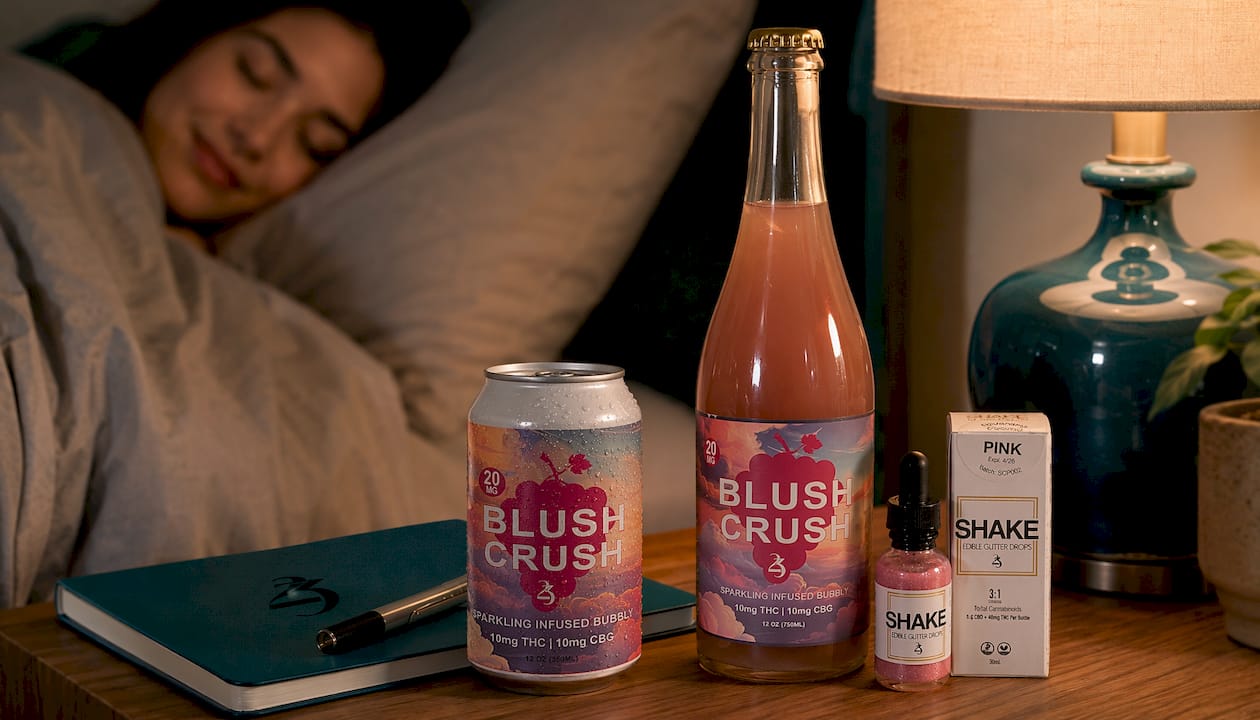
Blush Crush gives you the dosing control a first-timer needs, in a format that feels like a celebration rather than a supplement. No guessing, no portioning, no waiting 90 minutes wondering if it worked. Just a crisp, intentional sip to close out the evening. Ready to make it a ritual? Grab the Blush Crush THC Bundle and have a few on hand for your trial period — because one good night deserves a proper plan.
Useful sources and further reading
The research behind this guide comes from peer-reviewed clinical studies, systematic reviews, and expert commentary. Here are the primary sources, briefly annotated, for readers who want to go deeper.
-
Effects of Cannabinoids on Sleep and their Therapeutic Potential for Sleep Disorders (PMC) — A comprehensive review of cannabinoid effects on normal sleep architecture and specific sleep disorders, including insomnia, sleep apnea, and PTSD-related sleep disturbance. Covers dose-dependent THC effects and the distinction between acute and chronic use.
-
The Effects of Cannabinoids on Sleep (PMC) — A thorough clinical review covering cannabis products, sleep disorders, withdrawal effects, and drug interactions; includes a case study of significant insomnia following cannabis withdrawal. Particularly useful for understanding the dependency and rebound cycle.
-
Cannabis dosing and administration for sleep: a systematic review (PubMed) — Covers 19 randomized and 12 uncontrolled trials; finds improvements concentrated in pain populations and highlights the heterogeneity that limits firm dosing recommendations.
-
Acute effects of oral cannabinoids on sleep and high-density EEG in insomnia (OVID) — The EEG trial showing objective REM reduction and total sleep time decrease with a 10 mg THC + 200 mg CBD oral dose in adults with insomnia.
-
Medical cannabis for treatment of insomnia in adults: A systematic review and meta-analysis (PubMed, 2026) — The 2026 review recommending CBN (20–100 mg) and CBD/CBN combinations over THC-dominant products based on safety and efficacy signals.
-
Medical cannabis and cannabinoids for impaired sleep: a systematic review and meta-analysis of randomized clinical trials — Meta-analysis of approximately 39 RCTs in chronic pain populations; finds small sleep quality improvements alongside a significant increase in dizziness risk.
-
Using cannabis for sleep isn’t harmless — a neurologist explains how it can trap people in a cycle of dependency (The Conversation) — Expert commentary from neurologist Dr. Joanna Fong-Isariyawongse on the dependency cycle, rebound insomnia, and the case for CBT-I as a first-line intervention.
-
Cannabis Use and Sleep: Expectations, Outcomes, and… (PMC) — Examines the gap between what users expect from cannabis for sleep and what objective measures show; useful context for the subjective vs. objective sleep quality distinction.
For complex cases — chronic insomnia, co-occurring mental health conditions, or medication interactions — please consult a sleep medicine specialist or your primary care provider directly.
FAQ
Is it safe to take THC every night for sleep?
No. Regular nightly use builds tolerance quickly, suppresses REM sleep, and commonly causes rebound insomnia and vivid dreams when you stop. Most clinical guidance recommends limiting use to 2–3 nights per week at most, and treating it as short-term relief rather than a long-term solution.
What is a better sleep aid, CBD or THC?
For most adults without chronic pain, CBD or a CBN/CBD combination is the lower-risk starting point. A 2026 systematic review found that CBN (20–100 mg) and CBD/CBN formulations had more favorable safety and efficacy signals than THC-dominant products for insomnia, with fewer adverse events.
What is the best THC method for sleep?
A low-dose hemp-derived THC beverage (2–5 mg) taken 30–60 minutes before bed offers the most predictable onset and the easiest dose control for beginners. Edibles work but have highly variable onset (45–90 minutes) and longer duration, making accidental overconsumption more likely.
Is higher THC better for sleep?
No. Higher THC doses can act as a stimulant, trigger anxiety, and worsen sleep architecture. Low doses (2–5 mg) are more consistently sedating; moderate to high doses often produce the opposite of the intended effect, particularly in people new to cannabis.
