

TL;DR:
- Mixing THC and alcohol increases impairment beyond either substance alone and doubles the risk of driving and social harms.
- Starting with low doses, timing doses wisely, and staying hydrated can reduce immediate dangers, but driving is never safe afterward.
Mixing THC and alcohol amplifies intoxication beyond what either substance produces alone, and the combination raises your short-term risk of impaired driving, nausea, and loss of coordination. This isn’t a fringe concern. A narrative review published on PMC found that same-occasion co-use roughly doubles the odds of drunk driving and social harms compared with alcohol alone. The CDC is equally direct: mixing alcohol with other drugs is never without added risk, and co-use can mask intoxication signs, making overconsumption more likely.
Quick verdict:
- Co-use increases subjective intoxication, stimulation, and the likelihood of unpleasant effects like nausea and dizziness.
- A JAMA Network Open crossover trial found that edible THC combined with modest alcohol (targeting 0.05% BrAC) produced driving impairment comparable to or exceeding alcohol at the legal limit of 0.08% BrAC alone.
- The interaction between cannabis and alcohol varies depending on factors like dose, timing, product type, and individual tolerance.
If someone becomes severely ill (uncontrolled vomiting, confusion, difficulty breathing, loss of consciousness): call 911 immediately.
TL;DR:
- Don’t drive after co-use, period.
- Start with very low doses of each substance if you choose to use both.
- Separate your doses by more than 90 minutes when possible.
- Stay hydrated and stay with people you trust.
- When in doubt, skip the alcohol and try a low-dose THC beverage on its own.
Table of Contents
- How mixing THC and alcohol actually works in your body
- Immediate effects you’re likely to feel when combining cannabis and alcohol
- Practical harm-reduction steps when you choose to use both
- Driving, workplace, and legal risks in the United States
- Where the science stands on cannabis and alcohol co-use
- Medication interactions when you’re using both THC and alcohol
- Key Takeaways
- A note from 23rd State on celebrating smarter
- 23rd State: low-dose THC beverages for the moments that matter
- Useful sources
- FAQ
How mixing THC and alcohol actually works in your body
The short version: alcohol and THC hit overlapping brain systems, and they don’t just add up. They interact.
Alcohol can increase how much THC your body absorbs. When you drink before consuming cannabis, ethanol may raise THC plasma levels by dilating blood vessels in the gastrointestinal tract, which speeds absorption. With edibles specifically, alcohol can also increase the formation of 11-OH-THC, an active metabolite that tends to produce stronger, longer-lasting psychoactive effects than THC itself. That’s one reason a cannabis edible taken after a couple of drinks can feel dramatically more intense than the same edible taken sober.
Both substances depress the central nervous system and impair the same cognitive and motor functions: reaction time, balance, attention, and decision-making. When they’re active together, the impairment is synergistic, meaning greater than what you’d expect from simply adding the two effects together. Research on THC drinks effects and onset shows that the beverage route adds another timing variable: liquid-format THC typically absorbs faster than traditional edibles but slower than inhalation.
Order of use matters. Drinking first and then adding cannabis tends to produce more intense effects than the reverse. When cannabis comes first, some people actually drink less alcohol, possibly because THC’s own effects reduce the desire to drink more. That said, this pattern isn’t universal, and it doesn’t make the combination safe.
Timing is its own variable. An ecological momentary assessment study (PMC) found that co-use within a 0–90 minute window produced markedly higher subjective intoxication and “bad effects” compared with using either substance alone. When the two substances were separated by longer intervals, the amplification dropped. That 90-minute window is worth keeping in mind.
Several other factors shape how intense the THC and alcohol combination feels for any individual:
- Dose of each substance (even a small amount of alcohol shifts THC absorption)
- THC potency and product type (high-potency concentrates carry more risk than low-dose beverages)
- Tolerance to each substance separately
- Body weight and metabolism
- Set and setting (stress, fatigue, and environment all modulate response)
- Concurrent medications (discussed in a later section)
Laboratory-controlled studies and naturalistic observational studies sometimes reach different conclusions about co-use effects, partly because real-world users self-select doses and timing in ways that don’t match controlled conditions. Both types of evidence are useful, but controlled trials give cleaner causal data.
Immediate effects you’re likely to feel when combining cannabis and alcohol
Co-use reliably increases subjective intoxication, stimulation, and the probability of unpleasant reactions. The PMC narrative review consistently found that same-occasion use raises the odds of harms compared with alcohol alone.
Common acute effects of the THC and alcohol combination:
- Intensified dizziness and lightheadedness
- Nausea and vomiting (especially with higher doses of either)
- Heightened anxiety or paranoia
- Rapid heart rate (tachycardia)
- Impaired balance and coordination
- Slowed reaction time
- Difficulty concentrating or forming coherent thoughts
- Increased sedation or, paradoxically, agitation
“Greening out” is the informal term for the cluster of unpleasant physical reactions, including nausea, sweating, pallor, and rapid heart rate, that can follow cannabis use, especially when alcohol is also present. According to Healthline’s review of the combination, alcohol raises both the risk and the intensity of greening out. The mechanism is partly pharmacokinetic: higher THC absorption means more intense effects hitting faster.
Signs that require urgent care:
- Uncontrolled vomiting that won’t stop
- Confusion or inability to be roused
- Breathing that is slow, shallow, or irregular
- Bluish tint to lips or fingertips
- Seizure activity
If you see any of these, call 911. Don’t wait to see if it passes.
Key data points on impairment
| Finding | Detail | Source |
|---|---|---|
| Driving impairment at 0.05% BrAC + edible THC | Matched or exceeded impairment seen at 0.08% BrAC alone | JAMA Network Open crossover trial (25 adults) |
| Co-use and harms vs. alcohol alone | Roughly doubles odds of drunk driving and social consequences | PMC narrative review |
| Binge drinkers and cannabis co-use (Colorado) | 34.4% current marijuana use among binge drinkers vs. 14.8% among non-binge drinkers | CDC/MMWR Colorado BRFSS analysis |
Statistic to know: A JAMA Network Open trial involving 25 adults found that combining edible THC with enough alcohol to reach just 0.05% BrAC (below the legal driving limit) produced driving impairment equal to or greater than alcohol at 0.08% BrAC alone. Co-use doesn’t just add impairment. It multiplies it.
Practical immediate tips:
- Pace yourself: one drink or one low-dose serving at a time, with time between.
- Hydrate with water between any alcoholic or THC serving.
- Avoid stacking other substances (caffeine, sedatives, other drugs).
- Stay seated if you feel dizzy; lying down on your side is safer than sitting upright if nausea is severe.
Practical harm-reduction steps when you choose to use both
If you’re going to mix, here’s how to do it with the least risk. This isn’t permission; it’s pragmatics.
Before:
- Plan your transportation in advance. Decide before you start that you are not driving.
- Know your doses. Check the THC mg per serving on any cannabis product label.
- Start low on both substances, especially if you’re new to either.
- Eat a meal beforehand to slow alcohol absorption.
- Tell a trusted friend what you’re consuming so they can monitor you.
During:
- Pace yourself. One serving of each, then wait at least 90 minutes before considering more.
- Drink water between every alcoholic or THC serving.
- Avoid stacking other substances: no benzodiazepines, opioids, or high-caffeine stimulants alongside this combination.
- Check in with yourself. Dizziness, nausea, or anxiety are signals to stop, not push through.
- Stay in a safe, comfortable environment with people you trust.
After:
- Hydrate and rest. Both substances are dehydrating.
- Don’t drive until you’ve slept and feel fully clear-headed.
- Monitor how you feel the next day; lingering cognitive fog is a sign the dose was too high.
If someone is greening out
Lay them on their side (recovery position) to prevent choking if they vomit. Keep them calm, cool, and hydrated with small sips of water. Stay with them. Most greening-out episodes resolve with time, hydration, and rest. If vomiting is uncontrolled, breathing is labored, or the person can’t be roused, call 911.
If you suspect alcohol poisoning
Signs include confusion, vomiting while unconscious, seizures, slow or irregular breathing, pale or bluish skin, and low body temperature. Call 911 immediately. Do not leave the person alone. Do not give them coffee or food. Turn them on their side.
Product-specific note for hemp-derived THC beverages: liquid-format THC typically absorbs faster than traditional edibles but the onset still varies, often 15–45 minutes depending on formulation. Understanding how long a THC drink takes to kick in matters a lot when you’re also drinking alcohol, because the combined peak can arrive before you realize how impaired you are.
Pro Tip: If you’re mixing a THC beverage with alcohol at all, have the THC beverage first, then wait to see how you feel before adding any alcohol. Drinking alcohol first raises THC absorption and makes the combined effect harder to predict.
Driving, workplace, and legal risks in the United States
Never drive after mixing THC and alcohol. That’s the short version, and it’s non-negotiable.
The Colorado DOT is explicit: co-use slows reaction time and impairs coordination beyond what alcohol alone produces. The JAMA trial data reinforces this: impairment at a sub-legal alcohol level combined with edible THC can exceed the impairment of being legally drunk on alcohol alone. Standard roadside sobriety tests were not designed to detect cannabis impairment reliably, which means you can be significantly impaired and still pass a breathalyzer.
US legal landscape:
- DUID (Driving Under the Influence of Drugs): Every US state has DUID laws. Co-use doesn’t give you a legal pass because your BAC is below 0.08%. Officers can charge DUID based on observed impairment, field sobriety test performance, or drug recognition evaluations.
- THC detection windows: THC metabolites can remain detectable in blood and urine long after impairment has passed, which creates legal exposure even when you feel sober. For more on detection timelines, THC drink drug test detection is worth reading before any workplace or legal concern arises.
- Workplace policies: Many employers maintain zero-tolerance drug policies that include cannabis, regardless of state legalization status. Co-use adds another layer of risk for anyone subject to workplace drug testing.
- State law variability: Cannabis legality and DUID thresholds vary significantly by state. Always check your state’s current statutes and your employer’s specific policy.
Practical safety steps:
- Arrange a designated driver or rideshare before the evening starts.
- Use a sober friend system at events.
- Never rely on “I feel okay” as a measure of actual impairment after co-use.
Where the science stands on cannabis and alcohol co-use
The core consensus is solid: co-use amplifies intoxication and impairment, and driving risk increases meaningfully. The main scientific disagreements center on long-term patterns (substitution vs. complementarity) and the precise dose-response relationship for chronic harms.
Key studies and what they contribute:
- PMC narrative review (link): Synthesizes laboratory and naturalistic data showing that same-occasion co-use consistently raises subjective intoxication and harms vs. alcohol alone. Covers multiple methodologies, which strengthens confidence in the core finding.
- JAMA Network Open crossover trial (link): 25-adult within-participant design testing edible THC at 0, 10, and 25 mg combined with placebo or alcohol targeting 0%, 0.05%, and 0.08% BrAC. Controlled conditions make this one of the cleaner causal data points available on driving impairment.
- ARCR/NIAAA review (link): Broad synthesis of substitution vs. complementarity evidence. Highlights potency as a key moderator and notes that study design heavily influences which pattern emerges.
- PMC ecological momentary assessment study (link): Real-world, real-time data showing that co-use within 0–90 minutes raises subjective intoxication and “bad effects,” and that acute co-use experiences predict higher hazardous cannabis use months later.
- CDC guidance (link): Public-health framing on polysubstance risk, masking effects, and overdose risk.
Where the evidence is still thin:
The science is strong enough to support clear safety guidance. It’s not yet detailed enough to give you a precise “safe” dose combination, because that threshold likely doesn’t exist in a universal sense.
Medication interactions when you’re using both THC and alcohol
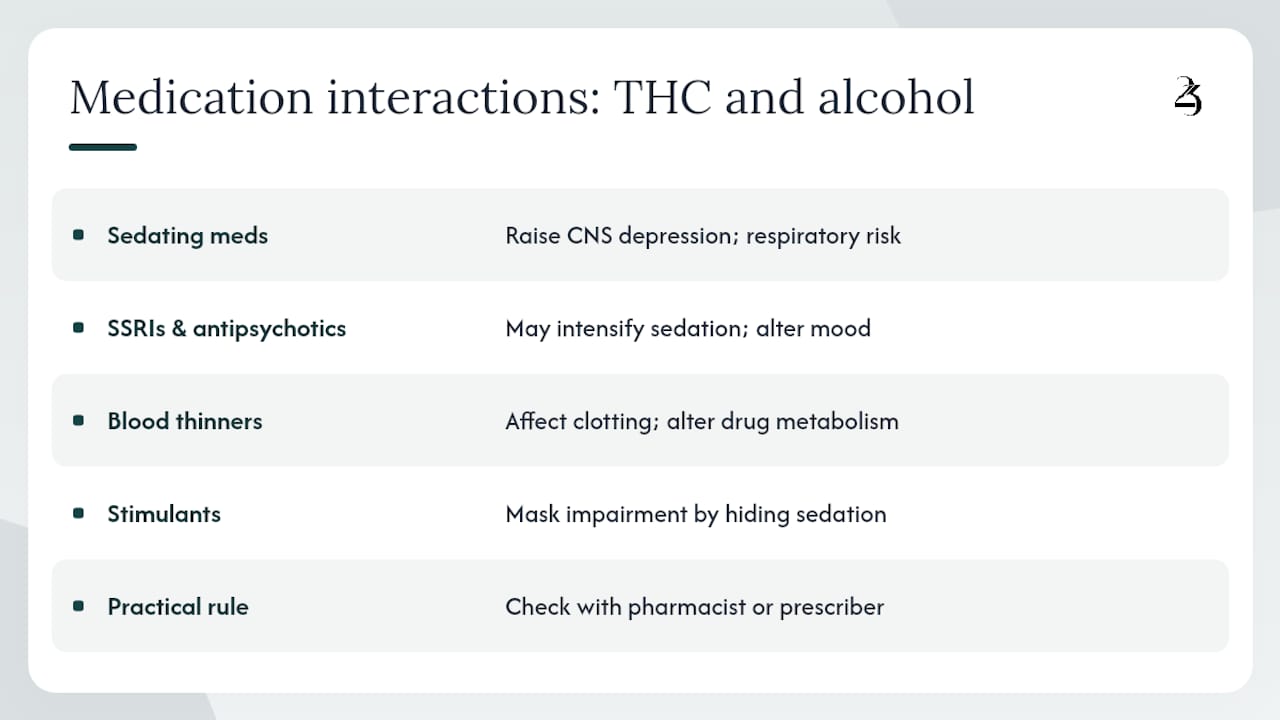
Medications and THC use should always include the guidance of your doctor. This is the most underappreciated risk in the co-use conversation. Adding prescription or over-the-counter medications to a THC and alcohol combination can shift a manageable situation into a dangerous one quickly.
Sedating medications: Benzodiazepines (like diazepam or lorazepam), sleep aids (like zolpidem), antihistamines (like diphenhydramine), and opioid pain medications all depress the central nervous system. Combining any of these with alcohol and THC stacks CNS depression, raising the risk of respiratory suppression, extreme sedation, and loss of consciousness. The CDC’s polysubstance guidance specifically flags this category as high-risk.
Antidepressants and antipsychotics: Some SSRIs and antipsychotics interact with both alcohol and cannabis, potentially intensifying sedation or altering mood responses unpredictably. THC can also affect serotonin pathways, which matters when serotonergic medications are in the mix.
Blood thinners: Both alcohol and cannabis can affect platelet function and blood clotting. People taking warfarin or other anticoagulants should be aware that co-use may alter drug metabolism through shared liver enzyme pathways (particularly CYP2C9 and CYP3A4).
Stimulant medications: ADHD medications like amphetamines or methylphenidate can mask the sedating effects of alcohol and THC, making it harder to gauge your actual impairment level. This is the masking effect the CDC warns about, applied to a specific medication class.
The practical rule: If you take any prescription medication regularly, check with your pharmacist or prescribing clinician before combining THC and alcohol. This isn’t overly cautious. Pharmacokinetic interactions at the liver enzyme level are real and can shift drug concentrations in ways that aren’t predictable from either substance alone.
Key Takeaways
Mixing THC and alcohol amplifies impairment beyond either substance alone, raises driving crash risk, and can trigger severe short-term reactions, especially when doses are high or timing is close.
| Point | Details |
|---|---|
| Co-use amplifies impairment | Same-occasion use roughly doubles the odds of harms like drunk driving compared with alcohol alone. |
| Timing window matters | Co-use within 0–90 minutes produces the highest subjective intoxication; separating doses reduces but doesn’t eliminate risk. |
| Driving is never safe after co-use | Edible THC plus modest alcohol (0.05% BrAC) can match or exceed impairment at the 0.08% legal limit. |
| High-risk groups need extra caution | Young adults, pregnant people, those with AUD/CUD history, and anyone on sedating medications face elevated risk. |
| 23state SHAKE as an alternative | A low-dose hemp-derived THC beverage like SHAKE lets you socialize without stacking alcohol’s risks on top. |
A note from 23rd State on celebrating smarter
Here’s what we genuinely believe: curiosity about cannabis is a good thing, and you deserve honest information to make the call that’s right for you. The science on mixing THC and alcohol is pretty clear that more isn’t always more fun. Sometimes it’s just more nausea on a Friday night you were looking forward to.
That’s exactly why we built 23rd State around low-dose, hemp-derived THC beverages. A bright, microdosed sip of SHAKE or a sparkling Blush Crush gives you that warm, social glow without the unpredictability of stacking two substances. You stay in control of the vibe. You wake up feeling like yourself. And honestly? That’s the celebration worth having. Explore THC drinks as an alcohol alternative and see what a different kind of Friday feels like.
23rd State: low-dose THC beverages for the moments that matter
If your goal is to unwind, connect, and actually enjoy the evening, hemp-derived THC beverages offer something the alcohol-plus-cannabis combo can’t: dose control, no ethanol, and a predictable, pleasant experience.
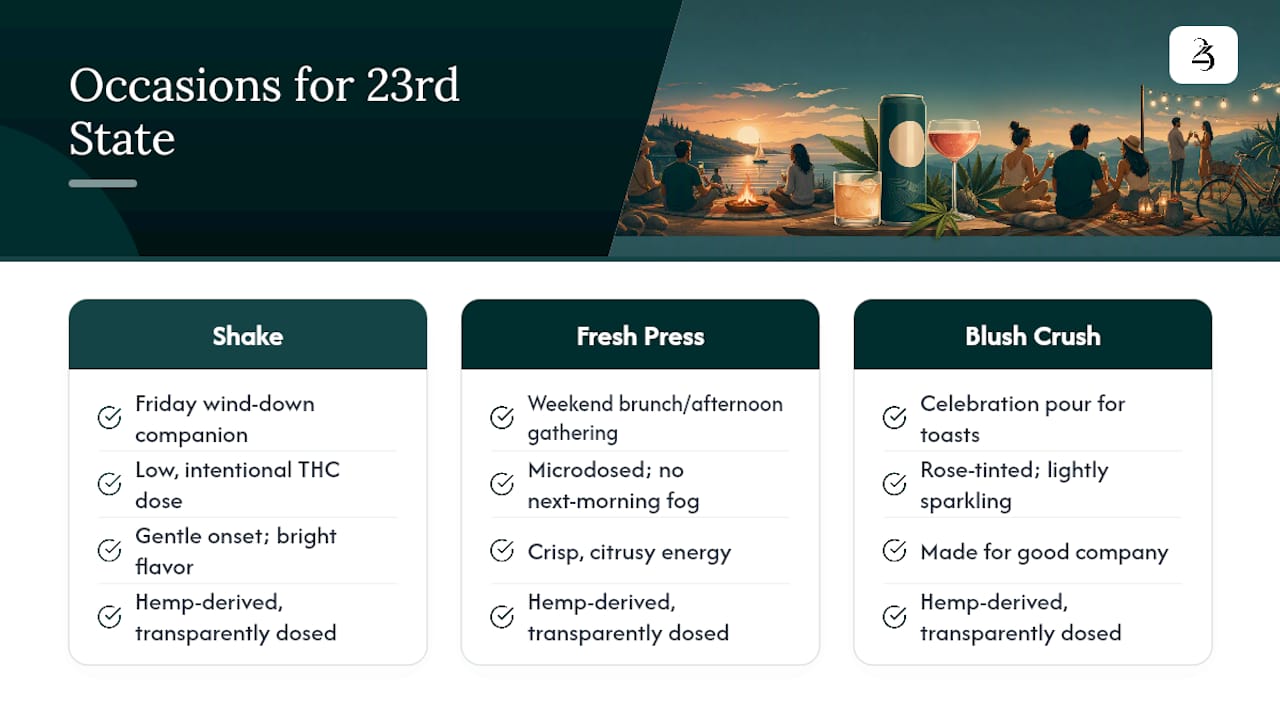
Here’s how 23rd State’s lineup fits the moment:
SHAKE is your Friday wind-down companion. It’s crafted for that end-of-week exhale, with a low, intentional THC dose that eases you into a relaxed, social headspace without the intensity of stacking substances. The onset is gentle, the flavor is bright, and you stay in the driver’s seat of how you feel.
FRESH PRESS brings a crisp, citrusy energy that fits a weekend brunch or afternoon gathering. Light, refreshing, and microdosed for a bubbly mood lift without the next-morning fog that alcohol tends to leave behind.
Blush Crush is the celebration pour. Rose-tinted, lightly sparkling, and made for toasts and good company. When the moment calls for something special, this is the one you crack open.
All three are hemp-derived, transparently dosed, and designed so you know exactly what you’re getting. No guessing, no stacking, no regrets. Browse the full lineup at 23state.com and find the one that fits your next occasion.
Useful sources
- The effects of simultaneous alcohol and cannabis use on subjective drug effects: A narrative review across methodologies (PMC)
- Impact of Cannabis Edibles Combined With Alcohol on Driving, Field Sobriety Performance, and Subjective Effects: A Within-Participant Crossover Trial | JAMA Network Open
- Patterns of Cannabis and Alcohol Co-Use: Substitution Versus Complementary Effects (ARCR/NIAAA review)
- The association between cannabis and alcohol co-use and momentary subjective effects: risks for increasingly hazardous cannabis use (PMC)
- Drinking alcohol while using other drugs — CDC
- Marijuana use and drinking patterns — Colorado MMWR analysis (CDC, 2021)
- What happens when you mix cannabis and alcohol? — Colorado DOT
Local cannabis laws and DUID thresholds vary by state. Check your state’s official resources or consult a legal professional for jurisdiction-specific guidance.
FAQ
What should you not mix THC with?
Avoid combining THC with alcohol, benzodiazepines, opioids, sleep aids, and high-caffeine stimulants. Each of these either stacks CNS depression or masks impairment, raising the risk of overconsumption and serious adverse effects.
What is it called when you are high and drunk at the same time?
The informal term is “crossfading.” When the combination produces severe nausea, dizziness, sweating, and rapid heart rate, that’s often called “greening out.” Both terms describe the amplified, often unpleasant state that results from mixing THC and alcohol.
Does alcohol affect THC tolerance?
Alcohol doesn’t directly change your THC tolerance, but it does increase THC absorption, which means the same cannabis dose hits harder when alcohol is present. Over time, frequent co-use can complicate tolerance to both substances independently.
Is mixing THC and alcohol more dangerous than using either alone?
Yes, for most people and most outcomes. Research consistently shows that same-occasion co-use raises the odds of impaired driving, nausea, anxiety, and other harms compared with either substance used alone, particularly when doses are high or timing is close.
Can a low-dose THC beverage replace alcohol at social events?
A low-dose hemp-derived THC beverage like 23rd State’s SHAKE or Blush Crush can provide a social, mood-lifting experience without ethanol. The dose is transparent, the onset is predictable, and you avoid the pharmacokinetic interaction that makes mixing risky.
Recommended
- Can You Mix THC Tinctures with Drinks? Safe Tips & Recipes – 23rd State
- Alcohol Alternatives: A Guide to THC-Infused Drinks | 23rd State
- Drinking THC: Effects, Benefits, and Safe Consumption Tips – 23rd State
- How to Be the Ultimate THC Beverage Host: Pairings, and Party Tips – 23rd State
This article is for general informational purposes only and does not constitute medical or legal advice. Confirm current laws and regulations with your state’s resources or a qualified professional. 23rd State products contain hemp-derived THC and are intended for adults 21+.
