

Federal law just redefined what “hemp” means, and the shift hits your favorite hemp beverages and edibles directly. P.L. 119-37 amends 7 U.S.C. The statutory effective date is November 12, 2026, though a Senate continuing resolution proposes pushing most provisions to December 11, 2026.
Here’s what that means in plain terms right now:
- Product reformulation is coming. Most intoxicating hemp beverages and edibles on shelves today exceed the 0.4 mg per-container cap and will need to be reformulated or pulled.
- Testing requirements tighten. Labs must now measure THCA alongside delta-9 THC, not just delta-9 alone.
- New exclusions apply. Viable seeds over the threshold, synthesized cannabinoids, intermediate products above 0.3% combined, and final products above 0.4 mg per container all fall outside the hemp definition.
- Products outside the definition become marijuana under the Controlled Substances Act (CSA), carrying serious federal legal consequences.
- Any delay is a stopgap, not a fix. The underlying statutory change remains in force unless Congress repeals it.
Key Takeaways
The most important fact to hold onto: P.L.
| Point | Details |
|---|---|
| New total THC standard | Hemp must test at or below 0.3% total THC (delta-9 + THCA × 0.877) on a dry weight basis. |
| 0.4 mg per-container cap | Finished consumer products above this limit fall outside the hemp definition and become Schedule I under the CSA. |
| Effective date is November 12, 2026 | A Senate CR proposes delaying most provisions to December 11, 2026, but the statutory change remains in force unless repealed. |
| State rules can be stricter | Federal compliance is the floor; check every state you sell or ship into for additional restrictions. |
| 23rd State FRESH PRESS | Formulated with plant-derived cannabinoids and total THC per container within the new standard. |
Primary sources and further reading
| Source | Best used for |
|---|---|
| P.L. 119-37 / CRS IF13136 | Statutory text summary, exclusions list, and container cap |
| CRS In Focus PDF (IF13136) | Full legislative history, effective date, and congressional context |
| USDA AMS Hemp Laws and Regulations | USDA testing standards, sampling protocols, and state plan requirements |
| FDA Cannabis and CBD Regulation | FDA jurisdiction, naturally occurring cannabinoid list task, and consumer product oversight |
| Forbes — Senate CR and hemp ban | Political context, CR proposal, and industry reaction |
| Scarinci Hollenbeck client alert | Legal mechanics of the CR delay and compliance planning advice |
This article is general information, not a substitute for advice from a qualified lawyer. Consult a qualified legal professional about your own circumstances before acting on anything here.
Table of Contents
- What did the Farm Bill hemp THC standard actually change?
- When does the new standard take effect, and what’s happening in Congress?
- How is total THC calculated, and what will labs actually test?
- Which federal agencies are involved, and what could enforcement look like?
- A practical compliance checklist for hemp businesses before November 2026
- How state laws create a patchwork risk for producers and consumers
- What do these changes mean for you as a shopper?
- How 23rd State is approaching compliance, and what FRESH PRESS represents
- What the market probably looks like on the other side of November 2026
- Sources
- FAQ
What did the Farm Bill hemp THC standard actually change?
The old federal definition of hemp, established by the 2018 Farm Bill (P.L. 115-334), measured only delta-9 THC. Delta-8 THC, delta-10 THC, and high-THCA flower all exploited this gap. Congress’s CRS analysis frames the shift to total THC as a deliberate effort to close exactly that loophole.
P.L. 119-37 rewrites the hemp definition in 7 U.S.C. For finished consumer products, a separate absolute limit applies: no more than 0.4 mg of combined total THC per container. The CRS In Focus PDF summarizes both changes and enumerates the exclusions that follow.
What the statute now excludes from the hemp definition
| Exclusion | What it means |
|---|---|
| Viable seeds exceeding 0.3% total THC | Seeds that could germinate and test above threshold are no longer hemp |
| Cannabinoids not naturally produced by the plant | Any cannabinoid absent from the cannabis plant’s natural chemistry is excluded |
| Cannabinoids synthesized outside the plant | Lab-converted or chemically derived cannabinoids (e.g., many delta-8 products) fall outside hemp |
| Intermediate products above 0.3% combined total THC | Extracts and concentrates in the supply chain must stay below the threshold |
| Final products above 0.4 mg total THC per container | Finished beverages, edibles, or capsules exceeding this cap are not hemp products |
The statute also tasks the FDA with publishing a list of cannabinoids that naturally occur in the cannabis plant and with formally defining the term “container” for enforcement purposes. Until FDA acts on both tasks, some definitional ambiguity remains, but the numeric thresholds are already fixed in law.
When does the new standard take effect, and what’s happening in Congress?
The statute includes a 365-day delayed effective date counted from enactment of P.L. 119-37, which lands the compliance deadline at November 12, 2026. That built-in runway was meant to give producers time to reformulate and retool. Whether the full runway survives depends on ongoing appropriations negotiations.
Key dates and legislative milestones
| Event | Date / Status |
|---|---|
| P.L. 119-37 enacted | November 12, 2025 |
| 365-day delayed effective date | November 12, 2026 |
| Senate CR proposal to delay most provisions | December 11, 2026 (proposed) |
| Synthetic cannabinoid carve-outs | May take effect earlier under CR scenario |
Forbes reported that a Senate continuing resolution proposes delaying most hemp restrictions to December 11, 2026, but that the statutory change itself was included in 2025 appropriations and remains the underlying law. A one-month reprieve is not a repeal.
Several bills have circulated to modify or delay the provisions:
- H.R. 7024 / H.R. 7010 — proposed delays to implementation timelines
- S. 3686 / H.R. 6209 / S. 2112 — various approaches to creating a regulated pathway for hemp-derived cannabinoid products or extending the compliance window
None of these had been enacted as of this writing. Legal counsel advises that businesses plan for November 12, 2026 regardless, because a continuing resolution is a stopgap and the statutory amendments remain in force unless Congress acts with finality. Critically, the synthetic-cannabinoid exclusions may not be covered by any CR delay, meaning some products could face earlier reclassification.
How is total THC calculated, and what will labs actually test?
Total THC is not a new concept in hemp science. It combines delta-9 THC with the THC equivalent of THCA, the non-intoxicating acidic precursor that converts to delta-9 THC when heated (a process called decarboxylation). The standard formula is:
Total THC = delta-9 THC + (THCA × 0.877)
The 0.877 conversion factor accounts for the molecular weight difference between THCA and delta-9 THC. A product with very low delta-9 but high THCA can still carry significant intoxicating potential once consumed, which is exactly why the old delta-9-only standard left a gap. USDA’s hemp program has used total THC testing practices since its 2021 final rule, so the lab infrastructure for this measurement already exists.
Dry weight vs. per-container counting
Moisture content matters: a fresh hemp flower sample and a dried one will test differently, so labs remove moisture before calculating percentage.
For finished consumer products (beverages, edibles, capsules), the law switches to an absolute milligram count per container. A 12 oz hemp beverage containing 5 mg of total THC exceeds the 0.4 mg cap by more than tenfold and falls outside the hemp definition entirely under the new rules. This is the change that industry observers say will remove the majority of current intoxicating hemp products from the legal market.
Pro Tip: When reviewing a Certificate of Analysis (CoA), look for labs that report both delta-9 THC and THCA separately, then calculate total THC using the 0.877 formula yourself. A CoA that only lists delta-9 is no longer sufficient for compliance under the new standard. Choose labs accredited under ISO/IEC 17025 and aligned with USDA sampling protocols for the most defensible results.
Which federal agencies are involved, and what could enforcement look like?
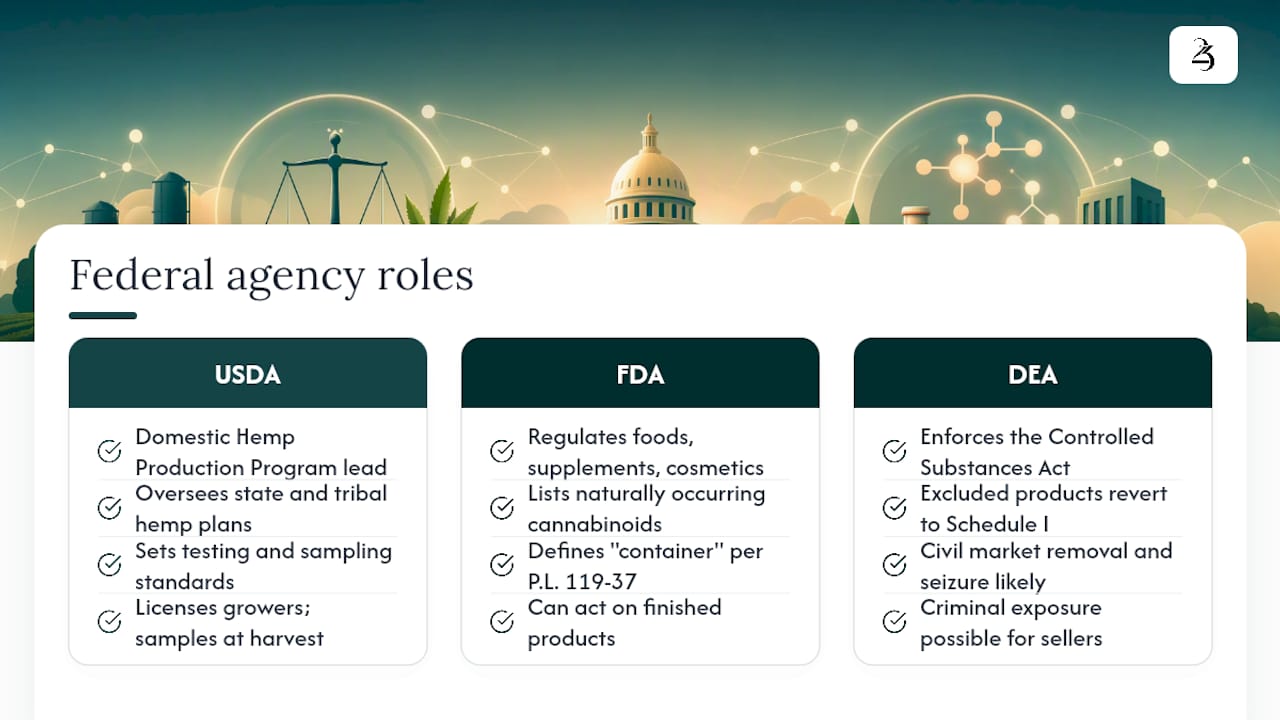
Three federal agencies share jurisdiction over hemp and hemp-derived products, and their roles shift meaningfully under the new definition.
USDA runs the Domestic Hemp Production Program, oversees state and tribal hemp plans, and sets testing and sampling standards for cultivation. USDA’s role is primarily agricultural: licensing, sampling at harvest, and ensuring plant material meets the threshold before it enters commerce.
FDA regulates hemp-derived cannabinoids in foods, dietary supplements, and cosmetics. The agency was explicitly tasked by P.L. 119-37 to list naturally occurring cannabinoids and define “container.” FDA’s existing regulatory posture already treats many hemp-derived cannabinoid products as subject to its oversight, and the new statutory framework gives FDA clearer authority to act on finished products that exceed the container cap.
DEA enforces the Controlled Substances Act. Products that fall outside the hemp definition revert to marijuana under the CSA, which means Schedule I status and potential criminal liability.
Products excluded from the hemp definition by P.L. 119-37 do not occupy a gray area. They become Schedule I controlled substances under the CSA, subject to the same federal enforcement framework as marijuana. Civil market removal and product seizure are the most likely near-term enforcement actions, but criminal exposure exists for producers and distributors who knowingly sell excluded products after the effective date.
Practically speaking, federal enforcement resources are finite, and DEA has historically prioritized large-scale trafficking over small retail operations. State-level enforcement often moves faster and with more granularity than federal action, particularly in states with active hemp regulatory programs. That state dimension matters a lot, as the next section covers.
A practical compliance checklist for hemp businesses before November 2026
The window between now and November 12, 2026 is real working time. Use it. Here’s a prioritized sequence for producers, manufacturers, and retailers:
- Audit every SKU for total THC content. Pull current CoAs and recalculate using the total THC formula (delta-9 + THCA × 0.877). Flag any finished product above 0.4 mg per container immediately.
- Retest raw materials and intermediates. Existing CoAs based on delta-9-only testing are not sufficient. Commission new tests from ISO/IEC 17025-accredited labs using USDA-aligned methods.
- Identify synthesized cannabinoids in your supply chain. Many delta-8 and delta-10 products are chemically converted from CBD, not extracted directly. These fall under the synthesized-cannabinoid exclusion regardless of the mg count.
- Update labeling to reflect total THC per container. Consumers and regulators will both look for this figure. Labels that show only delta-9 THC will be inadequate.
- Implement traceable chain-of-custody documentation. Every batch needs a CoA that travels with it from harvest through finished product, with clear sampling records.
- Consult legal counsel on state-by-state exposure. Federal compliance is the floor, not the ceiling. Some states have stricter rules or outright bans on hemp-derived cannabinoid products. See cannabis compliance guidance for a starting framework.
- Contact your state hemp program office. State plans approved under USDA may have their own testing and labeling requirements that differ from the federal baseline.
- Set a 60-day internal deadline for reformulation decisions. Waiting until October 2026 leaves no time to reformulate, repackage, and retest before the effective date.
How state laws create a patchwork risk for producers and consumers
Federal law sets the floor, but states can go further, and many already have. Even if P.L. 119-37 is delayed or modified at the federal level, state-level restrictions can make a product illegal in specific markets regardless of federal status.
- Some states ban hemp-derived intoxicating products outright, regardless of whether they meet the federal hemp definition. Selling a 2 mg hemp beverage that is federally compliant may still violate state law in those markets.
- State hemp production plans approved by USDA may impose stricter THC thresholds, different testing frequencies, or additional labeling requirements.
- State attorneys general and departments of agriculture have been active in issuing guidance and enforcement actions against delta-8 and similar products, often ahead of federal action.
- Travel and shipping across state lines can change a product’s legal status mid-journey. A hemp beverage that is legal in Minnesota under the Minnesota hemp THC law framework may be illegal in a neighboring state with stricter rules.
For businesses selling nationally, the practical standard is: comply with the strictest state you ship into, not just the federal baseline. Track state attorney general guidance and state hemp program updates alongside federal developments. The legal status of hemp varies enough by state that a single national compliance strategy requires ongoing monitoring.
What do these changes mean for you as a shopper?
If you buy hemp beverages or edibles, the new rules change what you’ll find on shelves and what you should look for on labels. Here’s a practical buying guide for the new era:
- Check total THC per container, not just per serving. A product might list 2 mg per serving but contain five servings in one can, putting total THC at 10 mg per container. Under the new standard, that product falls outside the hemp definition. Look for products that clearly state total THC per container at or below 0.4 mg.
- Ask whether cannabinoids are plant-derived or synthesized. Labels rarely specify this, but it matters legally and practically. Synthesized cannabinoids (common in many delta-8 products) are excluded from the hemp definition regardless of THC content. Look for “plant-derived” or “full-spectrum hemp extract” language and a CoA that confirms the source.
- Don’t assume hemp means non-intoxicating. Hemp-derived THC is chemically identical to marijuana-derived THC. Dosage, bioavailability, and your individual tolerance determine the effect. A hemp THC vs. dispensary THC comparison can help you understand the differences in onset and potency.
- Store products away from children. Hemp beverages and edibles can look like ordinary food and drink. The safe hemp usage guide covers storage and responsible use basics worth reviewing.
- Check with a pharmacist if you take other medications. Hemp-derived cannabinoids can interact with certain drugs. This is general information, not medical advice; a pharmacist or physician is the right resource for your specific situation.
How 23rd State is approaching compliance, and what FRESH PRESS represents
At 23rd State, we’ve been watching this statutory shift closely since P.L. 119-37 passed, and we’ve been building our compliance approach around the new standard rather than waiting for the effective date to arrive.
Here’s what that looks like in practice:
- Third-party lab testing on every batch, using ISO/IEC 17025-accredited labs that report both delta-9 THC and THCA separately, so total THC is calculated and documented on every CoA.
- Plant-derived cannabinoids only. 23rd State products use hemp-derived cannabinoids extracted directly from the plant, not chemically converted from CBD or other precursors. That keeps our products outside the synthesized-cannabinoid exclusion.
- Formulation designed around the per-container standard. FRESH PRESS is crafted with the 0.4 mg per-container threshold in mind, giving you a bright, refreshing hemp beverage experience that’s built for the regulatory environment ahead.
- Labeling that shows total THC per container, not just per serving, so you always know exactly what you’re holding.
If you’re a retailer evaluating your shelf for post-November compliance, or a curious consumer who wants a hemp beverage you can feel good about, FRESH PRESS is a concrete example of what responsible formulation looks like under the new rules.
What the market probably looks like on the other side of November 2026
Here’s an honest take: this statutory change is going to reshape the hemp beverage and edible market more dramatically than most operators are prepared for. Trade groups have estimated that the combination of the total THC standard and the per-container cap could remove a very large share of current intoxicating hemp products from the legal market, with some category estimates suggesting most existing SKUs may be affected. That’s not a minor adjustment; it’s a category reset.
The most likely near-term outcomes:
- Consolidation. Smaller producers without the capital to reformulate and retest will exit the market. Brands that invested early in compliant formulations will gain shelf space.
- Product reformulation at scale. Beverage makers will move toward lower-dose, plant-derived formulations. The 0.4 mg per-container standard effectively defines the new “micro-dose” category.
- Legislative uncertainty continuing through early 2027. A CR delay to December 11 gives the industry a few extra weeks, not a new regulatory framework. Watch for FDA guidance on the naturally occurring cannabinoid list and the “container” definition, both of which will clarify enforcement scope.
- State-level divergence accelerating. States with active hemp programs may move faster than federal agencies to define compliant product categories, creating a patchwork that rewards brands with strong state-by-state legal teams.
What to watch in the next 90–180 days: any FDA rulemaking on cannabinoid lists and container definitions, final appropriations language for FY2027, and state hemp program updates in major markets. The underlying law is not going away on its own.
Ready to try a hemp beverage built for what’s next?
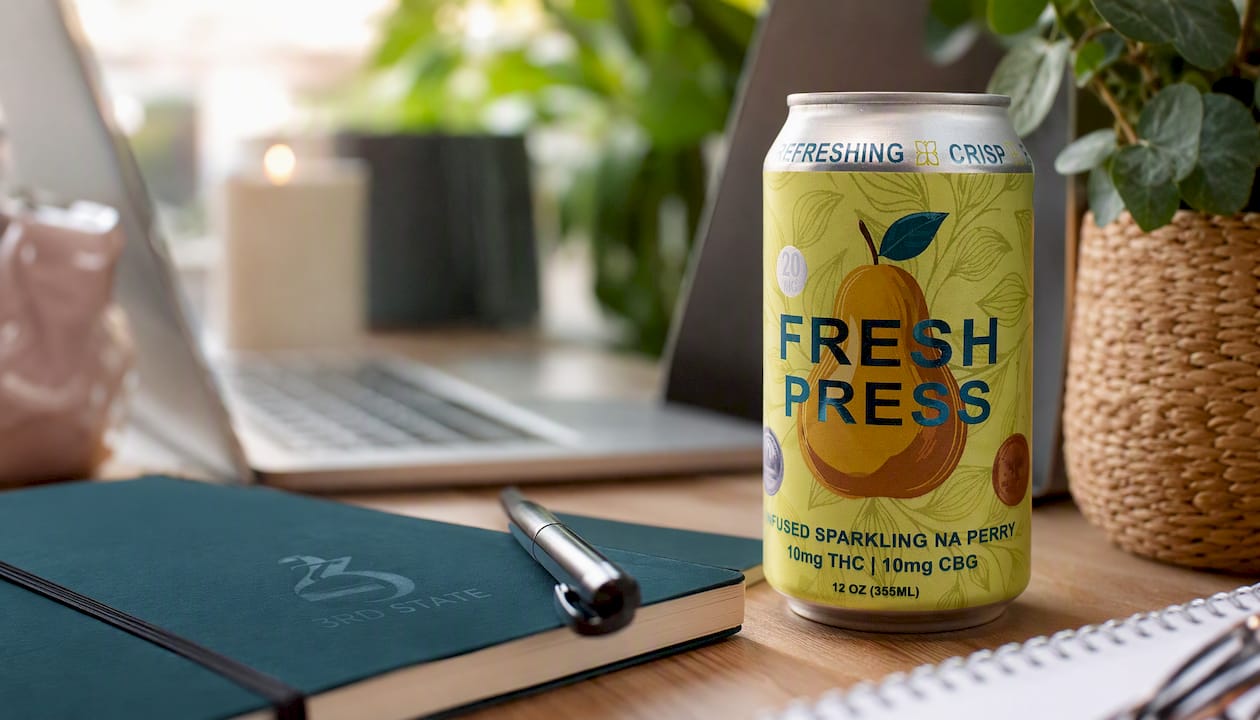
The regulatory picture is shifting, but your Friday wind-down doesn’t have to wait for Congress. 23rd State’s FRESH PRESS is crafted with plant-derived cannabinoids, third-party lab-verified total THC per container, and the kind of bright, clean flavor that makes compliance feel like a bonus rather than a compromise. Every can comes with a CoA you can actually read. If you want a hemp beverage formulated with the new standard in mind, this is the one to crack open.
Sign up for 23rd State compliance updates to stay current as FDA guidance and state rules evolve through the effective date.
Sources
- The FY2026 Agriculture Appropriations Act (P.L. 119-37) — Change to Federal Definition of Hemp and Implications for Federal Enforcement (CRS)
- Change to Federal Definition of Hemp and Implications for Federal Enforcement (CRS PDF)
- Senate continues spending bill talks today — here’s the hemp ban holding it up (Forbes)
- Hemp THC drinks and gummies could get a one month reprieve, but not for every product (MedicalDaily)
- Federal hemp restrictions delayed? What the Senate CR means (Scarinci Hollenbeck client alert)
- FDA — FDA regulation: cannabis and cannabis-derived products, including cannabidiol (CBD)
FAQ
Did the Farm Bill legalize THC?
P.L.
Is hemp THC going to be illegal in 2026?
Hemp-derived THC products that meet the new total THC standard and the 0.4 mg per-container cap remain legal under federal law after November 12, 2026. Products that exceed those limits fall outside the hemp definition and become Schedule I controlled substances under the CSA.
Is hemp THC as strong as marijuana THC?
Delta-9 THC from hemp is chemically identical to delta-9 THC from marijuana. Potency depends on dose, not source. A hemp beverage with 5 mg of total THC can produce effects comparable to a low-dose marijuana product at the same serving size.
Did the funding bill ban hemp?
P.L. 119-37 did not ban hemp outright. Products that cannot meet those standards are excluded from the hemp definition, but compliant hemp cultivation and products remain legal.
