

TL;DR:
- Most U.S. THC tinctures cost between $0.03 and $0.13 per milligram, depending on quality and potency.
- Checking price per milligram reveals the true value, which is more informative than bottle size or brand.
Most U.S. THC tinctures fall somewhere between $15 and $135 depending on potency, extraction method, and where you buy. The fastest way to cut through the noise: divide the listed price by total milligrams. That single number, your cost per mg, tells you more than the bottle size or brand name ever will.
TL;DR at a glance:
- Budget band ($0.03–$0.06/mg): Typically distillate or isolate-based, minimal flavoring, often private-label. Fine for regular users who know their dose.
- Mid-range ($0.06–$0.10/mg): The sweet spot for most shoppers. Usually CO2-extracted, third-party tested, with clear mg-per-dropper labeling.
- Premium ($0.13+/mg): Full-spectrum formulations, dual-cannabinoid ratios, premium carrier oils, or a well-known brand name. Sometimes worth it; sometimes a brand tax.
Table of Contents
- What do THC tinctures actually cost on U.S. dispensary menus?
- How does bottle potency map to your actual dose?
- Why do two 500 mg tinctures cost completely different amounts?
- What should you check before buying a tincture?
- Key Takeaways
- Why price-per-mg is the only metric that actually matters
- 23rd State’s hemp-derived THC options hit the value and clarity marks
- Further reading and sources
- FAQ
What do THC tinctures actually cost on U.S. dispensary menus?
Dispensary menus in 2026 show a consistent pattern once you map price to potency. A 300 mg bottle typically lists for $45–$60, a 500 mg bottle runs $60–$90, and a 1000 mg bottle spans $45–$135 depending on the market and applicable state taxes. That wide spread on the 1000 mg tier is exactly why price per mg matters so much.
| Package | Bottle size | Total THC | Listed price | Price per mg |
|---|---|---|---|---|
| Entry-level 300 mg | 30 mL | 300 mg | $45 | $0.15/mg |
| Mid-range 500 mg | 30 mL | 500 mg | $75 | $0.15/mg |
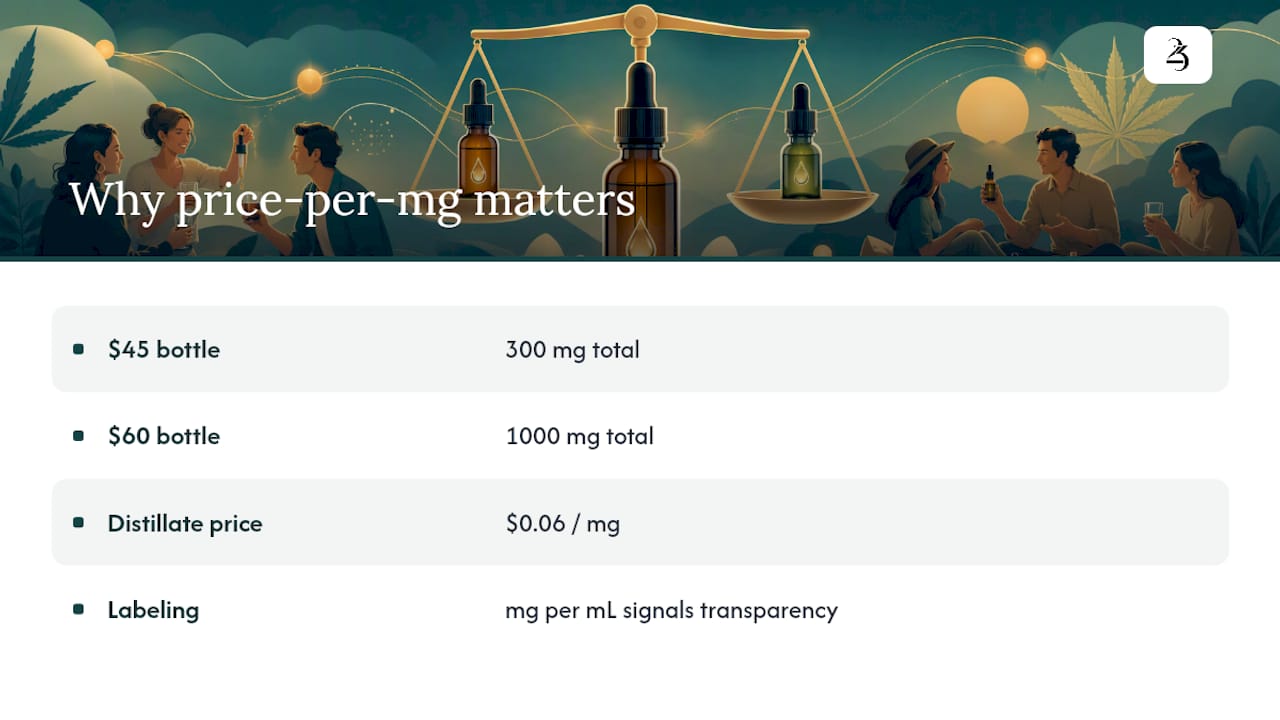
| Value 1000 mg | 30 mL | 1000 mg | $60 | $0.06/mg |
| Premium 1000 mg | 30 mL | 1000 mg | $135 | $0.135/mg |
Notice that the 300 mg and 500 mg examples above both land at $0.15/mg despite different price tags. The 1000 mg bottles show the real range: a value option at $0.06/mg versus a premium formulation at $0.10/mg. According to PrestoDoctor’s 2026 pricing benchmarks, the average retail unit price for a marijuana tincture sits around $62.50, with anything above $0.10/mg often reflecting a brand premium rather than a meaningful quality jump.
For beginners, a 300 mg bottle at a fair per-mg rate is a low-commitment way to learn your dose. Regular users who already know they need 10–25 mg per session get far better value from a 1000 mg bottle, even at a slightly higher unit price.
How does bottle potency map to your actual dose?
A standard tincture bottle is 30 mL. A standard dropper holds 1 mL, which is roughly 20 drops. Leafwell’s dosing guidance confirms this math and recommends it as the baseline for calculating mg per dropper.
The formula: Total mg ÷ total mL = mg per mL. Since one dropper = 1 mL, mg per mL = mg per dropper.
| Dose level | Typical mg per session | Dropper volume (1000 mg/30 mL bottle) | Dropper volume (300 mg/30 mL bottle) |
|---|---|---|---|
| Starter (microdose) | 2.5–5 mg | ~0.15 mL | ~0.25 mL |
| Moderate | 10–25 mg | ~0.3 mL | ~1–2.5 mL |
| Experienced | 25–50 mg | ~0.75 mL | ~2.5–5 mL |
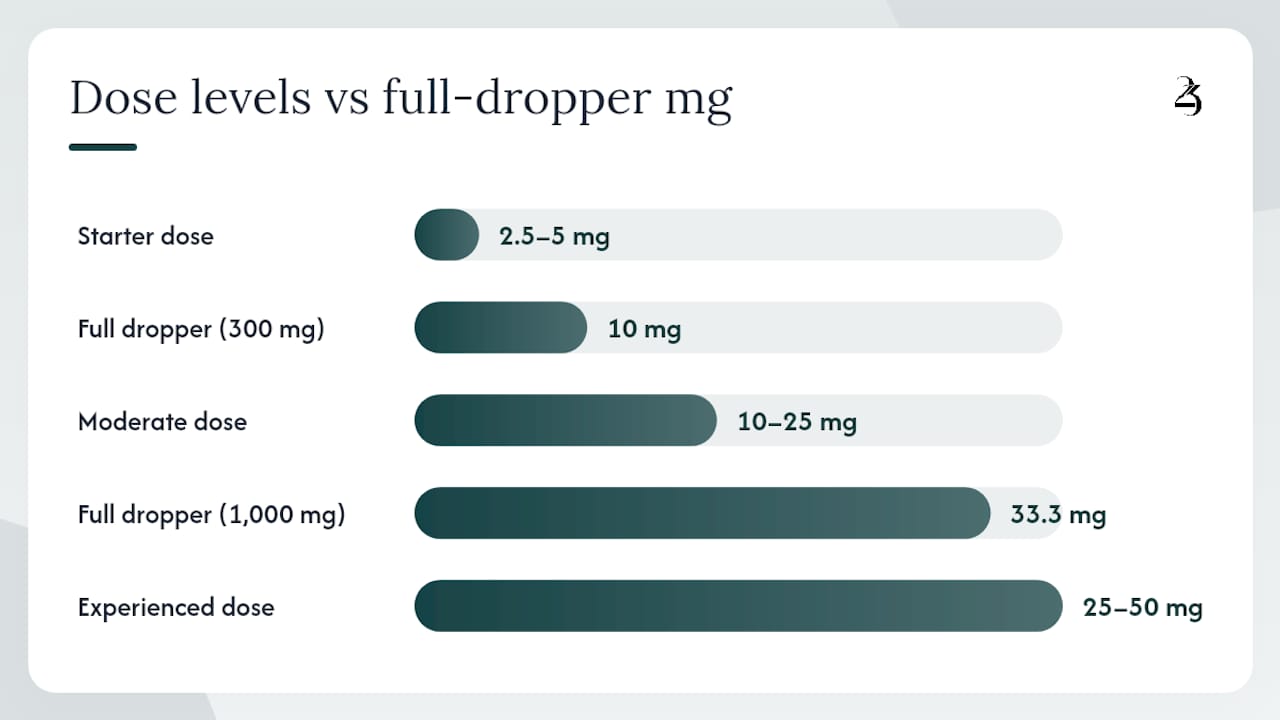
A 1000 mg / 30 mL bottle delivers an amount per full dropper that constitutes a moderate-to-high dose for most people. A 300 mg / 30 mL bottle delivers a friendlier dose per full dropper suitable for beginners finding their footing.
For sublingual use (held under the tongue for 60–90 seconds), onset typically runs 15–45 minutes, with effects lasting 2–6 hours. That window is longer than a beverage but shorter than a traditional edible. You can also mix tinctures into drinks for a more social, sippable experience, though onset shifts closer to the edible timeline when swallowed.
Pro Tip: If you are new to tinctures, start with 2.5–5 mg and wait a full 90 minutes before considering a second dose. The safe cannabis dosage guide from 23rd State walks through this step by step.
Why do two 500 mg tinctures cost completely different amounts?
Price variation in cannabis tinctures is real, and most of it traces back to five factors. Understanding them helps you decide which premiums are worth paying.
- Extraction method: CO2 extraction preserves a broader cannabinoid and terpene profile than solvent-based methods. Gamut Packaging’s cost breakdown identifies CO2 extraction, premium flower inputs, and full third-party COA testing as the primary cost drivers that legitimately justify a higher retail price.
- Spectrum and formulation: Full-spectrum products contain minor cannabinoids and terpenes alongside THC. Distillate or isolate products are purer THC but lack that broader profile. Full-spectrum commands a premium; whether that premium fits your needs depends on what you are after.
- Third-party lab testing and COAs: A Certificate of Analysis (COA) from an independent lab verifies potency and screens for pesticides and heavy metals. Products without a publicly linked COA are a red flag, not a deal.
- Carrier oils and flavoring: MCT oil, hemp seed oil, and flavoring ingredients add cost. Unflavored, basic-carrier options tend to be cheaper.
- State taxes and local supply: MJ Biz Daily’s historical analysis found tinctures and sublinguals averaged about $0.32/mg in tracked markets, with Colorado at $0.41/mg versus Nevada at $0.25/mg. State excise taxes, local supply chains, and licensing costs all feed into that gap.
The honest takeaway: CO2 extraction, verified COAs, and quality carrier oils are premiums worth paying. A logo on the label is not.
What should you check before buying a tincture?
The label and product page tell you almost everything you need. Here is what to verify before you commit.
A good tincture listing shows total THC in mg, bottle size in mL, and ideally mg per dropper or mg per mL. If any of those are missing, the math gets guesswork. Check for a linked COA from a third-party lab, not just a mention that testing was done. The COA should show a potency result that matches the label claim within a reasonable margin.
Ask these questions at the dispensary or on the product page:
- What is the mg per dropper at the listed potency?
- Is the COA from an independent lab, and is it current?
- Is this full-spectrum, broad-spectrum, or isolate?
- What carrier oil is used (MCT, hemp seed, other)?
Red flags to skip past:
- No COA link, or a COA that is more than a year old
- Vague potency language (“high potency” with no mg count)
- Discounts that seem too steep without a clear reason (clearance, expiry)
- Labels that list only “hemp extract” without a THC mg count
Pro Tip: Understanding how potency affects your wellness choices is the fastest way to match a bottle’s mg count to your actual dose needs, especially if you are comparing a 300 mg option to a 1000 mg one.
Key Takeaways
The single most useful number when comparing tincture prices is price per mg: divide the listed price by total THC in milligrams before you buy anything.
| Point | Details |
|---|---|
| Price-per-mg sweet spot | $0.05–$0.10/mg is the competitive range; above $0.13/mg often reflects brand premium. |
| Dropper math | A 30 mL bottle with a 1 mL dropper delivers mg/mL = total mg ÷ 30; one dropper equals that number. |
| COA transparency | Always verify a current, third-party COA before buying; no COA is a hard pass. |
| State price variance | Per-mg costs vary by state: Colorado has historically run higher ($0.41/mg) than Nevada ($0.25/mg). |
| 23rd State’s approach | 23rd State’s SHAKE and FRESH PRESS products offer clear mg labeling and transparent dosing for confident, social-ready use. |
Why price-per-mg is the only metric that actually matters
Most tincture shoppers fixate on the unit price and miss the real story. A $45 bottle sounds like a deal until you realize it holds 300 mg and a $60 bottle next to it holds 1000 mg. The $60 bottle is not just cheaper per mg; it is less than half the cost per dose.
What gets overlooked even more is the relationship between dose clarity and actual value. A bottle that lists total THC but not mg per dropper forces you to do math at the counter, and most people do not. Brands that print mg per mL directly on the label are not just being helpful; they are signaling that they stand behind the potency claim. That transparency correlates strongly with products that also publish full COAs, use cleaner extraction methods, and do not pad their price with marketing.
The other thing worth saying plainly: the premium full-spectrum conversation is real, but it is often overstated for casual or social use. If you are winding down on a Friday or adding a tincture to a sparkling drink at brunch, a well-made distillate at $0.06/mg does the job beautifully. Save the full-spectrum premium for moments when the broader cannabinoid profile genuinely matters to you.
23rd State’s hemp-derived THC options hit the value and clarity marks
23rd State’s SHAKE, FRESH PRESS, and Blush Crush are built around the two things this guide keeps coming back to: clear mg labeling and honest value per dose. Each product lists its THC content plainly, so you can run the price-per-mg math in seconds and know exactly what you are getting before you open the bottle.
FRESH PRESS is the pick for anyone who wants a clean, bright flavor and a social-ready format. Blush Crush brings a softer, rose-tinted vibe that fits a weekend brunch or a wind-down evening. SHAKE is the everyday option: consistent, well-dosed, and priced for regular use without the brand-tax markup.
All three are hemp-derived, ship across the U.S. where permitted, and come with the dosing transparency that makes them easy to compare against anything else on your menu. Browse the full 23state collection and find the right fit for your moment.
Further reading and sources
These are the primary sources behind the pricing benchmarks, dosing guidance, and state comparisons in this article.
- 2026 Marijuana Tincture Cost Guide: The True Value Matrix — PrestoDoctor
- How to dose cannabis tinctures - Leafwell
- Chart: Price per milligram of THC varies between cannabis-infused products
- Tincture Price Index | Blazed Deals
- Online Cannabis Price Benchmarks: US Market Reference 2026 | CannabisDealsUS
- How Much Does a Marijuana Tincture Cost? — Gamut Packaging
- The Price of Medical Cannabis in Texas: A Comprehensive Overview in 2025 | MMJ
- Can You Mix THC Tinctures with Drinks? Safe Tips & Recipes – 23rd State
FAQ
Are THC tinctures worth the price?
Yes, when you buy by price per mg rather than unit price. A $60 bottle at 1000 mg ($0.06/mg) delivers far more value than a $45 bottle at 300 mg ($0.15/mg), and clear COA documentation confirms you are getting what you paid for. Some premium tinctures may cost $0.13/mg or more.
How long do tincture effects last?
Sublingual tinctures typically kick in within 15–45 minutes and last 2–6 hours. Swallowing the dose (or mixing it into a drink) shifts onset closer to 45–90 minutes with a longer duration, similar to a traditional edible.
How much THC is in a full dropper?
It depends on the bottle’s potency. Divide total mg by total mL to get mg per mL; one full dropper (1 mL) equals that number. A 1000 mg / 30 mL bottle delivers about 33.3 mg per dropper; a 300 mg / 30 mL bottle delivers about 10 mg.
What is the best THC tincture for a first-time buyer?
Look for a bottle in the 300–500 mg range with a clearly labeled mg-per-dropper figure, a linked third-party COA, and a price between $0.06 and $0.10/mg (or up to $0.13/mg for premium options). 23rd State’s FRESH PRESS checks all three boxes and adds a clean, approachable flavor that makes starting low and going slow genuinely enjoyable.
How do dispensary prices compare to buying online?
Online hemp-derived THC products often land in the $0.05–$0.10/mg range with subscription or bundle discounts available. Licensed dispensary prices vary more by state due to excise taxes and local supply, and can run higher per mg for the same potency tier.
Recommended
- Can You Mix THC Tinctures with Drinks? Safe Tips & Recipes
- THC Drinks Education: Beverage Guides, Dosing & Wellness
- How to Compare THC vs CBG: A Clear Guide for 2025
- How many mg THC per serving? Your edible dosing guide
This article is general information, not medical or legal advice. Cannabis laws and product availability vary by state; confirm current rules with your state’s regulatory authority or a qualified professional before purchasing.
