

TL;DR:
- Inhalation offers the highest bioavailability for CBD, delivering effects within minutes. Oral infusions provide slower onset and lower absorption but can be enhanced by food, especially fats. The choice of infusion method depends on desired effects, lifestyle, and personal preferences.
Infusion methods are defined as the techniques used to bind hemp and CBD compounds into a carrier, whether oil, alcohol, water, or food, so your body can absorb them. The differences in infusion methods determine how fast you feel effects, how much of the compound actually reaches your bloodstream, and how enjoyable the whole experience is. Inhaled CBD delivers bioavailability of 25–55%, while oral ingestion lands at just 4–12%. That gap is not a minor detail. It shapes everything from your dose to your Friday night vibe.
What are the main types of infusion methods?
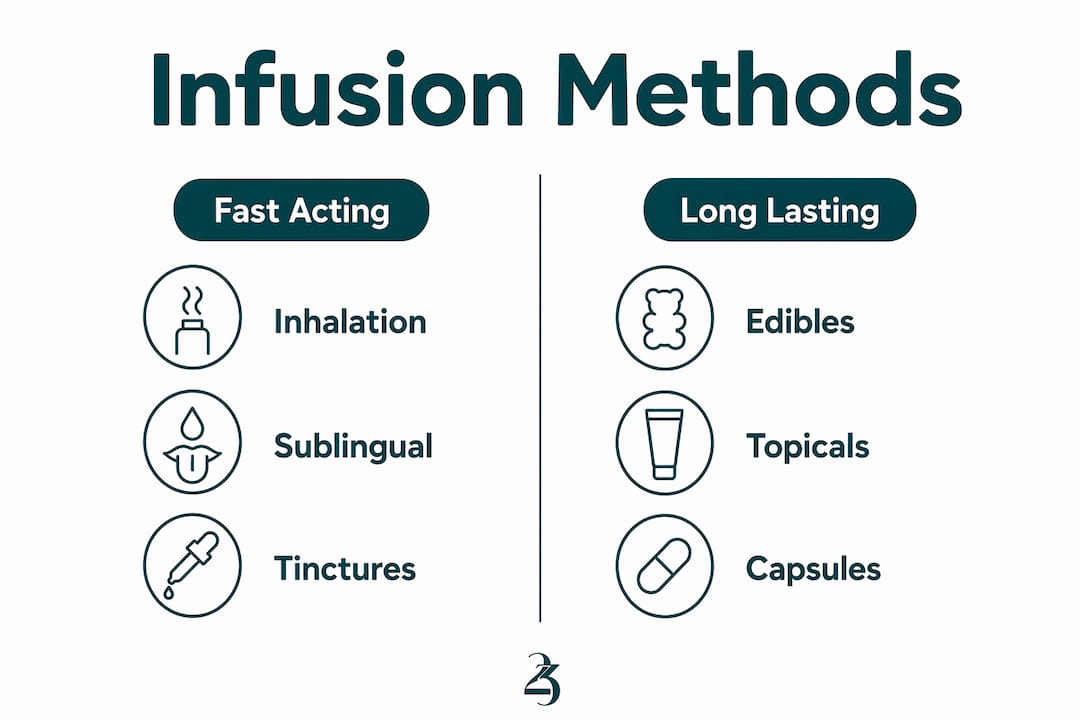
Hemp and CBD products reach your body through five core delivery formats. Each one works differently, and knowing the difference helps you choose with confidence.
Oil-based infusions suspend CBD or THC in a fat-soluble carrier like coconut oil or MCT oil. They are mild in taste, gentle on beginners, and versatile enough to stir into food or drinks. The tradeoff is a shorter shelf life and slower absorption compared to alcohol-based options.
Alcohol-based tinctures use ethanol to extract and carry cannabinoids. Tinctures offer faster absorption and a longer shelf life than oil infusions, but the taste is noticeably stronger. They work well sublingually, meaning you hold them under your tongue for 30–60 seconds before swallowing.
Inhalation covers vaping and smoking. This method delivers cannabinoids directly into the lungs and bloodstream, producing effects within minutes. The speed is unmatched, but inhalation carries respiratory considerations that other formats avoid entirely.
Edibles and capsules are infused foods or gel caps that pass through your digestive system. Onset is slower, ranging from 30 to 120 minutes, but effects tend to last longer. Beverages like 23rd State’s SHAKE and Blush Crush fall into this category, with the added benefit of nanoemulsion technology that improves consistency.
Topicals and transdermals apply cannabinoids directly to the skin. Topicals work locally and do not typically produce full-body effects. Transdermal patches penetrate deeper and can reach the bloodstream, making them a distinct subcategory worth understanding.
| Method | Delivery mechanism | Onset time | Bioavailability |
|---|---|---|---|
| Inhalation | Lungs to bloodstream | Minutes | 25–55% |
| Sublingual tincture | Mucous membranes | 15–45 minutes | 13–20% |
| Oral edibles/beverages | Digestive system | 30–120 minutes | 4–12% |
| Topical | Skin surface, local | 30–60 minutes | Minimal systemic |
| Transdermal patch | Skin to bloodstream | 60–120 minutes | Moderate |
How do infusion methods differ in bioavailability and onset time?
Bioavailability is the percentage of a compound that actually enters your bloodstream and produces an effect. The rest is lost to digestion, metabolism, or poor absorption. This number varies dramatically across infusion formats.
Inhaled CBD reaches 25–55% bioavailability with onset in minutes. That makes inhalation the fastest and most efficient delivery method available. Sublingual oils land at roughly 13–20% bioavailability with a 15–45 minute onset, though there is an important catch.
In practice, sublingual and oral absorption often converge because most people swallow the oil before full mucosal uptake occurs. Holding a tincture under your tongue for a full 60 seconds matters more than most labels suggest. Skip that step and you are essentially just taking an oral dose.
Oral ingestion sits at 4–12% bioavailability with a 30–120 minute onset. That range sounds discouraging, but food changes everything. A high-fat meal increases CBD absorption by up to 5-fold compared to taking it on an empty stomach. A handful of nuts or an avocado toast before your hemp beverage is not just a good brunch. It is a smarter dose.
Oral CBD also shows high variability between individuals due to differences in gut physiology, enzyme activity, and formulation. Two people can take the same edible and feel very different results. That is not a product flaw. It is biology, and it is why starting low and going slow is always the right call.
Pro Tip: Pair your hemp beverage or edible with a meal that contains healthy fats. Avocado, nuts, olive oil, or full-fat yogurt can meaningfully increase how much CBD your body absorbs.
| Method | Bioavailability | Onset | Duration |
|---|---|---|---|
| Inhalation | 25–55% | 1–5 minutes | 1–3 hours |
| Sublingual tincture | 13–20% | 15–45 minutes | 4–6 hours |
| Oral edible/beverage | 4–12% | 30–120 minutes | 4–8 hours |
| Topical | Minimal systemic | 30–60 minutes | Localized |
What are the practical implications of choosing one infusion method?
Choosing an infusion method is not just a science question. It is a lifestyle question. The right format depends on when you want to feel effects, what you are doing, and how you want the experience to taste.
Here is a practical breakdown of what each format delivers in real life:
- Oil infusions are beginner-friendly and food-versatile. Stir them into smoothies, salad dressings, or coffee. They taste mild and feel approachable. Shelf life runs shorter than tinctures, so store them in a cool, dark place and use them within a few months.
- Alcohol tinctures are efficient and long-lasting on the shelf. They absorb faster sublingually and work well for people who want a consistent daily routine. The strong taste is real, but mixing into a drink masks it easily. Learn more about carriers in tinctures to understand which base suits your goals.
- Inhalation is fast but comes with respiratory tradeoffs. It suits experienced consumers who want immediate, controllable effects. It is not the format for a casual brunch crowd or anyone with lung sensitivities.
- Edibles and beverages are social, delicious, and discreet. The slower onset requires patience, but the longer duration makes them ideal for evenings, celebrations, or wind-down moments. Check out how to maximize hemp edibles for practical tips on getting the most from this format.
- Topicals are non-intoxicating and targeted. They are perfect for localized use without any full-body effect.
One often-overlooked consideration is product quality verification. Always look for a batch-matched Certificate of Analysis (COA) from a third-party lab before buying any infused product. A COA confirms potency, purity, and the absence of contaminants. Knowing how to read a COA takes about five minutes and protects you from underdosed or mislabeled products.
Pro Tip: If you are making a DIY oil infusion at home, let the oil drip naturally through a strainer rather than squeezing the plant material. Squeezing adds bitter chlorophyll that worsens both taste and shelf stability.
How do extraction and infusion techniques impact product quality?
The quality of any infused product starts before the infusion itself. Extraction is the process of pulling cannabinoids out of the hemp plant, and the method used shapes everything downstream.
CO2 extraction delivers the highest purity and precision, making it the preferred choice for premium products. Ethanol extraction is cost-effective and scales well for larger production runs. Solventless methods, like ice water hash or rosin pressing, avoid chemical residues entirely but are harder to scale. The right choice depends on the producer’s goals for purity, cost, and volume. Learn more about cannabinoid extraction methods and how they connect to the final product you drink or apply.
Emulsification technology is where beverage infusions get genuinely exciting. Standard oil-based CBD does not mix with water, which is why most hemp beverages use emulsification or nanoemulsion to break cannabinoids into microscopic droplets. Nanoemulsions may improve oral bioavailability by creating particles small enough to interact more efficiently with the gut lining. Early data is promising, and the practical result is a more consistent, faster-acting beverage experience compared to traditional oil-based edibles.
Emulsion-based formulations also reduce the variability caused by gastric emptying and digestive enzymes, producing more predictable absorption than bulk oil formats. That consistency matters when you are trying to enjoy a specific, intentional experience rather than guessing how you will feel in an hour.
Key Takeaways
The infusion method you choose directly determines how much hemp or CBD your body absorbs, how fast you feel it, and how long the experience lasts.
| Point | Details |
|---|---|
| Bioavailability varies widely | Inhaled CBD reaches 25–55% bioavailability; oral edibles deliver just 4–12%. |
| Food boosts oral absorption | A high-fat meal can increase oral CBD absorption by up to 5-fold. |
| Sublingual timing matters | Hold tinctures under your tongue for a full 60 seconds to avoid swallowing before absorption. |
| Extraction quality shapes the product | CO2 extraction delivers the highest purity; always verify with a batch-matched COA. |
| Nanoemulsion improves consistency | Beverage formats using nanoemulsion technology produce more predictable onset and absorption. |
What I have learned from years of infusion method variations
No single infusion method wins for every situation. That is the honest truth, and anyone who tells you otherwise is selling you a shortcut.
Inhalation is fast and efficient, but it is not the format for a celebratory Saturday brunch or a wind-down with friends. Edibles and beverages are social, approachable, and genuinely enjoyable, but they ask for patience and a little food pairing knowledge. Tinctures sit in the middle, useful for daily routines but easy to misuse if you rush the sublingual step.
What I keep coming back to is this: the best infusion method is the one you will actually use correctly and consistently. A high-bioavailability inhalation method means nothing if the experience does not fit your lifestyle. A hemp beverage with nanoemulsion technology and a great flavor profile, taken with a meal, can deliver a genuinely satisfying and repeatable experience.
Read your labels. Check your COAs. Start with a low dose and give your body time to respond before reaching for more. The onset time for cannabis drinks is longer than most people expect, and patience is the skill that separates a great experience from a frustrating one.
— Leah Kollross, founder, 23rd State
23rd State’s Blush Crush: infusion done right
Blush Crush from 23rd State is a hemp-infused beverage built around the principles that make infusion methods actually work. It uses nanoemulsion technology for consistent, predictable absorption, so you are not left guessing when or how hard it will hit. The flavor is bright and refreshing, the kind of drink you reach for at a rooftop gathering or a slow Sunday afternoon. Each can is crafted with quality extraction at its foundation and verified with third-party lab testing. If you are ready to experience what a well-made hemp beverage feels like, Blush Crush is the place to start.
FAQ
What is the most bioavailable infusion method for CBD?
Inhalation is the most bioavailable method, delivering 25–55% of CBD into the bloodstream with onset in minutes. Oral edibles and beverages have the lowest bioavailability at 4–12%.
How do infusion methods differ in onset time?
Inhaled methods work in minutes, sublingual tinctures take 15–45 minutes, and oral edibles or beverages take 30–120 minutes. Topicals work locally within 30–60 minutes but produce minimal systemic effects.
Does food affect how well oral CBD infusions work?
Yes. Taking oral CBD with a high-fat meal can increase absorption by up to 5-fold compared to taking it on an empty stomach. Foods like avocado, nuts, and olive oil are particularly effective.
What is the difference between a tincture and an oil infusion?
Alcohol-based tinctures absorb faster and last longer on the shelf, but have a stronger taste. Oil-based infusions are milder and better for beginners, though they have a shorter shelf life and slower absorption.
Why do two people feel different effects from the same hemp edible?
Oral CBD absorption varies significantly between individuals due to differences in gut physiology, enzyme activity, and formulation factors. Starting with a low dose and adjusting gradually is the most reliable approach.
