

TL;DR:
- Traveling with hemp products is legal under federal law when they contain no more than 0.3% delta-9 THC and are properly documented. TSA aligns its policies with federal regulations, allowing compliant products on flights, but travelers should carry a batch-specific Certificate of Analysis and original packaging for verification. It is essential to research destination state laws, pack carefully, and avoid homemade or unlabeled products to prevent issues at security checkpoints.
Traveling with hemp products is legally permissible under federal law when you follow strict guidelines for THC content, packaging, and documentation. The 2018 Farm Bill established hemp as a legal agricultural commodity, defining it as cannabis containing no more than 0.3% delta-9 THC by dry weight. That 0.3% threshold is the single most important number you need to know before packing. The Transportation Security Administration (TSA) aligns its screening policies with federal law, meaning compliant hemp products can fly with you. Knowing the rules ahead of time turns what feels like a gray area into a clear, confident checklist.
What hemp products are allowed on planes?
Hemp-derived products that meet the federal 0.3% delta-9 THC limit are permitted on domestic flights. That covers a wide range of items you might already love, from gummies and capsules to tinctures, oils, and topicals. The key distinction travelers need to understand is the difference between three product types: CBD isolate, broad-spectrum CBD, and full-spectrum CBD.
- CBD isolate contains only cannabidiol with no other cannabinoids. It carries the lowest travel risk because there is no THC present at all.
- Broad-spectrum CBD includes multiple cannabinoids and terpenes but has THC removed during processing. It is a solid middle-ground choice for travelers.
- Full-spectrum CBD retains all naturally occurring cannabinoids, including up to 0.3% THC. It is federally legal but draws more scrutiny at security if packaging is unclear.
Legal experts recommend CBD isolates or broad-spectrum products to minimize THC-related travel risks compared to full-spectrum options. Full-spectrum products are not off-limits, but they require tighter documentation to back up their compliance. TSA’s screening policy aligns with federal hemp law, so a properly labeled, compliant product should clear security without drama. The legal status of hemp has been federally settled since 2018, but product type still shapes your risk level at the checkpoint.
What documentation do you need when flying with hemp?
Carrying the right paperwork is the single most underrated move a traveler can make. A batch-specific Certificate of Analysis, commonly called a COA, is your most powerful document. The COA must match the lot number on your product and confirm that delta-9 THC tests at or below 0.3% by dry weight. That document proves your product is hemp, not marijuana, in the eyes of any law enforcement officer who gets involved.
Here is what to have ready before you reach the airport:
- Batch-specific COA: Download it from the brand’s website or request it directly. Match the lot number on the label to the lot number on the COA.
- Original packaging: Keep products in their factory-sealed, professionally labeled containers. Homemade or unlabeled packaging raises immediate red flags.
- Purchase receipt: A receipt showing the retailer and product name adds a layer of credibility if questions arise.
- Product label with QR code: Many quality brands include a QR code linking directly to third-party lab results. That is instant verification in an officer’s hands.
Pro Tip: Save a digital copy of your COA in your phone’s photos or a cloud folder. Paper copies can get lost, but your phone is always with you at the checkpoint.
TSA agents cannot visually distinguish hemp-derived CBD from illegal marijuana by sight alone. That reality makes original, professional packaging non-negotiable. A well-labeled product with a matching COA tells the whole story before anyone has to ask a question. Knowing how to pick legal hemp from a quality brand means your documentation will already be solid before you pack.
How does TSA screening work for hemp products?
TSA’s primary mission is aviation security, not drug enforcement. That distinction matters enormously for hemp travelers. TSA security officers do not conduct on-the-spot chemical tests for THC concentrations at airport checkpoints. If a product is flagged, TSA refers the matter to local law enforcement, and that officer makes the legality call based on state and federal law.
“TSA’s screening procedures are focused on security and are not specifically designed to detect marijuana or other drugs. In the event a substance appears to be marijuana or a cannabis-infused product, TSA will refer the matter to a law enforcement officer.” — TSA official policy
A few critical rules govern how hemp products move through the checkpoint:
- Liquids follow the 3-1-1 rule: Hemp tinctures, oils, and infused beverages must fit in containers of 3.4 ounces (100 ml) or less, packed in a single quart-sized clear bag. Exceeding liquid limits leads to confiscation, full stop.
- Solid products are exempt from liquid rules: Gummies and capsules are not subject to the 3-1-1 restriction. Pack them in original packaging in your carry-on or checked bag.
- Checked baggage is an option for larger quantities: Liquids over 3.4 ounces must go in checked luggage, still in original packaging with documentation accessible.
- TSA policy has not changed in 2026: TSA’s April 2026 website update reduced cautionary language but did not change enforcement. Travelers should not read that edit as permission to carry non-compliant products.
Are hemp products legal to travel with across all states?
Federal compliance clears you through TSA, but it does not guarantee smooth sailing at your destination. State laws on hemp and cannabinoids vary widely, and some states impose restrictions that go beyond federal rules. A product that is perfectly legal under the 2018 Farm Bill may still conflict with laws in certain states.
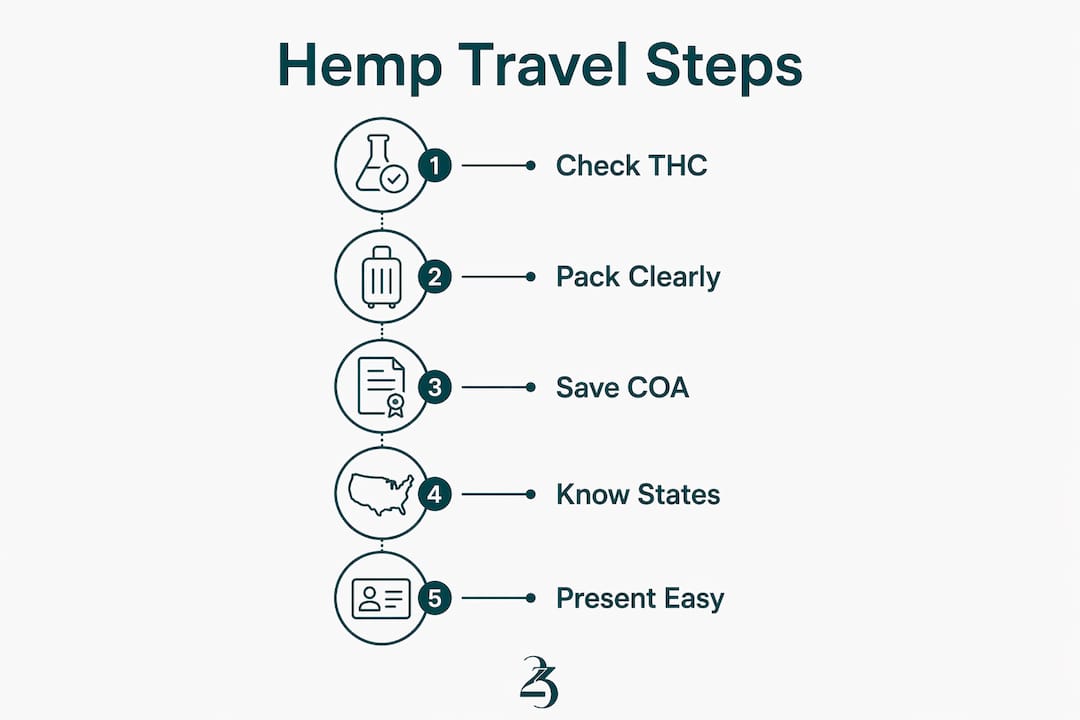
Federal law permits hemp-derived CBD with 0.3% THC or less on flights, but state laws at your destination govern what happens after you land. That gap between federal and state law is where travelers get caught off guard.
Follow these steps before every trip:
- Research your destination state’s hemp laws. Some states restrict delta-8 THC, delta-10 THC, or specific cannabinoid concentrations even when the product is federally compliant.
- Check your departure state’s rules too. A handful of states have stricter possession rules that apply before you even reach the gate.
- Avoid full-spectrum products when traveling to states with stricter rules. Broad-spectrum or isolate products carry less legal exposure in ambiguous jurisdictions.
- Minimize quantity. Carry only what you need for the trip. A smaller amount signals personal use and reduces scrutiny.
- Use the cannabis regulatory overview as a starting reference. State-level rules shift frequently, so verify with official state government sources before you fly.
Pro Tip: If you are traveling to a state where hemp regulations are unclear, choose a CBD isolate product. Zero THC means zero ambiguity, regardless of local law.
Practical tips to avoid common mistakes when flying with hemp
Most hemp travel problems are preventable. The mistakes that cause delays or confiscation almost always come down to packaging, quantity, or missing paperwork.
- Never use homemade containers. Unlabeled or repacked products look identical to illegal cannabis to a TSA agent. TSA cannot differentiate hemp from marijuana by appearance alone, so ambiguous packaging triggers secondary screening.
- Keep liquids under 3.4 ounces in your carry-on. Many travelers mistakenly assume hemp oils are exempt from the 3-1-1 rule. They are not.
- Carry your COA in two formats. A printed copy and a digital photo on your phone covers every scenario.
- Stay calm if questioned. TSA’s focus is security. If you have original packaging and a matching COA, you have the documentation to support your product’s legality.
- Do not overpack. Bringing a week’s supply of tinctures in a carry-on creates unnecessary volume and attention. Pack what you need, nothing more.
- Check the hemp travel essentials guide before your next trip. A quick pre-flight review of your packing list saves real headaches at the checkpoint.
Pro Tip: Place your hemp products at the top of your bag before going through security. Easy access means you can present packaging and documentation quickly if asked, without digging through your luggage.
Key Takeaways
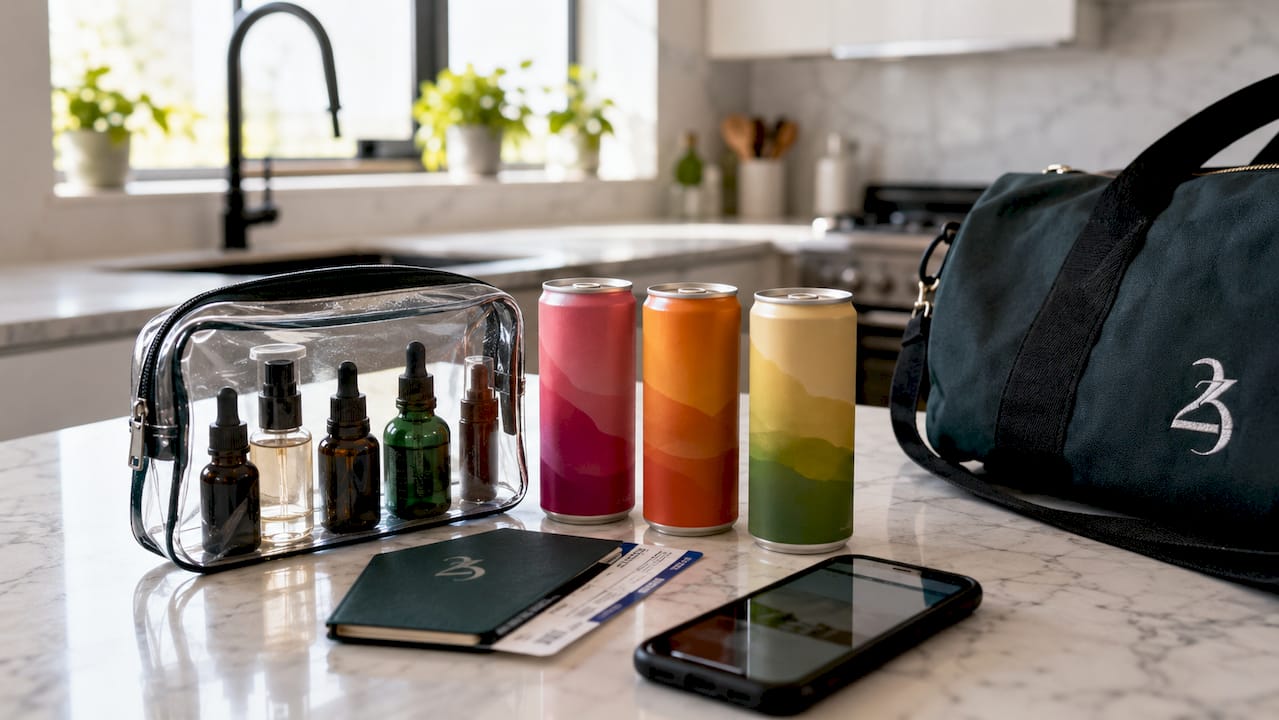
Traveling safely with hemp products requires federal compliance, proper documentation, and destination awareness at every step.
| Point | Details |
|---|---|
| Know the THC limit | Products must contain 0.3% delta-9 THC or less by dry weight to be federally legal for travel. |
| Carry your COA | A batch-specific Certificate of Analysis matching your product’s lot number is your strongest proof of compliance. |
| Follow the 3-1-1 rule | Hemp liquids and tinctures in carry-ons must be 3.4 ounces or less; solids like gummies are exempt. |
| Check destination state laws | Federal compliance does not override stricter state rules at your destination. |
| Use original packaging | Factory-sealed, professionally labeled containers prevent confusion and reduce the risk of confiscation. |
My honest take on hemp travel in 2026
I have watched the hemp travel conversation shift dramatically over the past few years, and the biggest mistake I see travelers make is assuming that federal legality means zero friction. It does not. TSA’s policy continuity since 2019 means the rules are stable, but enforcement still depends on the individual officer and the local law enforcement agency at each airport.
The April 2026 website update from TSA generated a wave of headlines suggesting a policy shift. There was no shift. The wording changed; the enforcement did not. Travelers who read those headlines and assumed they could now pack non-compliant products learned that lesson the hard way.
What actually works is boring but reliable: original packaging, a matching COA, and a product that is clearly within the 0.3% THC limit. I lean toward broad-spectrum or isolate products for any trip that crosses state lines, simply because they remove the THC variable entirely. Full-spectrum products are legal and wonderful, but they require more documentation confidence than most casual travelers want to manage at 6:00 AM in a security line.
The good news is that compliant hemp products are genuinely easy to travel with when you prepare. Pack smart, document everything, and check your destination state’s rules the night before you fly. That three-step habit makes the whole experience feel as easy as packing your vitamins.
— Leah Kollross, founder, 23rd State
23rd State SHAKE drops: a travel-ready hemp pick
If you want a hemp product that is genuinely built for life on the go, 23rd State’s SHAKE edible glitter drops are worth a look. They are solid, not liquid, which means they skip the 3-1-1 rule entirely. Original factory packaging, clear labeling, and third-party lab verification make the documentation side of travel straightforward.
SHAKE comes in three vibrant options: the bright and fresh Emerald Green, the playful and rosy Cosmo Pink, and the luxe, celebratory 24k Gold. Each drop is crafted to meet federal hemp standards, so your COA is clean and your packing is simple. Whether you are heading to a weekend getaway or a longer adventure, SHAKE drops fit right into your carry-on without a second thought.
FAQ
Are hemp products legal to travel with on domestic flights?
Yes. Hemp-derived products containing 0.3% delta-9 THC or less by dry weight are federally legal to carry on domestic flights under the 2018 Farm Bill. TSA aligns its policy with federal law, though state laws at your destination may vary.
Does TSA test hemp products for THC at the checkpoint?
No. TSA officers do not conduct on-the-spot chemical tests for THC. If a product is flagged, TSA refers the matter to local law enforcement, who then determines legality based on applicable state and federal law.
What is the liquid rule for hemp oils and tinctures?
Hemp oils and tinctures follow the standard TSA 3-1-1 rule. Containers must hold 3.4 ounces (100 ml) or less and fit in a single quart-sized clear bag in your carry-on. Larger quantities must go in checked baggage.
What documents should I carry when flying with hemp products?
Carry a batch-specific Certificate of Analysis that matches your product’s lot number, confirming delta-9 THC at or below 0.3% by dry weight. Keep products in original, professionally labeled packaging and bring a purchase receipt as additional support.
Can I travel with full-spectrum CBD products?
Full-spectrum CBD products are federally legal for travel if they contain 0.3% THC or less. They carry more scrutiny than isolate or broad-spectrum options, so pairing them with clear original packaging and a matching COA is especially important.
