

Finding the right balance with cannabinoid products can feel confusing, especially when THC, CBD, and CBG each bring something unique to the table. For health-conscious adults in South Carolina and Texas, understanding the cannabinoid ratio is the key to personalizing your wellness or recreational routine. This guide unpacks how these ratios actually work, clears up persistent myths, and helps you make informed choices for a better experience.
Table of Contents
- Defining Cannabinoid Ratio and Common Myths
- THC, CBD, and CBG Ratios Explained
- How Cannabinoid Ratios Affect Your Experience
- Legal Status of Cannabinoid Ratios in the U.S.
- Choosing the Right Ratio for Wellness Goals
Key Takeaways
| Point | Details |
|---|---|
| Understanding Cannabinoid Ratios | The ratio of cannabinoids like THC and CBD significantly influences their effects on the body, determining experiences from relaxation to psychoactive stimulation. |
| Myth-Busting | Common misconceptions, such as the all-or-nothing views on cannabis effects and the relationship between THC and CBD, can lead to misguided choices. |
| Legal Context | Legal status for cannabinoid products in the U.S. hinges on THC content, making understanding this distinction vital for compliant purchasing. |
| Personalization is Key | Choosing the right cannabinoid ratio must align with individual wellness goals, tolerance levels, and desired effects for optimal results. |
Defining Cannabinoid Ratio and Common Myths
Cannabinoid ratio refers to the proportion of different cannabinoids in a cannabis product. Think of it like a recipe where each ingredient affects the final flavor and effect.
The most commonly discussed cannabinoids are THC (the compound responsible for psychoactive effects) and CBD (a non-psychoactive compound). But there are actually over 113 identified cannabinoids in the cannabis plant, including CBG, CBN, and others that work together to shape your experience.
What Makes Ratios Matter
The ratio isn’t just a number on a label. It fundamentally changes how your body responds to the product. A product with a 1:1 THC-to-CBD ratio produces completely different effects than a 10:1 ratio, even if the total cannabinoid content is identical.
Here’s what varies based on ratio:
- Psychoactive intensity: Higher THC ratios create stronger mind-altering effects
- Body effects: CBD-dominant products tend to offer relaxation without impairment
- Symptom relief: Specific ratios address specific needs—anxiety, sleep, focus, or wellness
- Personal tolerance: Beginners often benefit from lower THC ratios or CBD-rich options
- Whole-plant synergy: Minor cannabinoids work alongside THC and CBD to shape overall effects
Common Myths That Miss the Mark
The cannabis world is full of misconceptions. Let’s clear up the ones that actually matter.
Myth 1: All cannabis products produce the same effects
This couldn’t be further from the truth. Cannabinoid ratios determine effects based on how each compound interacts with your system. A high-THC product feels nothing like a high-CBD product, even from the same plant strain.
Myth 2: Cannabis is either recreational or medicinal, not both
Ratios blur this line. Many people explore wellness benefits while also enjoying the recreational experience. A balanced ratio can serve both purposes depending on your dosage and intention.
Myth 3: Higher cannabinoid content always means better results
More isn’t always better. A 15 mg THC product with the wrong ratio for your needs delivers worse results than a 5 mg product with your ideal ratio. Precision beats potency.
Myth 4: CBD completely cancels THC effects
This oversimplifies the relationship. CBD does moderate THC’s psychoactive intensity, but they also work together. The two compounds create what researchers call “entourage effects”—synergistic interactions that neither produces alone.
Why Health-Conscious Consumers Should Care
If you’re in South Carolina or Texas exploring cannabinoid products for wellness, ratios matter because they let you be intentional. Rather than accepting whatever a product contains, understanding ratios means you can match products to your actual goals.
Whether you’re seeking support for sleep, stress, focus, or social enjoyment, the right ratio makes the difference between a great experience and a frustrating one.
The ratio you choose depends on your goals, tolerance, and where you’re at on your cannabis journey—not on what’s trendy.
Pro tip: Start by identifying your primary goal (relaxation, focus, or symptom relief), then seek products with ratios specifically designed for that outcome rather than grabbing whatever’s popular.
THC, CBD, and CBG Ratios Explained
These three cannabinoids form the backbone of most cannabis products. Understanding how they work together—and against each other—is key to finding your ideal ratio.
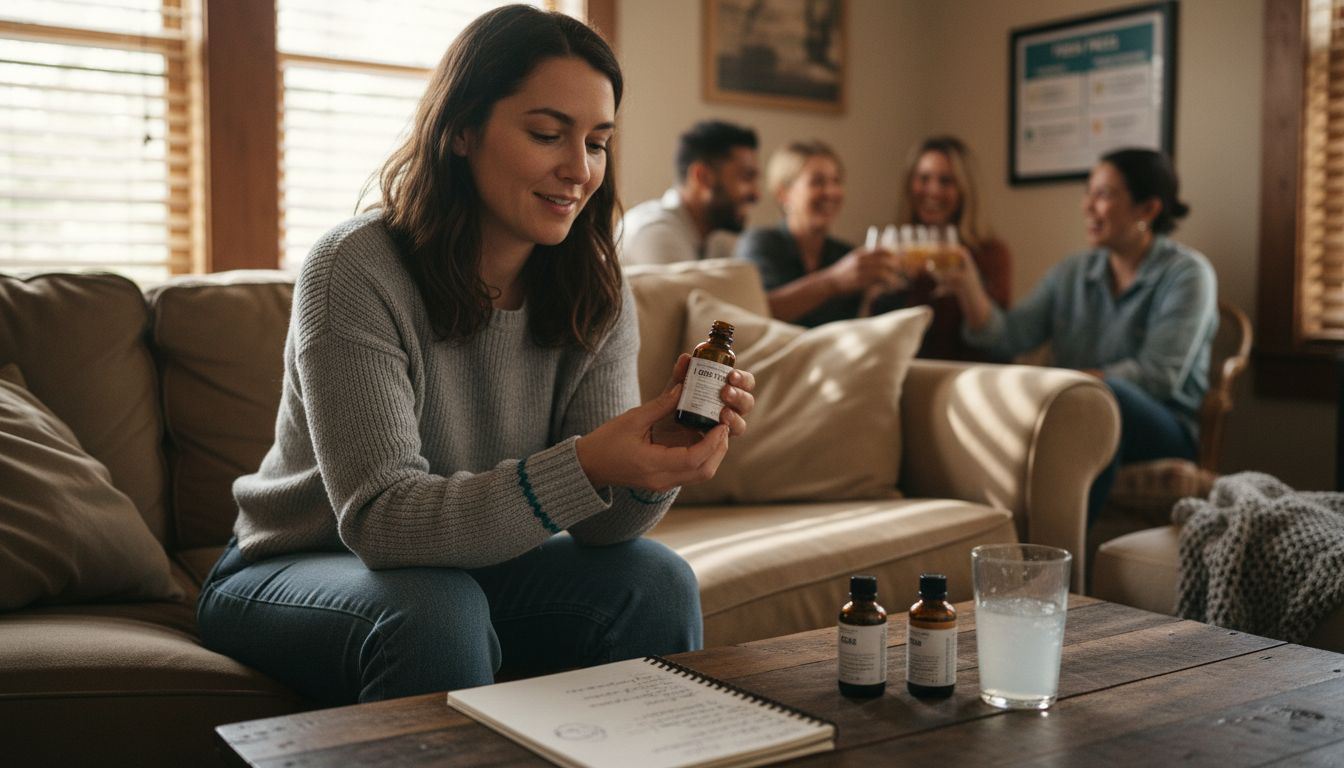
THC: The Psychoactive Component
THC (tetrahydrocannabinol) is the cannabinoid responsible for the psychoactive “high.” It’s the most abundant and most studied cannabinoid in cannabis plants.
When THC dominates a product’s ratio, you get:
- Strong mind-altering effects and euphoria
- Potential for relaxation and stress relief
- Enhanced sensory perception and creativity
- Higher risk of anxiety if you’re sensitive
For beginners or health-conscious consumers, THC-dominant products require careful dosing. Many people in Texas and South Carolina start with lower THC ratios to understand their tolerance before exploring higher concentrations.
CBD: The Therapeutic Powerhouse
CBD (cannabidiol) is non-intoxicating, meaning it doesn’t produce a “high” even in large amounts. It’s credited with therapeutic benefits like anti-anxiety and anti-inflammatory properties.
CBD-dominant products are ideal if you want:
- Relaxation without impairment
- Support for stress and occasional anxiety
- Potential anti-inflammatory effects
- Clarity to enjoy social settings
- A pathway to explore cannabis wellness safely
Many wellness-focused consumers prefer CBD-rich or balanced ratios because they deliver measurable calm without the intensity of high-THC products.
CBG: The Emerging Minor Cannabinoid
CBG (cannabigerol) is a minor cannabinoid produced in smaller quantities, but it’s gaining attention for its unique profile. Minor cannabinoids like CBG show promise in animal studies for reducing inflammation and supporting various wellness goals.
CBG works differently than THC or CBD because it acts on multiple receptors in your system. This makes it a wild card in ratios—it can enhance other cannabinoids’ effects or create entirely new experiences.
Products with meaningful CBG content are still emerging, but they appeal to adventurous consumers seeking something beyond standard THC:CBD ratios.
Here’s a breakdown comparing the key characteristics of THC, CBD, and CBG:
| Cannabinoid | Main Effect | Common Uses | Notable Cautions |
|---|---|---|---|
| THC | Psychoactive, euphoria | Stress relief, creativity, mood boost | Impairment, potential anxiety |
| CBD | Non-intoxicating, calming | Anxiety reduction, inflammation, wellness | May reduce THC intensity |
| CBG | Mild mood lift, support | Inflammation, experimental wellness | Limited research, rare in products |
How Ratios Actually Work Together
Think of ratios like a team sport. A 2:1 CBD-to-THC ratio means CBD moderates THC’s intensity while adding its own calming effect. A 1:1:1 ratio with all three creates a completely different experience than any single cannabinoid.
The ratio determines:
- Your overall experience intensity
- Which effects dominate
- How your body processes the product
- Whether you stay functional or embrace full relaxation
The best ratio isn’t the most potent one—it’s the one that matches your specific goal and tolerance level.
Pro tip: Track how different ratios affect you by keeping notes on products you try, then seek similar ratios when you find something that works—this builds your personal cannabinoid profile faster than random experimenting.
How Cannabinoid Ratios Affect Your Experience
Your experience with cannabis depends far more on the ratio of cannabinoids than on any single ingredient. The same product strength produces wildly different effects depending on which cannabinoids dominate.
Psychoactive Effects and THC Dominance
Higher THC ratios create stronger psychoactive effects. The more THC present relative to other cannabinoids, the more intense the mind-altering experience becomes.
With THC-dominant products, expect:
- Pronounced euphoria and altered perception
- Enhanced creativity and sensory awareness
- Potential impairment of motor skills and focus
- Greater risk of anxiety in sensitive individuals
- Stronger effects on mood and cognition
If you’re new to cannabis or prefer clarity, THC dominance means you need smaller doses or lower-THC ratios to stay functional.
How CBD Modulates THC Effects
CBD acts as a moderator. When present in meaningful amounts, CBD can modulate or reduce THC effects while adding its own therapeutic benefits.
A balanced ratio like 1:1 THC-to-CBD produces:
- Milder psychoactive effects
- Enhanced anti-anxiety benefits
- Better mood stability
- Reduced risk of paranoia or overthinking
- More sustained, manageable relaxation
This balance appeals to health-conscious consumers who want therapeutic benefits without intense intoxication.
The Impact on Mood, Cognition, and Performance
The ratio of cannabinoids impacts how cannabis affects cognition, mood, and psychomotor performance. You’re not just getting “more” or “less”—you’re getting a completely different neurological experience.
Different ratios influence:
- Mental clarity versus creative spaciness
- Social confidence versus introspection
- Energy levels and motivation
- Memory and focus capacity
- Physical relaxation intensity
A 10:1 CBD-to-THC ratio keeps you sharp. A 1:10 ratio might make conversation difficult. The ratio determines whether you’re functional or fully immersed.
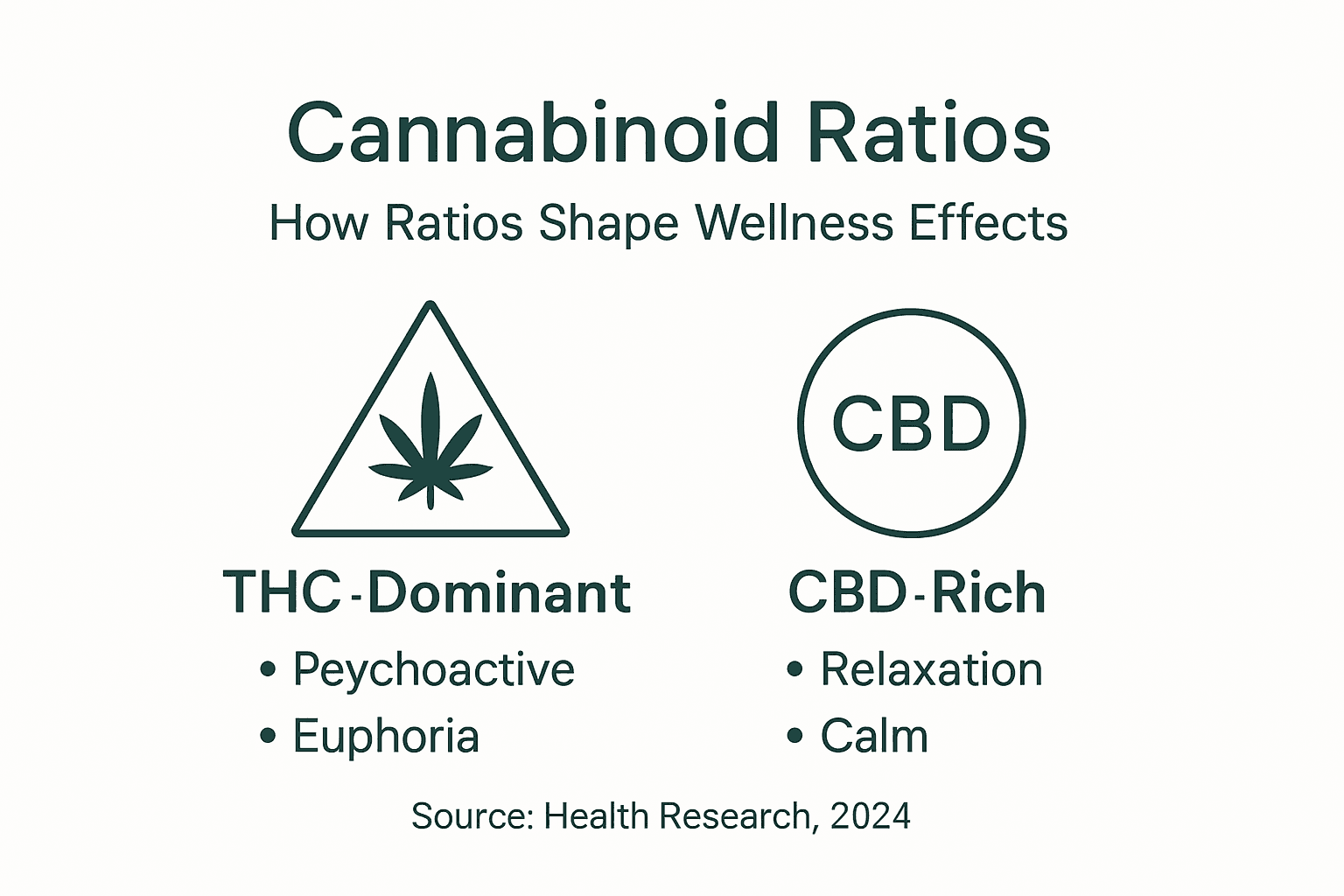
Synergistic and Antagonistic Interactions
Cannabinoids don’t work in isolation. When combined, they create additive effects (1+1=2), synergistic effects (1+1=3), or antagonistic effects (where one cancels the other).
This means the same dose of two different ratios feels nothing alike. A product with 10 mg THC alone feels different from 10 mg THC with 10 mg CBD, which feels different from 10 mg THC with 5 mg CBD.
Understanding these interactions helps you predict your experience instead of guessing.
The ratio you choose shapes not just the intensity but the entire character of your experience.
Pro tip: Start with a lower-ratio product and track how your mood, focus, and relaxation respond, then adjust the ratio based on your actual goals rather than what sounds appealing.
Legal Status of Cannabinoid Ratios in the U.S.
The legality of cannabinoid ratios in the United States is determined by THC content, not by the ratio itself. This distinction matters enormously for what you can legally purchase in Texas, South Carolina, and elsewhere.
The 0.3% THC Threshold
Hemp-derived products containing less than 0.3% THC by dry weight are federally legal. This threshold defines the entire legal landscape for cannabinoid products.
Products meeting this standard:
- Are legal to produce and sell nationwide
- Can be shipped across state lines
- May contain any ratio of CBD, CBG, or other cannabinoids
- Fall under agricultural regulations rather than controlled substance laws
- Offer consistent legal status regardless of your location
If a product exceeds 0.3% THC, it enters a completely different legal category with state-by-state variations.
Federal vs. State Legal Distinctions
Hemp is defined as cannabis containing less than 0.3% THC by dry weight, while marijuana with higher THC content is illegal federally but permitted under some state laws.
This creates a split jurisdiction:
- Federal level: Hemp-derived products are legal; marijuana is Schedule I
- State level: Texas and South Carolina have their own regulations
- Practical effect: You can legally buy hemp products everywhere but face restrictions on higher-THC products depending on your state
Understanding your specific state’s rules prevents legal confusion when shopping for cannabinoid products.
CBD and Food Regulations
Here’s where things get tricky. The FDA does not allow THC or CBD in dietary supplements or foods sold in interstate commerce, even though enforcement varies by state.
This means:
- Pure CBD isolate products exist in gray zones
- Full-spectrum hemp products with multiple cannabinoids may have unclear legal status
- Marketing restrictions apply even in states where cannabis is legal
- Labeling must comply with federal guidelines regardless of state law
When shopping, look for products that clearly state they’re hemp-derived and below 0.3% THC to ensure federal compliance.
What This Means for Your Cannabinoid Ratio Choices
Your legal options depend on THC content, not on whether you prefer a 1:1 CBD-to-THC ratio or a 10:1 ratio. Both ratios are equally legal as long as total THC stays under 0.3%.
However, the legal status of cannabinoid ratios is complex and varies by state, affecting which products retailers can stock and how they’re marketed.
Know your state’s specific regulations before purchasing—what’s legal in one state may not be in another.
Pro tip: Always check the Certificate of Analysis on any product to verify THC content and ensure it meets federal and state legal requirements before purchasing.
Choosing the Right Ratio for Wellness Goals
The best cannabinoid ratio for you depends entirely on what you’re trying to achieve. Rather than chasing trends or highest potency, align your ratio choice with your specific wellness intention.
Anxiety and Stress Relief
If anxiety or stress is your primary concern, CBD-dominant or balanced ratios work best. Higher CBD relative to THC reduces psychoactive intensity while delivering calming effects.
Ideal ratios for anxiety:
- 2:1 CBD-to-THC or higher: Maximum calm without mind-altering effects
- 1:1 balanced ratio: Gentle relaxation with mild euphoria
- CBD isolate (20:1+): Pure therapeutic effects for sensitive individuals
Many people starting their wellness journey prefer these ratios because they deliver measurable results without the intensity of high-THC products.
Pain Management and Inflammation
Cannabinoid ratios for pain require balancing relief with functionality. Some people respond better to CBD-dominant products, while others find THC’s analgesic properties essential.
Try these approaches:
- Equal ratio (1:1): Combines THC’s pain relief with CBD’s anti-inflammatory benefits
- Slightly THC-forward (1.5:1 THC-to-CBD): Enhanced relief while maintaining clarity
- CBD-dominant with minor cannabinoids: Explore ratios including CBG for inflammation support
Start low and adjust based on your pain response and functional needs.
Sleep Support and Rest
For better sleep, higher THC ratios with moderate CBD often work well because THC promotes relaxation while CBD prevents anxiety. However, choosing the right cannabinoid ratio depends on individual wellness goals.
Sleep-focused ratios:
- 2:1 or 3:1 THC-to-CBD: Strong relaxation and sedation
- Balanced 1:1: Gentle support without heavy effects
- With CBN: Minor cannabinoid CBN shows promise for sleep support
Evening timing matters—use these ratios 1-2 hours before bed.
Mental Clarity and Focus
For daytime wellness and sustained focus, CBD-rich products with minimal THC keep your mind sharp. You maintain functionality while addressing stress or inflammation.
Focus-friendly ratios:
Use this table as a quick guide for selecting a cannabinoid ratio based on your wellness goal:
| Wellness Goal | Suggested Ratio | Desired Outcome |
|---|---|---|
| Stress/Anxiety | 2:1 CBD-to-THC or higher | Calm with minimal intoxication |
| Pain Relief | 1:1 or 1.5:1 THC-to-CBD | Balanced relief and functionality |
| Sleep Support | 2:1 or 3:1 THC-to-CBD | Deep relaxation, potential sedation |
| Mental Clarity | 5:1 CBD-to-THC or CBD/CBG only | Focus and alertness |
- 5:1 CBD-to-THC or higher: Daytime support without impairment
- Pure CBD or CBG products: Energizing clarity
- Low-dose balanced: 1 mg THC with 2 mg CBD for subtle support
A Note on Individualization
Your body’s response to ratios is unique. Cannabinoid effects can be highly individualized, necessitating personalized approaches to wellness. What works brilliantly for your friend might not feel right for you.
Start with lower doses in ratios designed for your goal, then adjust based on your actual results—not on what the label claims.
Pro tip: Keep a simple wellness journal tracking which ratio addressed your goal, how long effects lasted, and any side effects, then use this personal data to refine future choices instead of starting from scratch each time.
Discover Your Ideal Cannabinoid Ratio for Wellness and Balance
Understanding how cannabinoid ratios affect your experience is key to unlocking personalized wellness. Whether you seek the calming effects of CBD, the mindful euphoria of THC, or the emerging benefits of CBG, choosing the right ratio can help you achieve your stress relief, pain management, or sleep support goals. Navigating this can be challenging without trusted guidance or quality products designed for your unique needs.

Explore our curated collections at 23rd State and find products tailored to your ideal cannabinoid balance. Dive into our CBD-rich selections for gentle relaxation or browse THC-infused offerings for those moments when enhanced mood and creativity are your focus. Start your wellness journey with confidence today by choosing handcrafted, hemp-derived options that meet legal standards and deliver consistent, premium experiences. Visit us now and take control of your cannabinoid journey with products made to fit your lifestyle.
Frequently Asked Questions
What is a cannabinoid ratio, and why does it matter?
A cannabinoid ratio refers to the proportion of different cannabinoids, particularly THC and CBD, in a cannabis product. It matters because the ratio fundamentally changes how your body responds to the product, affecting psychoactive intensity, body effects, and symptom relief.
How do THC and CBD ratios affect my experience with cannabis?
THC-dominant ratios produce stronger psychoactive effects and euphoria, while CBD-dominant ratios offer relaxation without impairment. Balanced ratios can provide therapeutic benefits while moderating THC’s intensity, leading to a more manageable experience.
Can cannabinoid ratios help with specific wellness goals?
Yes, cannabinoid ratios can be tailored to meet specific wellness goals. For example, for anxiety relief, higher CBD ratios are recommended, while pain management may benefit from equal or slightly THC-forward ratios. Sleep support often involves higher THC ratios for relaxation.
Are higher cannabinoid contents always better for effectiveness?
Not necessarily. A lower dose with the right ratio can provide better results than a higher dose with a suboptimal ratio. Precision in cannabinoid ratios tailored to individual needs often leads to more effective outcomes.
