

TL;DR:
- Organic certification for hemp is a USDA-backed process confirming farms follow strict organic standards. It involves an eight-step certification journey, including practice adoption, documentation, inspection, and annual recertification. Certified organic hemp ensures environmental protection, product trust, market access, and legal compliance for producers and consumers.
Organic certification for hemp is the USDA-backed verification that hemp is cultivated, processed, and handled following strict National Organic Program (NOP) standards. The 2018 Farm Bill made this possible by legalizing hemp as an agricultural commodity, opening the door for growers to pursue the same USDA certification that governs organic vegetables, grains, and livestock. For you as a consumer, that label is not a vibe or a marketing angle. It is a legally regulated assurance that what you are drinking or consuming meets verified environmental and purity standards. Understanding what is organic certification hemp means understanding exactly what went into your product before it reached your hands.
What is the organic hemp certification process?
The organic hemp certification process follows an 8-step certification journey from initial practice implementation through annual recertification. That structure exists because organic compliance is not a one-time event. It is an ongoing commitment verified by a USDA-accredited certifying agent.
Here is how the process works from start to finish:
- Adopt organic practices. The grower stops using prohibited inputs like synthetic fertilizers and pesticides. This transition period typically lasts three years before certification is granted.
- Develop an Organic System Plan (OSP). The OSP is a comprehensive living document covering management practices, approved inputs, monitoring methods, recordkeeping, and physical barriers to prevent contamination. It must be updated regularly.
- Submit an application and fees to a USDA-accredited certifying agent. The agent reviews the OSP for completeness and compliance.
- Undergo an onsite inspection. A certifier visits the farm or facility to verify that practices match the OSP on paper.
- Correct any non-conformances. If the inspector flags issues, the operation must resolve them before certification moves forward.
- Receive your certificate. Once approved, the operation is officially certified and can legally label products as organic.
- Maintain detailed records. Comprehensive records covering all inputs, purchases, sales, and farming practices must be kept for at least five years and be ready for certifier review at any time.
- Recertify annually. Certification is not permanent. Annual reviews keep operations accountable and current.
The NOP recognizes four certification scopes: Crops, Wild Crops, Livestock, and Handling. Hemp falls under the Crops scope, which determines which OSP modules a grower must complete. That specificity matters because it keeps the compliance requirements relevant to what hemp farmers actually do.
Pro Tip: Inconsistencies inside the OSP, like mismatches between your pest management section and your approved inputs list, are flagged by certifiers as higher risk than some underlying farming practices. Get the documentation right first.
How does organic hemp certification benefit you and producers?
Organic certification delivers real, tangible advantages to both the people growing hemp and the people consuming it. These are not abstract promises.
- Environmental protection. Certified organic hemp is grown without synthetic fertilizers, pesticides, or genetically engineered seeds. Those methods protect soil health, water quality, and biodiversity on and around the farm.
- Consumer assurance. The USDA seal tells you the product was verified by an independent third party, not just labeled by the brand. That verification is the difference between trust and hope.
- Premium market access. Retailers and distributors often require organic certification to carry a product. Certification adds traceability and supply chain control that buyers at every level demand.
- Brand credibility. Certification builds long-term trust with health-conscious consumers who read labels and do their research.
- Product differentiation. In a crowded hemp market, the organic label separates verified quality from conventional production.
“Organic certification is more than marketing. It is a legal, regulated assurance of compliance with USDA standards.” — Cannabis Science and Technology
For you as a wellness-focused consumer, the benefits of organic hemp certification translate directly to confidence. You know the hemp in your beverage was grown with intention, verified by a credible authority, and handled with care from seed to sip. That is worth knowing. Learn more about organic hemp’s advantages and why it matters for your lifestyle.
What are the requirements for organic hemp compliance?
The USDA NOP sets specific requirements for organic hemp that go well beyond simply skipping synthetic sprays. Compliance covers soil, inputs, pest management, contamination prevention, and documentation.
Soil fertility and crop nutrition
Organic hemp growers must build and maintain soil health using approved methods. Compost, cover crops, and crop rotation are standard tools. Synthetic fertilizers are prohibited. The goal is a living soil ecosystem that feeds the plant naturally and sustains productivity over time.
Approved inputs and prohibited substances
Every input used on an organic hemp farm, from seeds to soil amendments to pest controls, must appear on the National List of Allowed and Prohibited Substances. Genetically engineered seeds are not permitted. Certified organic hemp is grown using materials that have a low environmental impact by design.
Pest and disease management
Organic pest management follows a hierarchy: prevention first, then approved biological and mechanical controls, and finally approved botanical or mineral-based products as a last resort. Synthetic pesticides are off the table entirely.
Contamination and commingling prevention
Physical barriers and clear operational procedures must prevent organic hemp from mixing with non-organic hemp at any point in the supply chain. This applies to fields, storage, processing, and transport. The OSP must document exactly how the operation prevents contamination.
Recordkeeping specifics
Operations must maintain records adapted to their specific processes, always ready for certifier review. Sales records, input purchase receipts, field maps, and harvest logs all count. USDA NOP certification is typically required for businesses with annual organic sales exceeding $5,000, though retailers often require it regardless of that threshold.
Pro Tip: Treat your OSP as a living operations manual, not a one-time filing. Update it every time a practice, input, or supplier changes. Certifiers notice when the document does not match reality.
| Compliance area | Key requirement |
|---|---|
| Soil management | Approved amendments only; no synthetic fertilizers |
| Seeds and planting stock | Non-GMO; certified organic when commercially available |
| Pest management | Prevention first; approved biological and botanical controls |
| Contamination prevention | Physical barriers and documented procedures throughout supply chain |
| Recordkeeping | Minimum five years of records covering all inputs, sales, and practices |
How does organic certification compare to non-organic hemp?
The gap between certified organic hemp and conventional hemp is significant, and it shows up in farming practices, legal standing, and what ends up in your product.
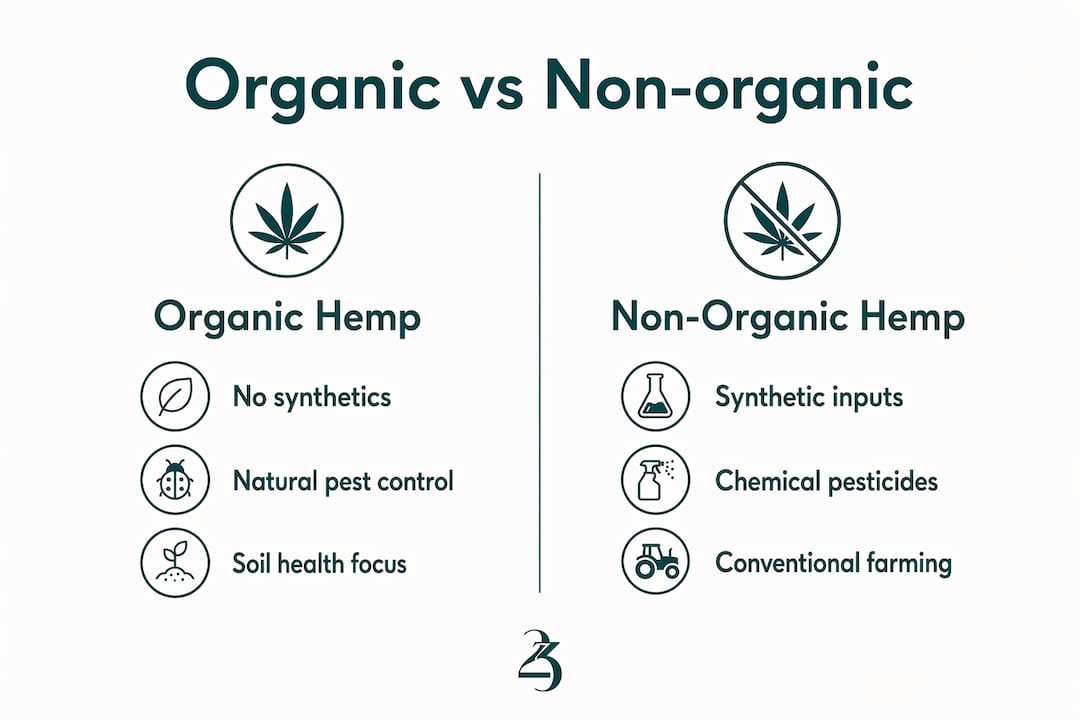
Because cannabis remains federally illegal, marijuana cannot receive USDA Organic certification. Legal hemp, defined as cannabis containing no more than 0.3% THC, is eligible for full USDA organic certification when it meets all NOP standards. That legal distinction is the foundation of the entire organic hemp category.
Conventional hemp farming allows synthetic inputs that organic standards prohibit. That means conventional crops may carry pesticide residues, synthetic nutrient loads, and no verified chain of custody. For a consumer buying a hemp beverage, that difference is invisible on the shelf but very real in the product.
Other certification programs exist in the cannabis space, including state-level “comparable to organic” designations for marijuana in states where it is legal. These programs vary widely in rigor and have no federal backing. USDA NOP certification for hemp is the only federally recognized standard, which gives it a credibility floor that state programs cannot match.
Misusing the term “organic” without certification carries fines up to $11,000 per violation. Only certified producers can legally label products as organic. That enforcement mechanism is what makes the label meaningful.
CBD products made from federally compliant hemp can be certified organic when all NOP standards are satisfied. Health claims on CBD products, however, can affect certification eligibility. That nuance matters if you are evaluating hemp beverages that make wellness-adjacent statements. Understanding the difference between hemp and marijuana helps clarify why only hemp can carry the USDA seal.
Key Takeaways
Organic certification for hemp is a federally regulated USDA process that verifies sustainable farming, prohibits synthetic inputs, and gives consumers a legally backed assurance of product integrity.
| Point | Details |
|---|---|
| USDA NOP is the standard | Hemp certification falls under the Crops scope of the National Organic Program. |
| OSP documentation is critical | An accurate, updated Organic System Plan is the core of every successful certification. |
| Records must span five years | All inputs, sales, and practices must be documented and available for certifier review. |
| Organic label has legal weight | Misusing “organic” without certification risks fines up to $11,000 per violation. |
| Certification opens premium markets | Retailers and distributors require certification for traceability and supply chain confidence. |
Why organic certification is the future of hemp, not just a checkbox
Here is my honest take after spending real time in the hemp beverage space: organic certification is the single most misunderstood concept in this category. Consumers assume it means “natural.” Producers sometimes treat it like a marketing badge. Both miss the point entirely.
Certification is a discipline. It forces a grower to document every decision, justify every input, and submit to independent scrutiny. That process creates a level of operational rigor that non-certified farms simply do not have. The result is a more consistent, traceable product. And consistency is everything when you are building trust with a consumer who is new to hemp.
The challenge I see most often is documentation. Growers who farm beautifully but document carelessly fail certification reviews. The OSP is not bureaucracy for its own sake. It is the paper trail that proves your practices are real. Get that right, and the rest follows.
For consumers, the takeaway is simple. When you pick up a hemp beverage and see a certified organic claim, you are not paying for a story. You are paying for a verified system. That is worth understanding, and worth seeking out. Explore why organic hemp matters for your health and the planet before your next purchase.
— Leah Kollross, founder, 23rd State
23rd State’s take on quality you can taste and trust
At 23rd State, quality starts at the source. Every product in the lineup reflects a commitment to traceable, intentional hemp that meets the standards health-conscious consumers actually care about.

Whether you reach for the bright, refreshing SHAKE, the crisp and lively FRESH PRESS, or the rosy, smooth Blush Crush, you are getting a hemp beverage crafted with ingredient integrity at every step. These are not just good drinks. They are the kind of drinks you feel good about cracking open on a Friday evening, at brunch, or whenever the moment calls for something a little more intentional. Ready to find your favorite? Shop the full 23state lineup and taste the difference that real care makes.
FAQ
What is organic certification for hemp?
Organic certification for hemp is a USDA National Organic Program designation that verifies hemp is grown and handled without synthetic fertilizers, prohibited pesticides, or genetically engineered seeds. It is a legally regulated standard, not a self-declared label.
How long does it take to certify hemp organic?
The organic hemp certification process typically requires a three-year transition period away from prohibited inputs before certification is granted, followed by an application, onsite inspection, and annual recertification.
Is hemp certification necessary for selling hemp products?
USDA NOP certification is required for businesses with annual organic sales exceeding $5,000, and retailers often require it regardless of sales volume for traceability purposes. Without it, you cannot legally label any product as organic.
Can CBD products be certified organic?
Yes. CBD products made from federally compliant hemp can receive USDA organic certification when all NOP standards are met. Health claims on those products, however, may affect certification eligibility.
What is the difference between organic and non-organic hemp?
Organic hemp is grown using only approved inputs, verified by a third-party certifier, and documented through a comprehensive Organic System Plan. Non-organic hemp may use synthetic fertilizers and pesticides with no independent verification of practices.
