

TL;DR:
- Cannabinoid-focused conversations often overlook flavonoids, plant compounds that influence aroma, color, and wellness properties. These compounds are distinct from cannabinoids and terpenes, with cannflavins unique to cannabis showing promising anti-inflammatory effects. Flavonoid profiles vary based on genetics, cultivation, and extraction methods, contributing to the full sensory and potential health benefits of whole-plant cannabis products.
Most cannabis conversations start and stop at THC and CBD. That’s understandable. Those two cannabinoids get the headlines. But if you’ve ever wondered why one strain smells floral and another tastes earthy, or why some cannabis flowers turn a gorgeous deep purple, you’re already brushing up against cannabis flavonoids. These polyphenolic compounds are one of the most overlooked parts of the cannabis plant, and once you understand them, you’ll never look at your cannabis beverage the same way again.
Key takeaways
| Point | Details |
|---|---|
| Flavonoids are not cannabinoids | They are structurally distinct plant compounds that don’t produce a high but shape aroma, color, and potential wellness properties. |
| Cannflavins are cannabis-specific | Cannflavin A, B, and C are unique to cannabis and show strong anti-inflammatory potential in early research. |
| Profiles vary by product | Extraction method, plant part, and cultivar all affect how many flavonoids survive into your final beverage or edible. |
| Entourage effect includes flavonoids | Flavonoids work alongside cannabinoids and terpenes to shape the full experience of whole-plant cannabis products. |
| Research is promising but early | Most anti-inflammatory and antioxidant findings come from lab studies, not large-scale human clinical trials. |
What cannabis flavonoids actually are
The scientific term you’ll hear most often is flavonoids, and it’s the recognized industry standard. They are polyphenolic secondary metabolites, meaning the cannabis plant produces them not for energy or basic survival, but for protection and communication. Think UV shielding, pest deterrence, and attracting pollinators. According to a 2026 MDPI hemp review, flavonoids are major phytochemicals that meaningfully contribute to the biological properties of hemp products.
Here’s where cannabis gets interesting compared to other plants. Most of the flavonoids found in cannabis, like apigenin, luteolin, and quercetin, also appear in fruits, vegetables, and tea. But cannabis produces a class of flavonoids that exist nowhere else in nature.
- Cannflavin A, B, and C are prenylated flavonoids unique to cannabis. The same 2026 review highlights cannflavins’ anti-inflammatory potency, suggesting they may outperform some non-steroidal anti-inflammatory drugs in lab settings.
- Anthocyanins give certain cannabis cultivars their striking purple and blue hues. If you’ve seen a violet-tinged flower, anthocyanins are doing that work.
- Flavonols like quercetin contribute antioxidant activity and are shared with blueberries, onions, and green tea.
- Flavones like apigenin and luteolin appear frequently across cannabis extracts and have been studied for their calming properties in other plant contexts.
One thing worth clarifying right away: flavonoids are not cannabinoids. THC and CBD interact directly with your endocannabinoid system to produce psychoactive or therapeutic effects. Flavonoids work through entirely different biological pathways and do not get you high. They’re also distinct from terpenes, which are aromatic compounds responsible for most of cannabis’s scent. Flavonoids influence color, contribute subtle flavor complexity, and carry their own biological activity. All three compound classes coexist in the same plant, and that coexistence is exactly what makes whole-plant cannabis so layered and interesting.
You can learn more about how cannabinoids and flavonoids differ in terms of structure and effects if you want a side-by-side comparison.
Pro Tip: Look for terms like “full-spectrum” or “whole-plant” on cannabis product labels. These indicate that flavonoids, terpenes, and cannabinoids are all present, rather than isolated extracts that may contain only one compound.
Sensory experience and wellness potential
This is where flavonoids move from chemistry class into your actual evening. Cannabis flavonoid benefits show up in two places you probably already notice without naming them: how your product looks and tastes, and how your body responds after consuming it.
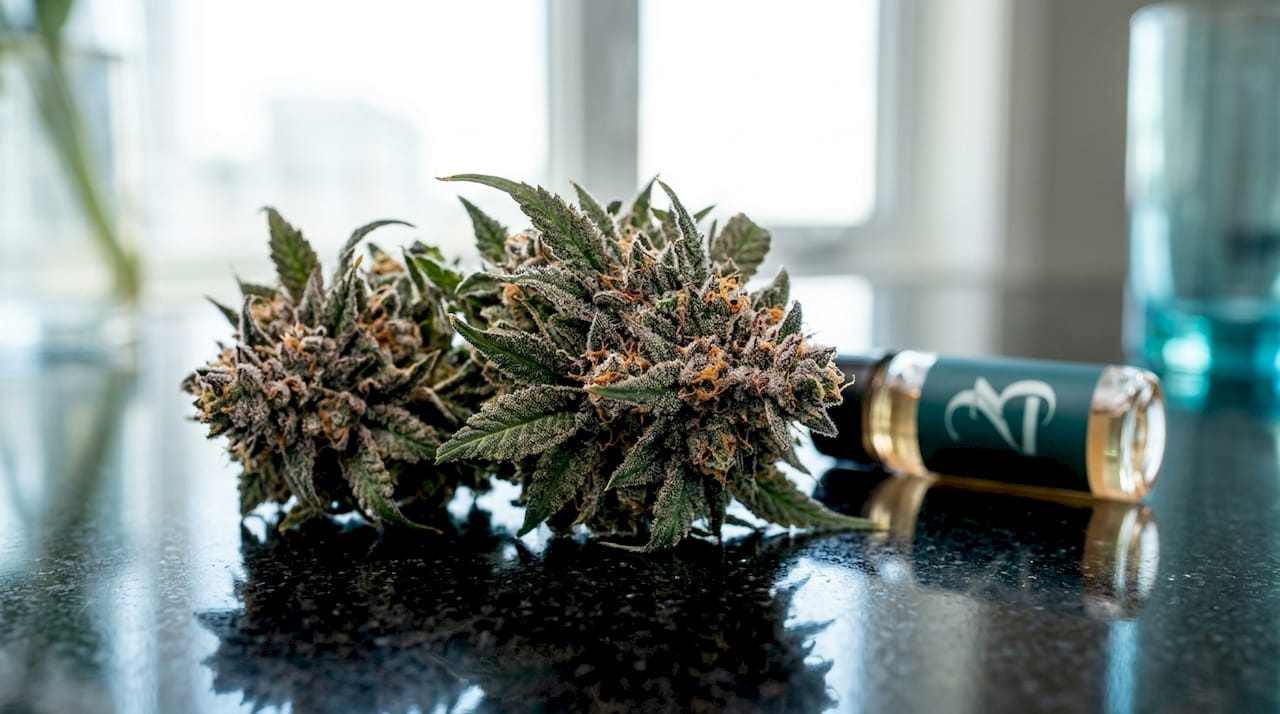
On the sensory side, flavonoids don’t work alone. Terpenes carry the heavy aromatic lifting, but flavonoids add subtle bitter, grassy, or floral notes that round out the overall flavor. Anthocyanins are the reason some cannabis strains look like they belong in a botanical garden. That rich purple coloration isn’t a marketing trick. It’s a flavonoid doing its job.
On the wellness side, the early science is genuinely exciting. A 2026 Journal of Cannabis Research study found that prenylated flavonoids inhibit mPGES-1, an enzyme closely linked to inflammation, with effectiveness comparable to or better than a leading pharmaceutical inhibitor called MK-886. That’s a remarkable result from plant compounds.
Antioxidant properties are also well-documented at the extract level. A 2026 Springer study screening Moroccan Cannabis sativa found that flavonoid content varies widely depending on which part of the plant was analyzed and which solvent was used for extraction, with leaf methanol extracts showing meaningful antioxidant activity.
Most of the anti-inflammatory and antioxidant findings for cannabis flavonoids come from in vitro studies, meaning lab-based cell or enzyme assays. Translating those results to what actually happens when you drink a cannabis beverage requires more human clinical research. Get excited about the potential. Stay grounded about the certainty.
That context matters. The role of flavonoids in cannabis is genuinely promising, especially for people interested in the plant from a wellness angle. But they’re not a cure or a guaranteed health boost. Think of them as part of a broader, whole-plant experience that feels good and may support your wellness routine, not as a supplement with a proven dosing protocol.
How cultivation and extraction shape flavonoid profiles
Here’s something most cannabis beverage drinkers don’t know: two products from the same strain, extracted differently, can have completely different flavonoid profiles. This is why “flavonoid-rich” isn’t a standard you can assume across products. The variables are significant.
-
Cultivar genetics. Research published in Frontiers in Plant Science confirmed that flavonoid biosynthesis is regulated at the chromatin level, meaning gene expression differences between cultivars directly control how much of which flavonoids get produced. Two plants labeled “hemp” can have dramatically different flavonoid outputs based on genetics alone.
-
Growing environment. Light exposure, temperature, and soil conditions all affect secondary metabolite production. Cannabis grown under more UV stress tends to produce higher levels of protective compounds, including certain flavonoids.
-
Plant part used. Leaves, flowers, resin, and seeds all yield different flavonoid concentrations. The 2026 Moroccan Cannabis sativa study showed that extraction solvent and plant matrix produce notably different total flavonoid content and antioxidant activity, even within the same plant.
-
Extraction method. Ethanolic versus CO2 extraction pull different flavonoid subsets. Some high-heat extraction processes degrade heat-sensitive flavonoids before they ever reach your drink.
Here’s a quick look at how different factors stack up for flavonoid preservation:
| Factor | Higher flavonoid preservation | Lower flavonoid preservation |
|---|---|---|
| Extraction solvent | Cold ethanol, methanol | High-heat supercritical CO2 |
| Plant part | Leaves and flowers | Seeds |
| Cultivar | High-phenolic genetics | Low-secondary-metabolite strains |
| Processing temp | Low temperature | High temperature |

What does this mean for you as a consumer? Not every cannabis product offers the same flavonoid experience, even if the THC numbers match. Look for brands that disclose extraction methods and source whole-plant or full-spectrum profiles.
Pro Tip: Advanced chromatographic analysis of cannabis phenolics has now identified 79 distinct phenolic compounds in cannabis, including previously unknown flavoalkaloids. Most consumer-facing Certificates of Analysis don’t capture this complexity, so “full-spectrum” is your best shorthand until more detailed reporting becomes standard.
The flavonoid entourage effect
You may have heard of the entourage effect. It’s the idea that cannabinoids, terpenes, and flavonoids work better together than any single compound does on its own. Flavonoids are a full participant in this synergy, not just a side character.
Here’s what that looks like in practice, according to a 2026 summary of entourage research:
- Flavonoids modulate how cannabinoids interact with receptors in the body, potentially changing the intensity or character of effects.
- They inhibit certain enzymes that break down cannabinoids, which may enhance cannabinoid bioavailability and extend the duration of effects.
- Flavonoids also contribute their own biological activity (antioxidant, anti-inflammatory) that adds another dimension to the overall experience.
Think about a cannabis beverage formulated with whole-plant extract versus one built from isolated THC distillate. The isolated product delivers a clean, predictable dose of THC. The whole-plant product delivers that same THC plus a complex web of terpenes, flavonoids, and minor cannabinoids that shape the ride. Many experienced consumers describe whole-plant effects as smoother, more nuanced, and more satisfying.
That said, the entourage effect involving flavonoids is still an active research area. You can explore how this synergy works in edibles and beverages for a deeper read, but treat current findings as exciting leads rather than settled science.
My take on the flavonoid conversation
I’ll be honest. When I first started paying close attention to cannabis beverages, flavonoids weren’t even on my radar. THC dosing and onset time consumed most of my attention, and I think that’s true for a lot of people who are newer to the category.
What changed my perspective was tasting the difference between a well-formulated whole-plant beverage and a product built entirely from isolated distillate. The distillate version worked. But it tasted thin. The flavor had no depth. The whole-plant version had brightness, a little complexity, something that made you want another sip. I started asking why, and flavonoids were a significant part of the answer.
I’m genuinely excited about the research on cannflavins and prenylated flavonoids. The early anti-inflammatory data is not something I’d dismiss. But I also think it’s worth being clear with yourself: you’re drinking a cannabis beverage because you enjoy it and it supports how you want to feel in a moment. The flavonoid benefits are a bonus, not a pharmaceutical promise. Explore cannabis wellness and education resources to keep building your understanding, but mostly, trust your experience. If a full-spectrum beverage feels better to you than an isolate-based one, that sensation is real and worth following.
— Leah Kollross, founder, 23rd State
Taste what whole-plant cannabis actually means
If you’re ready to experience flavonoids in action, not just in theory, 23rd State’s Fresh Press THC Pear Cider is the place to start. It’s crafted with 10mg THC and 10mg CBG using whole-plant profiles that preserve the full spectrum of compounds, including the flavonoids and terpenes that give cannabis its depth and character.
Compare that to lower-dose competitors like Cann (2mg THC) or Wynk (2.5mg THC), which often rely on THC isolate rather than whole-plant extraction. The dosing transparency, the CBG pairing, and the bright, crisp pear flavor put Fresh Press in a category of its own for anyone who wants a beverage that actually tastes like something and delivers a nuanced, layered experience. This is the kind of drink you crack open on a Friday evening when you want to feel good and taste something worth savoring.
FAQ
What are cannabis flavonoids in simple terms?
Cannabis flavonoids are natural plant compounds that influence the color, aroma, and potential wellness properties of cannabis. They are distinct from THC, CBD, and terpenes, and they do not produce a high.
What do cannabis flavonoids do for the plant?
Flavonoids protect the cannabis plant from UV radiation, pests, and environmental stress. They also produce the purple and blue pigmentation seen in certain cultivars through anthocyanins.
Are cannflavins the same as regular flavonoids?
No. Cannflavins are a prenylated subclass of flavonoids found only in cannabis. They are chemically distinct from flavonoids like quercetin and have shown stronger anti-inflammatory activity in early research.
Do cannabis flavonoids affect how a product tastes?
Yes. Flavonoids contribute subtle bitter, grassy, and floral notes that add complexity beyond what terpenes provide. They are one reason whole-plant cannabis products often taste richer than isolate-based formulas.
Can flavonoid content in cannabis products vary?
Absolutely. Flavonoid levels depend on the cultivar, which plant part was used, and the extraction method applied. Research confirms that genetics directly regulate how much of each flavonoid any given cannabis plant produces.
